
Bitcoin Price Forecasting and High-IQ Investor Influence: A Behavioral Finance Perspective
Bitcoin's price trajectory has long defied traditional financial models, driven instead by a volatile interplay of speculative behavior, macroeconomic shifts, and psychological forces. As the cryptocurrency market matures, advanced forecasting tools and behavioral finance insights are becoming critical for investors seeking to navigate its turbulence. This article examines how high-IQ investors leverage machine learning, sentiment analysis, and behavioral psychology to influence Bitcoin's price dynamics, drawing on empirical studies and real-world examples.
The Rise of Machine Learning in BitcoinBTC-- Forecasting
Bitcoin's volatility—exacerbated by its speculative nature and lack of intrinsic fundamentals—has made it a fertile ground for machine learning (ML) and deep learning (DL) models. Traditional statistical methods like ARIMA struggle to capture the nonlinear patterns in Bitcoin's time-series data, but advanced architectures such as Long Short-Term Memory (LSTM) networks and their bidirectional variants (Bi-LSTM) excel at identifying long-term dependencies[1]. A 2024 study demonstrated that combining Boruta feature selection with a CNN–LSTM model achieved an 82.44% accuracy in predicting Bitcoin's price direction, outperforming LightGBM and XGBoost models[2]. These findings underscore the growing reliance on hybrid models that integrate historical price data, on-chain metrics, and social media sentiment to enhance predictive accuracy[3].
However, even the most sophisticated models face challenges. Bitcoin's price remains highly sensitive to external shocks, such as regulatory announcements or macroeconomic events, which can disrupt even the most robust algorithms[4]. This has spurred interest in adaptive frameworks like AutoML and reinforcement learning, which dynamically adjust to shifting market conditions[5].
Behavioral Finance and the Psychology of Bitcoin Markets
Bitcoin's price is not merely a function of supply and demand but a reflection of collective investor psychology. Behavioral finance principles—such as herd behavior, overconfidence, and the availability heuristic—play a pivotal role in shaping market outcomes. For instance, studies show that Bitcoin prices exhibit strong correlations with investor sentiment, as measured by social media activity and sentiment indices[6]. During periods of extreme optimism, such as the 2021 bull run, FOMO (fear of missing out) drives irrational exuberance, while panic selling during downturns amplifies losses[7].
A 2023 case study highlighted how a single tweet from Elon Musk in Q2 2021 triggered a 40% price drop in a single day, illustrating the outsized influence of social media on Bitcoin's valuation[8]. Similarly, research using 91 million tweets found a negative correlation between social media sentiment and Bitcoin prices during December 2022, with optimism preceding price declines[9]. These patterns align with behavioral finance theories, which posit that markets often overreact to news and underreact to fundamentals[10].
High-IQ Investors and Strategic Sentiment Manipulation
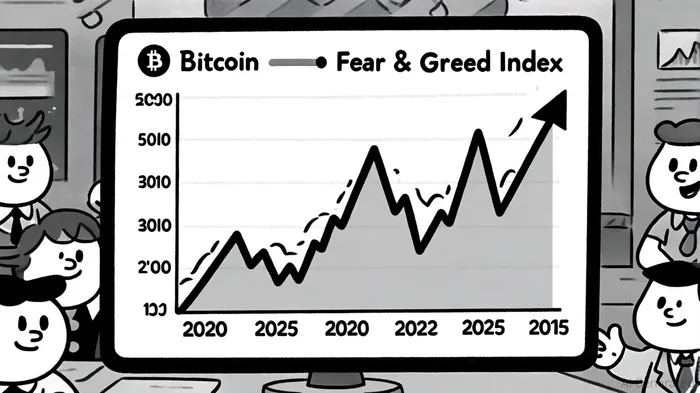
High-IQ investors, often equipped with advanced quantitative tools, exploit these psychological dynamics to influence Bitcoin's price. By analyzing sentiment data from platforms like X (Twitter), Reddit, and Telegram, they identify market turning points and deploy algorithmic strategies to capitalize on sentiment-driven volatility[11]. For example, the Fear & Greed Index—a composite metric derived from search trends, social media sentiment, and on-chain activity—has become a key tool for timing trades. Extreme fear levels often signal oversold conditions, while extreme greed indicates potential tops[12].
These investors also leverage behavioral nudges to shape market psychology. By selectively disseminating information or amplifying specific narratives, they can create self-fulfilling prophecies that drive price movements. A 2024 study demonstrated how AI-driven sentiment analysis tools, such as FinBERT and attention-augmented CNN-LSTM models, enable real-time sentiment tracking, allowing investors to adjust positions before mass sentiment shifts[13].
Case Studies: Sentiment Analysis in Action
The integration of sentiment analysis into investment strategies is not theoretical. In 2023, a hybrid model combining sentiment data with technical indicators and on-chain metrics achieved a 78% accuracy in predicting Bitcoin's price direction during the post-pandemic market correction[14]. Another example is the PreBit model, which used a support vector machine trained on price data alongside a convolutional neural network processing tweets, significantly improving predictions of extreme price movements[15].
However, challenges persist. A 2024 analysis found that AI models trained on altcoin sentiment achieved only a 51% success rate in predicting Bitcoin trends, highlighting the need for multimodal approaches that integrate diverse data sources[16].
Implications for Investors and the Future
As Bitcoin's market evolves, the fusion of behavioral finance and machine learning will become increasingly vital. High-IQ investors who master sentiment analysis and behavioral psychology will likely outperform traditional traders, leveraging tools like LLMs and on-chain analytics to anticipate market shifts[17]. For the broader market, this raises questions about efficiency: while Bitcoin's price remains susceptible to sentiment-driven anomalies, its growing institutional adoption may eventually reduce the influence of behavioral biases[18].
Investors must also remain vigilant. The same tools that enhance predictive accuracy can be weaponized to manipulate markets, particularly in decentralized ecosystems where regulatory oversight is limited. As one 2025 report noted, the line between informed trading and strategic manipulation is increasingly blurred in the age of AI[19].
Conclusion
Bitcoin's price forecasting and market dynamics are inextricably linked to behavioral finance and sentiment analysis. While machine learning models offer powerful tools for prediction, their effectiveness hinges on understanding the psychological forces that drive investor behavior. High-IQ investors, armed with advanced analytics and behavioral insights, are reshaping the landscape—proving that in the world of cryptocurrencies, the mind is as valuable as the algorithm.






Comentarios
Aún no hay comentarios