
Bitcoin's Price Dynamics and Macro Drivers: Strategic Entry Points in a Shifting Landscape
Macroeconomic Catalysts: Inflation, Rates, and Liquidity
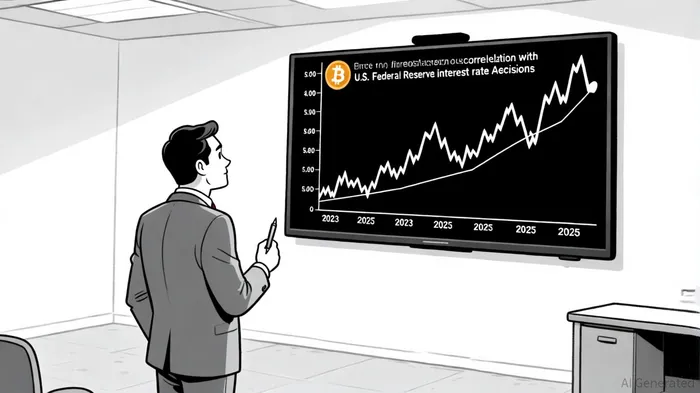
Bitcoin's role as a hedge against inflation and a competitor to traditional assets remains central to its price dynamics. As a finite-supply asset, Bitcoin has historically attracted demand during periods of high inflation, particularly in economies with weak fiat currencies, as noted in coincryptorank's analysis. However, its behavior as a "risk asset" or "safe-haven asset" is context-dependent. For instance, rising U.S. interest rates in 2023–2024 reduced liquidity and diverted capital to interest-bearing instruments, suppressing Bitcoin's price, according to an arXiv paper. Conversely, signals of rate cuts in late 2024 reignited investor appetite for riskier assets, propelling Bitcoin to an all-time high of $100,000 in December 2024, according to a CNBC report.
The Federal Reserve's policy trajectory thus remains a critical macro driver. Analysts suggest that Bitcoin's price sensitivity to rate changes has diminished slightly due to institutional adoption, but it remains a key variable for short- to medium-term positioning, according to the CNBC report.
Geopolitical Events: Volatility and Asymmetric Opportunities
Geopolitical instability has had a mixed impact on Bitcoin. While the asset's decentralized nature makes it a potential refuge during crises, its performance has diverged from traditional safe-haven assets like gold. For example, the October 2024 Iran-Israel missile attack triggered a 15% drop in Bitcoin's price as investors flocked to gold, according to an Analytics Insight article. Conversely, the Russia-Ukraine war in 2022 saw a 15% price surge as Ukrainians and Russians used Bitcoin to preserve wealth amid economic sanctions and hyperinflation, as reported in a Cointelegraph article.
The key takeaway is that Bitcoin's response to geopolitical events is highly context-sensitive. In regions with capital controls or economic sanctions-such as Venezuela and Turkey-Bitcoin has emerged as a viable alternative to devalued local currencies, as coincryptorank's analysis shows. For investors, this suggests asymmetric opportunities in markets where geopolitical instability drives demand for decentralized assets.
The 2024 Halving: Scarcity and Structural Shifts
The 2024 Bitcoin halving, which occurred on April 19, 2024, marked a structural shift in the market. By reducing block rewards from 6.25 to 3.125 BTC, the event introduced scarcity, historically a precursor to price appreciation, as noted in Cointelegraph. However, the 2024 halving unfolded in a unique environment: spot Bitcoin ETFs had already begun trading in January 2024, altering traditional price discovery dynamics, per the CNBC report.
Bitcoin's price peaked at $73,800 in March 2024-nearly a month before the halving-before retreating to $59,000 post-event, according to the Analytics Insight article. This deviation from historical patterns underscores the influence of institutional adoption and regulatory clarity. One year post-halving, Bitcoin had gained 31% from its halving-day price, reaching $83,671 by April 15, 2025, according to a Fidelity analysis. Analysts project that the bull run could extend into 2026, with potential targets exceeding $135,000, according to coincryptorank's analysis.
Institutional Adoption: A New Era of Stability
Institutional adoption has been a game-changer for Bitcoin's price dynamics. The approval of U.S. spot Bitcoin ETFs in early 2024 attracted over $435 billion in institutional capital by September 2025, with entities like MicroStrategy and Marathon Digital Holdings accumulating 3.8 million BTC, per a Bitcoin Magazine article. This influx has reduced Bitcoin's volatility-its 30-day rolling volatility dropped to 35% by early 2025, matching the S&P 500, according to the CNBC report.
Moreover, Bitcoin's correlation with traditional assets has risen sharply. By 2024, its correlation with the Nasdaq 100 and S&P 500 reached 0.87, signaling its integration into mainstream portfolios, as the arXiv paper notes. Regulatory clarity, including the EU's MiCA framework and U.S. SEC approvals, has further legitimized Bitcoin as a systemic asset, as coincryptorank's analysis points out.
Strategic Entry Points: Timing the Catalysts
For investors, the interplay of these factors creates distinct entry windows:
1. Post-Halving Periods: Historical patterns suggest a 12–18 month bull run following halvings. While the 2024 event saw an early peak, the delayed response to ETFs and institutional demand indicates a prolonged cycle.
2. Regulatory Clarity: ETF approvals and MiCA's implementation in 2024–2025 have already triggered price surges. Future regulatory milestones-such as U.S. tax framework updates-could offer additional entry points.
3. Geopolitical Volatility: In regions with capital controls or hyperinflation, Bitcoin's adoption as a store of value presents localized opportunities.
Conclusion
Bitcoin's price dynamics in 2023–2025 reflect a maturing market influenced by macroeconomic cycles, geopolitical shifts, and institutional adoption. While volatility persists, the asset's integration into traditional finance and its role as a hedge against inflation and capital controls create a compelling case for strategic entry. Investors who align their timing with halving events, regulatory developments, and geopolitical catalysts are well-positioned to capitalize on Bitcoin's evolving trajectory.






Comentarios
Aún no hay comentarios