
Bitcoin's Price Divergence from CME Futures: Arbitrage Waning, Sentiment Splits Market
Bitcoin's recent price divergence from CME BitcoinBTC-- futures has sparked intense debate among investors, with the spot price trading at $112,052.81 on October 15, 2025, while the October 2025 futures contract remains anchored at $116,250, according to a BiteMyCoin price prediction. This $4,200 gap reflects a complex interplay of arbitrage dynamics, institutional confidence, and divergent market sentiment. Below, we dissect the forces shaping this divergence and its implications for investors.
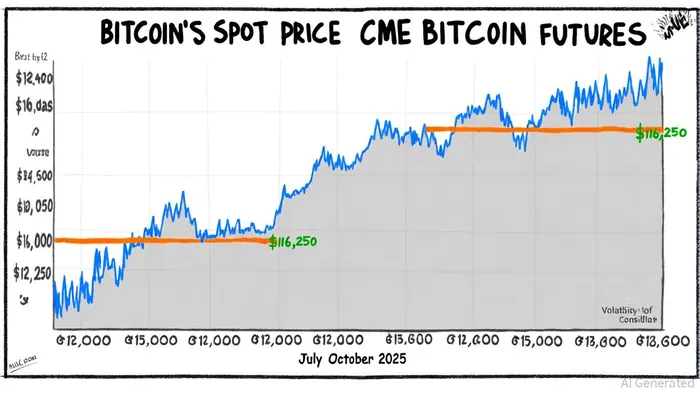
Arbitrage Opportunities: A Diminishing Playbook
The narrowing of the CME Bitcoin futures premium to 4.3% as of July 2025-its lowest level since October 2023-has rendered traditional cash-and-carry arbitrage strategies less attractive, according to a CoinDesk report. Historically, hedge funds exploited price discrepancies by purchasing Bitcoin via ETFs and shorting futures to lock in risk-free profits. However, with the premium shrinking, the margins for such strategies have eroded.
Data from CME GroupCME-- indicates that institutional arbitrage activity has waned, with ETF inflows now driven primarily by directional investors rather than arbitrage-focused hedge funds, according to a Bitget report. This shift underscores a broader realignment of institutional capital toward long-term Bitcoin exposure, rather than short-term market inefficiencies. For example, open interest in CME Bitcoin futures surged to $39 billion by October 2025, reflecting robust institutional participation, according to Darkex weekly technicals. Yet, this growth has not translated into renewed arbitrage activity, as CoinDesk later reported that yield spreads between spot and futures markets have converged.
Sentiment Imbalances: Institutions Bullish, Retail Bearish
The market's divergence extends beyond price to sentiment. Institutional investors remain bullish, with record open interest and corporate treasury acquisitions-such as Strategy Inc. and Trump Media & Technology Group removing 3.68 million BTC from circulation-signaling sustained confidence, Bitget found. Over 64% of Bitcoin's supply is now held for more than one year, a metric often correlated with long-term accumulation, Bitget added.
Conversely, retail sentiment has turned cautious. Negative funding rates in offshore perpetual futures markets and a 20% decline in public forum mentions since February 2025 highlight waning retail enthusiasm, as BiteMyCoin noted. This imbalance is further exacerbated by macroeconomic headwinds, including U.S.-China trade tensions and Federal Reserve policy uncertainty, which have triggered a 1.55% 24-hour decline in Bitcoin's spot price, BiteMyCoin reported.
Technical and Macro Factors: A Fragile Equilibrium
Technically, Bitcoin's price action remains mixed. While the RSI (59.80) and MACD histogram suggest bullish momentum, Darkex observed, the asset trades below its 50-day SMA of $114,665, raising concerns about short-term volatility. A sustained close below $115,000 could trigger a pullback toward $110,000, Darkex warned. Meanwhile, on-chain data reveals profit-taking by whales in June 2025, followed by a consolidation phase that has left market direction ambiguous, CoinDesk noted.
Macro factors add to the uncertainty. The U.S. government shutdown and geopolitical tensions have created a bearish overhang, yet Bitcoin's resilience near $111,000 has drawn comparisons to gold's safe-haven appeal, Bitget reported. Analysts like Tom Lee and Arthur Hayes remain optimistic, projecting targets of $200,000–$250,000 for 2025, according to a FinancialContent report, but these forecasts hinge on Bitcoin breaking above the $116,000 threshold-a level that has historically signaled a bull market transition, as a CoinDesk indicator suggests.
Implications for Investors
For arbitrageurs, the narrowing premium suggests limited opportunities in the near term. However, directional investors may find value in the current divergence. If Bitcoin can hold above $112,000-a level supported by its 200-day SMA-short-term rallies to $113,000 or higher are plausible, BiteMyCoin suggested. Conversely, a breakdown below $111,000 could reignite bearish sentiment, particularly if macroeconomic risks escalate.
Retail investors, meanwhile, should remain cautious. The bearish bias in perpetual futures markets and subdued spot volumes indicate that retail participation is unlikely to drive a near-term rebound, CoinDesk noted. Institutions, however, may continue to prop up prices through ETF inflows and long-term accumulation, creating a scenario where Bitcoin's trajectory is dictated by institutional demand rather than retail momentum.
In conclusion, Bitcoin's divergence from CME futures reflects a market at a crossroads. While arbitrage opportunities have diminished, the interplay between institutional confidence and retail caution offers a nuanced outlook. Investors must weigh technical signals, macro risks, and sentiment imbalances to navigate this pivotal phase in Bitcoin's 2025 journey.





Comentarios
Aún no hay comentarios