
Bitcoin Price Action and Psychological Market Levels: Strategic Entry Points for Institutional Investors in a Volatile Macro Environment
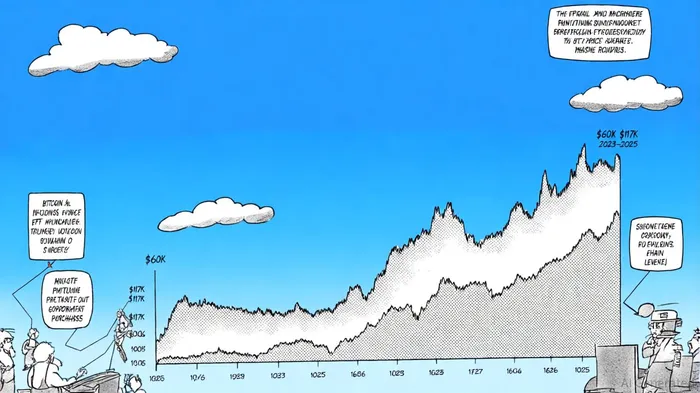
In 2025, Bitcoin's price dynamics have entered a new era, shaped by institutional adoption, regulatory clarity, and macroeconomic volatility. As global markets grapple with inflationary pressures, geopolitical tensions, and shifting monetary policies, institutional investors are increasingly treating BitcoinBTC-- as a strategic asset. This article dissects how institutional players are leveraging psychological price levels—such as $60k, $80k, and $112k—as strategic entry points, while navigating risks in a maturing market.
The Institutionalization of Bitcoin: A New Paradigm
By early 2025, institutional Bitcoin exposure has surged, with spot Bitcoin ETFs amassing over $65 billion in assets under management (AUM) [1]. These vehicles, offered by firms like BlackRockBLK-- and Fidelity, have democratized access to Bitcoin for large investors, reducing logistical barriers and regulatory uncertainty [1]. The result? A 75% drop in Bitcoin's 30-day volatility compared to previous cycles, as institutional capital stabilizes price swings [2].
Corporate treasuries have also embraced Bitcoin as a hedge against fiat depreciation. For example, MicroStrategy's aggressive accumulation of 11,000 BTCBTC-- in January 2025—valued at $1.1 billion—exemplifies how firms are redefining corporate balance sheets [3]. Meanwhile, sovereign wealth funds and pension funds are quietly accumulating Bitcoin, viewing it as a non-correlated store of value [4].
Psychological Levels: The New Battleground for Institutional Capital
Bitcoin's price action around key psychological levels has become a focal point for institutional strategy. In mid-2025, the asset traded in a $62k–$66k range, with institutional OTC purchases acting as a floor despite retail caution [5]. This consolidation phase was driven by a 3.3x imbalance in supply and demand: public corporations bought 196,207 BTC, far outpacing newly mined supply [5].
At $80k, Bitcoin faced a critical test in late 2024. A head-and-shoulders pattern suggested a potential dip, but institutional inflows into ETFs and corporate treasuries countered downward pressure [6]. For instance, when Bitcoin approached $80k in Q1 2025, 59% of institutional investors allocated at least 10% of their portfolios to Bitcoin, treating it as a core asset [7]. This demand compressed circulating supply, with 2.2 million BTC (10% of total supply) now held by institutions [7].
Risk Management: Beyond Volatility
Institutional investors have refined their risk frameworks to address Bitcoin's inherent volatility. By 2025, 72% of institutional portfolios employ AI-driven risk assessment tools, multi-signature wallets, and cold storage solutions [8]. For example, firms like ProCap Financial use DeFi strategies and yield farming to hedge their Bitcoin treasuries, while others leverage derivatives to lock in gains [9].
A notable case study is Twenty One Capital, which transparently ties corporate value to Bitcoin holdings, using TWAP strategies to accumulate BTC below $95k during a 15% market correction [10]. This measured approach contrasts with retail panic selling, underscoring institutional confidence in Bitcoin's long-term value proposition.
The Road Ahead: Breakouts and Macro Drivers
Looking forward, Bitcoin's trajectory hinges on three factors:
1. ETF Growth: With spot Bitcoin ETFs dominating institutional flows, further inflows could push BTC toward $200k by mid-2026 [11].
2. Halving Impact: The 2024 halving reduced miner supply, historically correlating with price surges. Analysts project a $175k target by late 2025 [12].
3. Macro Conditions: Bitcoin's role as an inflation hedge remains intact, with its negative correlation to the U.S. dollar attracting capital during dollar weakness [13].
Conclusion: A New Era of Strategic Allocation
Bitcoin's journey in 2025 reflects a shift from speculative frenzy to institutional pragmatism. Psychological levels like $60k and $80k are no longer just chart patterns—they are battlegrounds where institutional capital tests market sentiment. As volatility wanes and adoption deepens, Bitcoin is evolving into a cornerstone of diversified portfolios, offering both risk mitigation and long-term value capture. For investors, the lesson is clear: in a volatile macro environment, strategic entry points at key levels are not just opportunities—they are imperatives.





Comentarios
Aún no hay comentarios