
Bitcoin's Potential Rebound Amid Shifting Monetary Policy
The Fed's Dilemma: Data vs. Sentiment
The Fed's recent minutes revealed a fractured consensus, with policymakers split between inflation risks and weakening labor market indicators. While Governor Lael Brainard has hinted at the need for "policy accommodation," others, like John Williams, have cautiously suggested "room for a further adjustment". This ambiguity has caused the market-implied probability of a rate cut to oscillate wildly, creating a volatile backdrop for risk assets.
Bitcoin's price action mirrors this uncertainty. In 2020, Bitcoin surged 200% during the Fed's quantitative easing (QE) cycle, as investors flocked to assets perceived as hedges against inflation and currency devaluation. Similarly, during the 2016-2017 easing cycle, Bitcoin's correlation with risk-on assets like equities and gold strengthened, reflecting its growing role as a "digital gold" narrative.
Bitcoin's Evolving Role in Easing Cycles
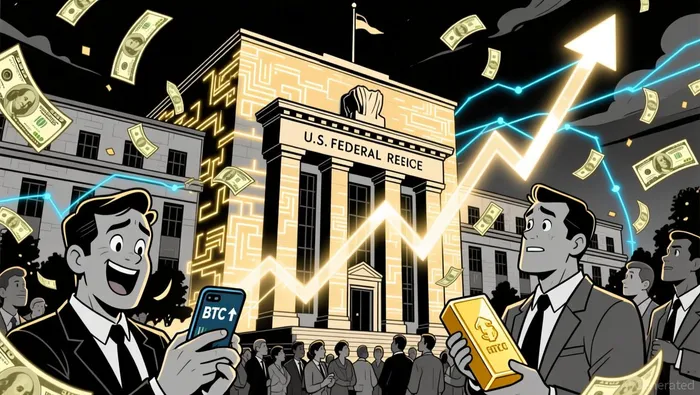 Pre-2020, Bitcoin's response to Fed policy was inconsistent. For example, during the 2008 financial crisis, Bitcoin (which did not exist then) and its early iterations were not directly impacted by rate cuts. However, post-2020, Bitcoin's behavior has shifted dramatically. A 2023 study found that Bitcoin's correlation with risk-on assets like the S&P 500 and gold has intensified, with price surges often preceding Fed easing announcements. This shift is attributed to Bitcoin's adoption as a speculative asset rather than a tool for circumventing capital controls, as was the case in pre-2018 tightening cycles.
The 2025 context is unique. A rate cut would signal a broader acceptance of Bitcoin as a legitimate store of value, particularly if the Fed prioritizes growth over inflation. This aligns with the "risk-on" environment, where investors rotate into high-beta assets. For Bitcoin, this could mean a retest of the $100,000 psychological barrier, last seen in 2021 during the previous easing cycle.
The Path Forward: Volatility as an Opportunity
While the current 46% probability of a December rate cut is lower than recent peaks, the market remains sensitive to shifting narratives. A surprise cut could trigger a short-term parabolic move in Bitcoin, driven by algorithmic trading strategies and macro hedge funds rebalancing portfolios. Conversely, a "hawkish pause" would likely see Bitcoin consolidate in the $50,000–$60,000 range, awaiting clarity on 2026 policy expectations.
Investors should also consider the indirect effects of Fed easing. Lower rates reduce the opportunity cost of holding non-yielding assets like Bitcoin, while boosting equities and risk assets broadly. This dynamic was evident in 2020, when Bitcoin's price surged alongside the Nasdaq 100 during the Fed's $120 billion monthly asset purchases.
Conclusion: Positioning for a Policy-Driven Rally
Bitcoin's potential rebound hinges on the Fed's December decision, but the broader narrative is about monetary policy's evolving relationship with crypto. As the Fed grapples with inflation, labor market weakness, and global economic uncertainty, Bitcoin's role as a hedge against fiat devaluation-and a speculative play on risk-on sentiment-remains intact. For investors, the key is to balance short-term volatility with long-term conviction, leveraging historical patterns to navigate the next phase of the crypto cycle.






Comentarios
Aún no hay comentarios