
Bitcoin's Potential Path to $125K Amid Surging Treasury Inflows
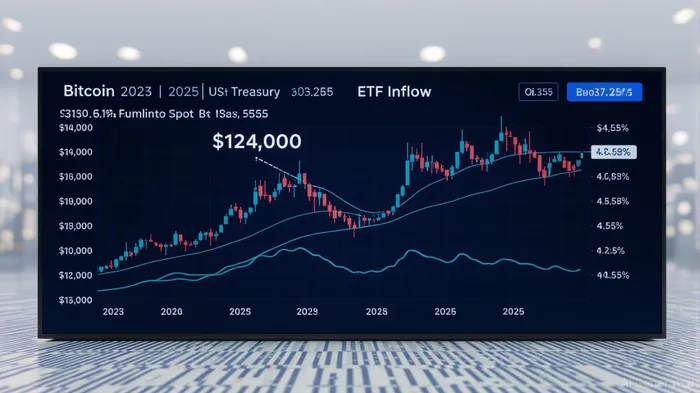
The macroeconomic landscape of 2025 has become a battleground for asset allocation, with BitcoinBTC-- emerging as a formidable contender against traditional safe-haven assets like U.S. Treasuries and gold. As institutional adoption accelerates and on-chain metrics signal robust fundamentals, the question is no longer whether Bitcoin can reach $125,000—but how it might get there.
Macroeconomic Tailwinds: Treasury Inflows and the Fed’s Shadow
The U.S. Treasury’s Q2 2025 inflow data reveals a paradox: while investors withdrew $11 billion from U.S. bond funds, foreign capital poured $195.9 billion into U.S. bonds, reflecting divergent strategies amid rising fiscal risks [1]. This duality underscores a broader shift. As central banks grapple with inflation and geopolitical tensions, Bitcoin’s low correlation with Treasuries (and its inverse relationship with bond yields) has made it an attractive hedge [2].
The Federal Reserve’s anticipated rate cuts in late 2025 have further amplified this dynamic. A 50-basis-point cut in September 2025, for instance, catalyzed Bitcoin’s rally to an all-time high near $124,000 [3]. This sensitivity to monetary policy is not coincidental. With Bitcoin’s structural properties—fixed supply and decentralized issuance—offering a counterweight to fiat devaluation, institutional investors are increasingly treating it as a “digital treasury” [4].
Institutional Adoption: ETFs and Corporate Balance Sheets
The normalization of Bitcoin as an institutional asset has been the single most transformative development of 2025. The approval of spot Bitcoin ETFs, including BlackRock’s IBIT and Fidelity’s FBTC, has unlocked a $132.5 billion influx into these vehicles by August 2025 [1]. This surge is not merely speculative; it reflects a strategic reallocation. Over 180 corporations, including MicroStrategy and SpaceX, now hold Bitcoin as a reserve asset, collectively accumulating 951,323 BTC [5].
Corporate adoption has been driven by both financial logic and regulatory tailwinds. The BITCOIN Act of 2025 and the inclusion of cryptocurrencies in 401(k) plans have normalized Bitcoin’s role in institutional portfolios [6]. Meanwhile, companies like DDC EnterpriseDDC-- have leveraged Bitcoin’s volatility as a tool for capital structuring, issuing preferred stock to fund further accumulation [1].
On-Chain Metrics: The Infrastructure of Bullishness
Bitcoin’s fundamentals are reinforced by on-chain data. The Network Value to Transaction (NVT) ratio, a key metric for assessing valuation relative to usage, has crossed a golden cross at 1.51, indicating that Bitcoin’s price is supported by real-world adoption rather than speculative fervor [7]. Daily transaction volumes hover between 390,000 and 400,000, with 735,000 active addresses, signaling sustained network activity [7].
Hashrate, a proxy for network security, has reached 1 Zettahash/s, a record high that underscores miner confidence despite the 2024 halving [7]. Exchange outflows, particularly from Binance, have turned deeply negative, suggesting that large holders are locking Bitcoin in cold storage and reducing liquidity—a classic precursor to price surges [7].
Challenges and the Road to $125K
Despite these tailwinds, Bitcoin’s path to $125,000 is not without obstacles. Volatility remains a double-edged sword. While Bitcoin’s 30-day volatility ranges between 16.32% and 21.15%, this choppiness can deter risk-averse investors [1]. Regulatory uncertainty also lingers, with governments still evaluating tax frameworks and classification standards for crypto assets [1].
However, the macroeconomic case for Bitcoin is compelling. Goldman SachsGS-- has theorized that for every 15% rise in gold’s price, Bitcoin could surge 250%—a projection that gains traction as gold approaches $5,000 per ounce [8]. If this correlation holds, Bitcoin’s $125K target becomes not just plausible but inevitable.
Conclusion: A New Paradigm in Asset Allocation
Bitcoin’s ascent to $125,000 is not a speculative gamble but a logical outcome of macroeconomic forces and institutional adoption. As U.S. Treasuries face headwinds from inflation and fiscal expansion, Bitcoin’s role as a hedge against fiat devaluation—and its structural advantages over gold—position it as a cornerstone of modern portfolios. With ETF inflows, corporate accumulation, and on-chain strength aligning, the next leg of Bitcoin’s journey is as much about institutional validation as it is about price.
Source:
[1] Bitcoin Treasuries: The Quiet Revolution Reshaping Global Capital Flows [https://www.bitget.com/news/detail/12560604940997]
[2] Bitcoin or Gold: Which Is the Better Hedging Asset in 2025? [https://finance.yahoo.com/news/given-trump-pro-crypto-stance-081241472.html]
[3] Crypto Market Update: Aug 15, 2025 [https://klever.io/blog/crypto-market-update-august-15-2025/]
[4] Bitcoin Q1 2025: Historic Highs, Volatility, and Institutional Moves [https://blog.amberdata.io/bitcoin-q1-2025-historic-highs-volatility-and-institutional-moves]
[5] Q2 2025: From Balance Sheets to Benchmarks [https://www.coindesk.com/coindesk-indices/2025/07/16/q2-2025-from-balance-sheets-to-benchmarks]
[6] The Macro Fault Line: Structural Breaks in Treasuries and ... [https://bitwiseinvestments.eu/blog/regular-updates/the-macro-fault-line-03-2025/]
[7] Bitcoin Price Prediction 2025: What On-Chain Metrics Tell Us [https://medium.com/@XT_com/bitcoin-price-prediction-2025-what-on-chain-metrics-tell-us-d3812d6717d8]
[8] Could Bitcoin Surpass $200K if Gold Hits $5000? GoldmanGS-- Sachs Weighs In [https://coincentral.com/could-bitcoin-surpass-200k-if-gold-hits-5000-goldman-sachs-weighs-in/]





Comentarios
Aún no hay comentarios