
Bitcoin's Potential as a Global Reserve Asset and Trade Settlement Tool by 2050: A Structural Revolution in Institutional Allocation
The global financial system is on the cusp of a seismic shift, driven by Bitcoin's emergence as a strategic reserve asset and trade settlement tool. By 2050, institutional investors and central banksBANK-- may view BitcoinBTC-- not merely as a speculative asset but as a foundational pillar of monetary policy and cross-border commerce. This transformation is underpinned by regulatory clarity, institutional adoption frameworks, and structural monetary shifts that position Bitcoin to rival traditional reserves like gold and fiat currencies.
Institutional Adoption: From Speculation to Strategic Allocation
Institutional demand for Bitcoin has surged since 2023, with 86% of institutional investors either holding or planning to allocate to digital assets by 2025. Regulatory milestones, such as the U.S. SEC's approval of spot Bitcoin ETFs in January 2024 and the passage of the GENIUS Act in July 2025, have normalized Bitcoin as a legitimate financial instrument. By 2025, Bitcoin ETPs alone held over 1.2 million BTC, reflecting $140 billion in assets under management. This growth is not speculative but structural: institutions now treat Bitcoin as a macro asset with diversification benefits, akin to "digital gold".
The repeal of SAB 121 in 2025 further accelerated adoption, allowing banks to manage digital assets as risk-based assets rather than liabilities. This regulatory shift enabled pension funds, state treasuries, and corporate entities to integrate Bitcoin into their portfolios. For example, the U.S. Strategic Bitcoin Reserve (SBR), established in March 2025, designated over 200,000 seized BTC as a national asset, signaling a long-term commitment to digital assets as a strategic reserve. Similarly, several U.S. states began exploring Bitcoin reserves to diversify balance sheets and hedge against inflation.
Structural Monetary Shifts: Bitcoin as a Reserve Asset
Central banks are increasingly considering Bitcoin as a reserve asset due to its unique properties. Unlike fiat currencies, Bitcoin's fixed supply of 21 million coins offers a hedge against inflation. VanEck projects that if Bitcoin captures 2.5% of central bank balance sheets by 2050, its price could reach $2.9 million. This scenario assumes Bitcoin handles 5–10% of global trade settlements, leveraging its efficiency in cross-border transactions.
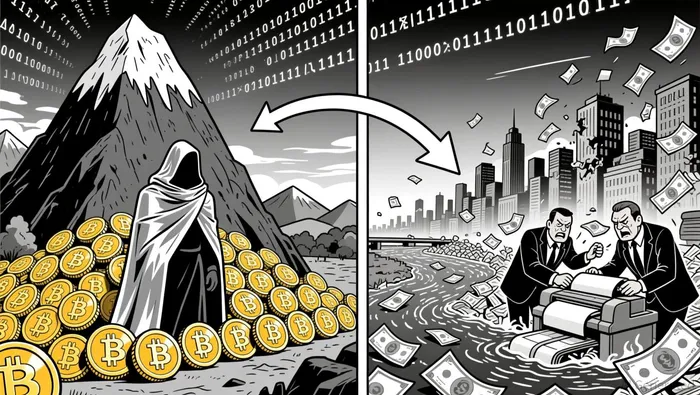
The Bank for International Settlements (BIS) is already exploring tokenized central bank reserves and commercial bank money to modernize global payments systems. Bitcoin's role in this evolution is twofold: as a decentralized reserve asset and as a settlement layer for tokenized assets. For instance, tokenized money market funds and commodities are growing rapidly in 2025, demonstrating how digital assets can be integrated into central bank portfolios.
Trade Settlement: Bitcoin's Role in Global Commerce
Bitcoin's utility in trade settlements is expanding, driven by stablecoins and blockchain-based platforms. The GENIUS Act and EU's Markets in Crypto-Assets (MiCA) Regulation have created frameworks for stablecoins to facilitate cross-border transactions. By 2025, stablecoins accounted for a significant portion of institutional trade settlements, offering faster and cheaper alternatives to traditional banking systems.
VanEck's hyper-bitcoinization scenario envisions Bitcoin capturing 20% of international trade by 2050, with its price soaring to $53.4 million. This projection hinges on Bitcoin's adoption as a settlement currency, particularly in regions with unstable fiat systems. For example, countries facing hyperinflation or capital controls may increasingly use Bitcoin to settle trade, bypassing traditional financial intermediaries.
Regulatory Frameworks and Institutional Case Studies
The institutionalization of Bitcoin is supported by robust regulatory frameworks. The U.S. and EU have led the way:- U.S.: The GENIUS Act and SAB 121 repeal removed barriers for banks to engage with crypto assets.- EU: MiCA Regulation harmonized crypto rules across member states, creating a predictable environment for institutional participation.
At the state level, U.S. states like Wyoming and Texas have pioneered Bitcoin reserve frameworks, emphasizing transparency and accountability. These models could serve as blueprints for national and international adoption. Meanwhile, the Financial Stability Board (FSB) is addressing regulatory gaps to ensure financial stability as digital assets become systemically relevant.
The Road to 2050: Challenges and Opportunities
While Bitcoin's trajectory is promising, challenges remain. Regulatory arbitrage, cybersecurity risks, and energy consumption debates could slow adoption. However, innovations like tokenization, decentralized finance (DeFi), and blockchain analytics are mitigating these risks. By 2026, financial institutions are expected to expand into stablecoins, tokenized assets, and DeFi, further embedding Bitcoin into the global financial system.
Conclusion
Bitcoin's journey from a speculative asset to a global reserve and trade settlement tool is not a distant dream but an unfolding reality. Institutional adoption, regulatory clarity, and structural monetary shifts are aligning to position Bitcoin as a cornerstone of the 21st-century financial system. By 2050, central banks and corporations may view Bitcoin not as a disruptor but as an essential tool for managing inflation, diversifying reserves, and streamlining global trade. The question is no longer if Bitcoin will achieve this role, but how quickly the world will adapt to its inevitability.






Comentarios
Aún no hay comentarios