
Bitcoin's Potential 80% Correction and the Rise of Altcoin 2.0 Leaders: A Contrarian Play for Bear Market Resilience
Bitcoin's price history is a masterclass in volatility. From its 2013 crash (83% decline) to the 2022 bear market (70% drop), the asset has repeatedly demonstrated a cyclical pattern: sharp corrections followed by exponential rebounds. As of October 2025, BitcoinBTC-- hovers near all-time highs of $122,000, but a hypothetical retest of this level could trigger a 5% pullback in major altcoins like SolanaSOL-- (SOL) and CardanoADA-- (ADA), according to a FinancialContent report. This volatility, while daunting, presents a unique opportunity for contrarian investors to rebalance portfolios toward high-utility altcoins-specifically Solana, Cardano, and Polkadot-that are structurally positioned to outperform during systemic corrections.
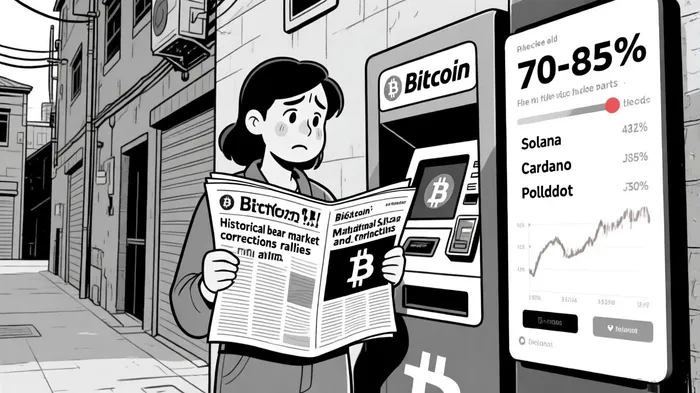
The Case for Bitcoin's 80% Correction
Historical data suggests Bitcoin's bear markets often stabilize after 70–85% declines, with average bull market rallies of 3,485% following such troughs, according to historical statistics. For instance, the 2018–2019 cycle saw Bitcoin plummet from $19,500 to $3,600 before surging 100% in 2019. Similarly, the 2022 crash from $68,000 to $20,000 was followed by a 2023–2024 rebound. A Monte Carlo simulation by Diaman Partners projects Bitcoin could drop to $60,000 during the next bear market, aligning with historical drawdowns, as noted in a Cointelegraph analysis.
While Bitcoin's dominance (62% of the crypto market cap in early 2025) ensures it remains a bellwether, its volatility-though lower than Netflix stock (53% 90-day realized volatility)-still poses risks, according to Fidelity research. For risk-averse investors, this volatility underscores the need for strategic hedging.
Altcoin 2.0: The Next-Generation Playbook
Altcoin 2.0 projects like Solana, Cardano, and PolkadotDOT-- are not mere speculative assets; they are engineered to address Bitcoin's limitations through innovation in scalability, interoperability, and governance.
Solana (SOL) has emerged as a high-performance Layer-1 blockchain, combining Proof of History (PoH) with Delegated Proof of Stake (DPoS) to process 65,000 transactions per second at minimal cost, as described in a Solana–Polkadot comparison. Its ecosystem has grown exponentially, with total value locked (TVL) rising 126% in 2024 and institutional adoption (e.g., partnerships with R3) signaling operational utility over speculation, according to a Coin Republic article. During the 2022–2023 bear market, Solana's price rebounded 43% annually, outpacing Bitcoin's recovery, per a Tickeron report.
Cardano (ADA), with its research-driven architecture, prioritizes security and formal verification. Its Hydra Layer-2 protocol promises thousands of transactions per second, while its on-chain governance model allows ADAADA-- holders to vote on funding proposals, according to a Crypto.com comparison. Despite slower transaction speeds than Solana, Cardano's methodical upgrades-such as Project Acropolis and Bitcoin bridging-position it for long-term resilience. In 2024, ADA's price stabilized after a 70% drawdown, reflecting growing institutional interest in its real-world applications (e.g., Ethiopia's education credentials system), according to a Cardano Foundation guide.
Polkadot (DOT), meanwhile, focuses on interoperability via its Relay Chain and parachain model. The Polkadot 2.0 upgrade introduced elastic scaling and coretime, enabling dynamic resource allocation, as detailed in a p2p.org article. While DOT's 2022–2023 recovery was slower than Solana's, its ecosystem's diversity-hosting DeFi, gaming, and supply chain projects-provides a buffer against single-point failures.
Contrarian Rebalancing: Why Shift Exposure?
During bear markets, altcoins often mirror Bitcoin's declines but recover faster due to their niche use cases and active development. For example, in the 2018–2019 cycle, altcoins like Solana and Polkadot fell 70–86% but rebounded alongside Bitcoin's 2019 rally, per an AltcoinInvestor history. This pattern suggests that investors who rebalance toward high-utility altcoins during Bitcoin's corrections can capture asymmetric returns.
Consider the following strategy:
1. Reduce Bitcoin exposure as it approaches overbought levels (e.g., $122,000).
2. Allocate to Solana for its institutional partnerships and TVL growth.
3. Invest in Cardano for its governance model and Bitcoin bridging.
4. Diversify with Polkadot to capitalize on its interoperability-driven ecosystem.
This approach leverages altcoins' lower correlation to Bitcoin during rebounds. For instance, Solana's 2024–2025 surge to $157.73 (a 43% annualized return) occurred amid broader market volatility, highlighting its potential as a hedge, according to an Alpha Digital review.
Risk Mitigation in a Bear Market
While altcoins are more volatile than Bitcoin, their real-world utility and active ecosystems mitigate downside risks. Solana's low fees and enterprise adoption, Cardano's academic rigor, and Polkadot's cross-chain capabilities create moats against speculative sell-offs. Moreover, altcoins with strong developer activity (e.g., Solana's Firedancer validator) and governance frameworks (e.g., Cardano's Voltaire era) are better positioned to weather liquidity crunches, as an OANDA overview notes.
Critically, investors should avoid overexposure to smaller altcoins, which are more susceptible to Bitcoin's price swings. Instead, focus on Altcoin 2.0 leaders with proven use cases and institutional backing.
Conclusion
Bitcoin's cyclical nature ensures another 80% correction is inevitable, but this volatility is not a death knell-it's an opportunity. By rebalancing portfolios toward Solana, Cardano, and Polkadot, investors can hedge against Bitcoin's downside while positioning for the next bull cycle. As the crypto market matures, Altcoin 2.0's emphasis on scalability, interoperability, and governance will increasingly outperform Bitcoin's monolithic model during systemic corrections.






Comentarios
Aún no hay comentarios