
Bitcoin's Potential for 50% Upside in Q4 2025: A Macro-Driven Case for Optimism
Bitcoin is entering a critical inflection point in Q4 2025, with a compelling case for a 50% price surge driven by institutional adoption, macroeconomic tailwinds, and regulatory clarity. As the crypto market navigates a shifting landscape of capital flows and policy dynamics, Bitcoin's unique positioning as a "digital gold" asset and its alignment with broader financial trends suggest a strong finish to the year.
Institutional Adoption and ETF Inflows: A Catalyst for Momentum
The most immediate tailwind for BitcoinBTC-- is the unprecedented institutional adoption accelerating through U.S. spot Bitcoin ETFs. Since their approval in early 2024, these funds have attracted over $54.4 billion in net inflows, with BlackRock's iShares Bitcoin Trust (IBIT) dominating the market, according to a Bitcoin Info News report. In October 2025 alone, ETFs saw $3.24 billion in inflows, including a record $791 million in a single day as reported in a WRAL MarketMinute article. This liquidity surge has not only stabilized Bitcoin's price but also reduced volatility historically tied to retail-driven cycles, according to the CoinGecko report.
Major financial institutions are now forecasting aggressive price targets. JPMorganJPM-- anticipates $165,000 by year-end, while CitiC-- and Standard Chartered project $133,000 and $200,000, respectively, in a CoinCentral analysis. These projections hinge on sustained ETF inflows and a shift of capital from gold to Bitcoin, which is increasingly viewed as a "hard asset" with limited supply in an Awaken Tax analysis.
Macroeconomic Tailwinds: Fed Policy and Inflation Dynamics
Bitcoin's price performance is inextricably linked to macroeconomic conditions, particularly Federal Reserve policy. The Fed's September 2025 rate cut of 0.25%-the first easing since late 2024-initially pushed Bitcoin to a six-week high of $123,996, as discussed in an Analytics Insight piece. While the market had largely priced in the move, analysts argue that the medium-term impact of lower interest rates could be transformative. Reduced borrowing costs increase liquidity, making riskier assets like Bitcoin more attractive, per a CoinLineup analysis.
However, the Fed's cautious stance on inflation remains a wildcard. August 2025 CPI data showed a 2.9% year-over-year increase, slightly above expectations according to CoinRank data. Chair Jerome Powell has emphasized that inflation control takes precedence over rate cuts, even at the expense of labor market growth, in CoinDesk coverage. This uncertainty has led to a risk-off environment, with leveraged crypto positions seeing liquidations and ETF outflows in late September, according to a Financial Express report. Yet, if inflation moderates and the Fed adopts a more dovish stance, Bitcoin could benefit from a broader risk-on rally.
Regulatory Clarity and Global Adoption
Regulatory developments in the U.S. and Europe are further solidifying Bitcoin's institutional appeal. The SEC's ongoing review of crypto ETF applications and the European Union's Markets in Crypto-Assets (MiCA) framework are creating clearer guidelines for institutional participation, according to another Analytics Insight article. These frameworks reduce legal ambiguity, enabling pension funds, insurance companies, and corporate treasuries to allocate capital with greater confidence, as noted by Dapp.Expert coverage.
Corporate adoption is also accelerating. Firms like MicroStrategy and Twenty One have significantly increased Bitcoin holdings, treating it as a strategic treasury asset (see the Awaken Tax analysis). This trend mirrors gold's role in traditional portfolios, with Bitcoin's programmable nature and scarcity offering a digital alternative in a Bitrue analysis.
Historical Seasonality and Structural Advantages
Historical patterns suggest Bitcoin's Q4 performance is often robust. Excluding volatile years like 2017 and 2020, Bitcoin has gained an average of 44% in Q4 around 70% of the time, according to the Awaken Tax analysis. The current environment-marked by deeper liquidity, institutional depth, and regulatory progress-positions Bitcoin for a more structured and resilient move.
Moreover, Bitcoin's correlation with gold is strengthening. As macroeconomic uncertainty persists, investors are shifting toward assets with intrinsic value and limited supply (Awaken Tax). This dynamic reinforces Bitcoin's identity as "digital gold," further supported by its ETF-driven accessibility and reduced volatility reported by WRAL MarketMinute.
Conclusion: A Confluence of Tailwinds
Bitcoin's potential for a 50% upside in Q4 2025 rests on a convergence of factors: record ETF inflows, favorable Fed policy, regulatory clarity, and historical seasonality. While risks such as inflation persistence and regulatory delays remain, the current trajectory suggests a strong finish to 2025. For investors, the combination of institutional momentum and macroeconomic tailwinds makes Bitcoin an increasingly compelling asset in a diversified portfolio.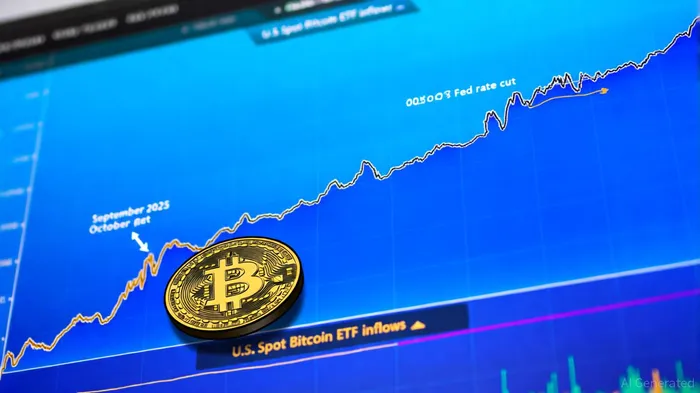





Comentarios
Aún no hay comentarios