
Bitcoin's Post-Liquidity Sweep Recovery: A Technical and Risk-Rebalance-Driven Opportunity
The Liquidity Sweep and Market Reset
The April 2025 ETP outflow revealed a critical shift in investor behavior. While Bitcoin ETPs still held $1.3 billion in year-to-date inflows, the weekly outflows highlighted growing caution amid macroeconomic headwinds, per Coinglass. This was compounded by the October liquidation event, which erased $20 billion in futures open interest (FOI) and exposed the fragility of over-leveraged positions, as detailed in an Investor Empires analysis. The subsequent drop to $101,000 triggered a market-wide deleveraging, with open interest variance hitting a historic low of -25 points, a level highlighted by the same Investor Empires piece. This purge of speculative excess has left the market in a state of equilibrium, where volatility is now driven by institutional-grade tools like options trading rather than retail-driven leverage, according to a Yahoo Finance article.
RSI Normalization and Consolidation
Bitcoin's Relative Strength Index (RSI) has since normalized into neutral territory, signaling a period of consolidation, as reported by Blockchain Reporter. On hourly and four-hour timeframes, RSI values reached extreme lows, historically indicating potential reversals, as Kitco noted. This technical signal is reinforced by on-chain data showing Bitcoin's daily volume exceeding the yellow moving average-a sign of underlying demand (reported by Kitco). While short-term traders dominate price action, the broader trend suggests a transition from bearish capitulation to a balanced accumulation phase.
Key Support/Resistance Levels and Structural Catalysts
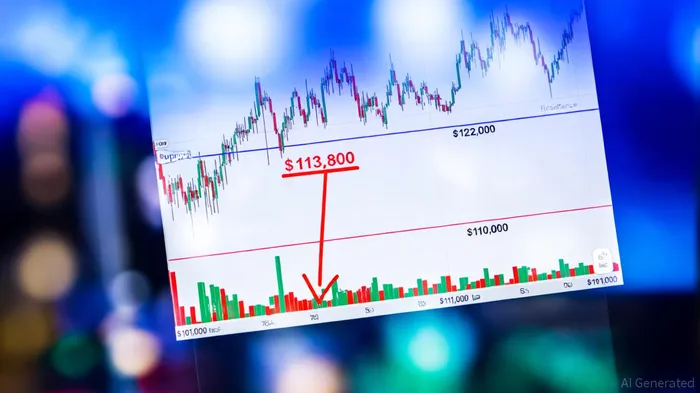
Bitcoin's price action is now anchored by a broadening wedge pattern, with the current price near $113,800 and upper resistance forming at $122,000, according to Crypto Front News. This level represents a critical juncture for a potential all-time high breakout. Meanwhile, $110,000 serves as immediate support, with the $78,000–$80,000 range acting as a deeper consolidation zone, per a Kagels Trading forecast. On-chain analysis also reveals structural shifts: OG whale holders are offloading supply, while TradFi entities absorb Bitcoin at a pace that could accelerate in 2026, according to Coinotag. These dynamics create a dual-layer catalyst-technical resistance and supply-side rebalancing-that could drive Bitcoin above $115,000.
Open Interest and Leverage Rebalance
The post-liquidation environment is defined by a stark divergence between futures and options open interest. While FOI collapsed to $68 billion, options open interest (OOI) surged to $108 billion-$40 billion higher than FOI, a gap highlighted by the earlier Yahoo Finance coverage. This shift reflects a maturing derivatives market, where sophisticated hedging strategies reduce volatility and create a more stable foundation for spot-driven growth. Additionally, Bitcoin's volatility relative to equities has hit multi-year lows, reinforcing its role as a macro-neutral asset, per VanEck Chaincheck. Historical patterns suggest that such extreme open interest contractions are often followed by 40%–50% price recoveries, a trajectory that could see Bitcoin reclaiming $122,000 by early 2026 (as noted above by Investor Empires).
Conclusion: A Foundation for Spot-Driven Growth
The confluence of RSI normalization, structural support from ETF adoption, and a deleveraged market creates a compelling case for spot-driven growth above $115,000. While macroeconomic risks persist, the reduced leverage and stabilized open interest metrics indicate a cleaner market environment. Investors should monitor key resistance levels and on-chain absorption rates, as these will determine whether Bitcoin's wedge pattern resolves bullish or requires further consolidation. For those with a medium-term horizon, the current setup offers a rare opportunity to enter a market primed for a sustainable upward trajectory.






Comentarios
Aún no hay comentarios