
Bitcoin as a Political Risk Hedge: Navigating Government Instability and Fiscal Uncertainty
In an era marked by escalating political instability and fiscal uncertainty, BitcoinBTC-- (BTC) has emerged as a contentious yet compelling asset for investors seeking to hedge against systemic risks. From hyperinflationary economies to geopolitical conflicts, the cryptocurrency's decentralized nature positions it as both a speculative tool and a potential safe-haven asset. This analysis examines empirical evidence and case studies to evaluate Bitcoin's role as a political risk hedge, while acknowledging its limitations and volatility.
Empirical Evidence: Bitcoin's Dual Role in Political and Fiscal Crises
Academic research underscores Bitcoin's complex relationship with political instability. A 2023 Nature study found that Bitcoin and EthereumETH-- can act as short-term hedging tools during periods of economic policy uncertainty (EPU), though their effectiveness wanes over time. This duality is mirrored in global markets: while the U.S. and other developed economies treat Bitcoin as a speculative asset, developing nations-facing acute political and economic volatility-often adopt it as a lifeline, as shown in a 2025 study. For instance, during the 2022 Russia-Ukraine War, Bitcoin trading volumes surged as individuals bypassed banking restrictions and preserved wealth, according to a ScienceDirect analysis. Similarly, in Venezuela and Afghanistan, Bitcoin has served as a critical alternative to hyperinflationary currencies and capital controls, a pattern documented in a 2024 arXiv study.
However, Bitcoin's price is not immune to geopolitical shocks. During the U.S.-China trade war (2018–2020), its volatility spiked, reflecting broader market uncertainty, as reported in a Finance Magnates article. Regulatory actions, such as China's 2021 Bitcoin mining ban, further highlight how political decisions can directly impact the cryptocurrency's value, explained in a Mudrex article. These examples illustrate Bitcoin's dual identity: a decentralized store of value and a volatile asset sensitive to macroeconomic narratives.
Case Studies: Bitcoin in Action During Crises
The Russia-Ukraine War offers a vivid case study. Initially, Bitcoin prices dipped amid conflict-related uncertainty but later rebounded as demand for decentralized financial tools surged, according to a ScienceDirect study. This pattern aligns with findings from the arXiv paper cited above, which noted that Bitcoin's trading volumes in developing countries grow significantly during geopolitical crises. In contrast, developed economies like the U.S. exhibit less pronounced correlations, as Bitcoin is often perceived as a speculative investment rather than a necessity, as discussed in a SciSimple analysis.
El Salvador's adoption of Bitcoin as legal tender in 2021 further demonstrates its potential. Despite initial volatility, the move attracted foreign investment and stabilized the country's credit rating, according to a Forbes article. Conversely, nations like China have imposed strict controls to preserve monetary sovereignty, a dynamic explored in a ResearchGate paper.
Global Implications and Challenges
Bitcoin's rise challenges the traditional dominance of the U.S. dollar in global finance. By enabling cross-border transactions outside conventional systems like SWIFT, it offers an alternative for countries under sanctions, such as Iran and North Korea, as noted in the ResearchGate paper mentioned above. However, this shift raises concerns about environmental sustainability due to energy-intensive mining operations, another point the same ResearchGate analysis highlights. Additionally, while Bitcoin can hedge against short-term EPU, its long-term utility remains limited, as evidenced by studies showing diminishing returns over time (see the 2023 Nature study cited earlier).
Conclusion: A Prudent but Imperfect Hedge
Bitcoin's role as a political risk hedge is neither absolute nor static. While it offers resilience during crises-particularly in unstable economies-its volatility and regulatory sensitivity temper its effectiveness. Investors must weigh its potential against the risks of speculative swings and evolving geopolitical narratives. As governments grapple with the implications of decentralized finance, Bitcoin's future will likely hinge on its ability to balance innovation with stability.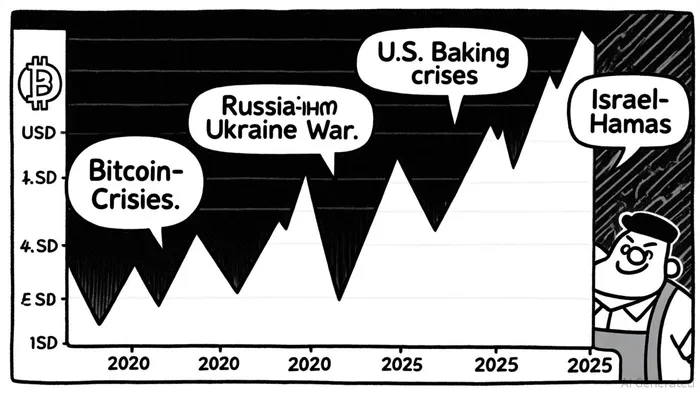






Comentarios
Aún no hay comentarios