
Bitcoin as a Political Proxy: Is Trump's Waning Power Hurting Crypto's Future?
Bitcoin's valuation has long been a barometer for macroeconomic and geopolitical shifts. In recent years, however, its price movements have increasingly mirrored the political fortunes of one individual: Donald TrumpTRUMP--. From 2023 to 2025, Trump's pro-crypto rhetoric and policy proposals-ranging from positioning the U.S. as the "crypto capital of the planet" to pardoning industry figures-acted as a catalyst for Bitcoin's meteoric rise according to analysis. Yet, as of November 2025, a sharp decline in Trump's political influence appears to be unraveling this narrative, with BitcoinBTC-- plummeting 25% since late October. This article examines the interplay between political influence and cryptocurrency valuation, asking whether Bitcoin's future is now inextricably tied to the fate of Trumpism.
The Trump-Driven Crypto Boom (2023–2025)
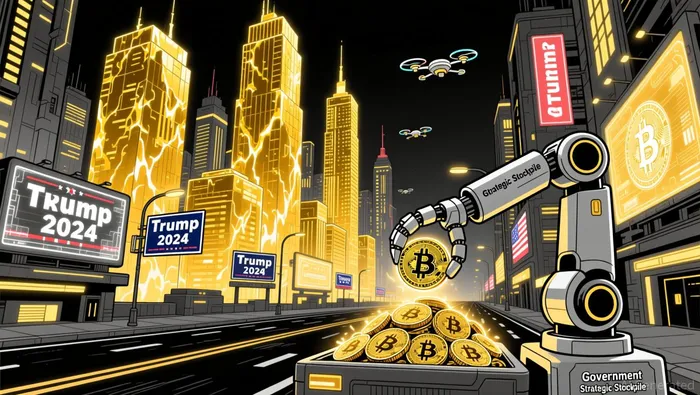
Trump's 2024 election victory marked a turning point for Bitcoin. His campaign's pledge to create a government strategic stockpile of Bitcoin and ease retirement fund access to crypto assets sent shockwaves through the market according to reports. By late 2024, Bitcoin surged past $100,000, fueled by both speculative fervor and institutional validation. The Trump family's foray into crypto-via platforms like World Liberty FinancialWLFI-- and the proprietary token $WLFI-further cemented perceptions of state-backed legitimacy.
Institutional adoption accelerated alongside this political tailwind. The launch of BlackRock's ASX Bitcoin ETF and JPMorgan's IBIT ETF signaled a shift toward mainstream acceptance, while Harvard's $100 million allocation to a U.S. Bitcoin ETF underscored growing confidence in the asset class according to data. These developments were not purely speculative; they reflected broader macroeconomic dynamics, including renewed liquidity and the maturation of digital assets as part of the global financial system according to analysis.
The 2025 Government Shutdown: A Test of Resilience
The U.S. government shutdown in October 2025, however, exposed vulnerabilities in this narrative. During the 40-day fiscal impasse, Bitcoin dropped 5% as liquidity contracted and market sentiment soured according to reports. Yet, the resolution of the crisis-marked by a bipartisan funding bill passed on November 10-spurred a 6.7% rebound, pushing Bitcoin to $106,000 according to market analysis. Analysts attributed this recovery to renewed optimism around fiscal stability and regulatory clarity, with Trump's proposed $2,000 rebate checks (funded by tariff revenue) further stoking demand according to forecasts.
This episode highlighted Bitcoin's dual nature: a speculative asset sensitive to political uncertainty, yet increasingly resilient due to institutional infrastructure. Even amid a $578 million ETF outflow in early November, the broader trend pointed to growing acceptance of Bitcoin as a legitimate asset class according to institutional data.
The Unraveling of the "Trump Trade"
By November 2025, however, the political underpinnings of Bitcoin's ascent began to fray. Nobel laureate Paul Krugman argued that Bitcoin's 25% price drop since late October was directly linked to Trump's waning influence according to analysis. Key indicators of this decline include:
- Bipartisan alignment on issues like fiscal responsibility, diluting Trump's economic nationalism according to reports.
- Republican dissatisfaction with Trump's leadership, particularly among fiscal conservatives according to polling data.
- Electoral defeats in key states, undermining his narrative of a "crypto-friendly" America according to analysis.
Krugman posits that Bitcoin has become a "Trump trade"-a bet on policies that now appear increasingly out of reach according to analysis. The Trump family's financial exposure to Bitcoin, including Eric Trump's involvement with American Bitcoin, further entwined the asset's fate with the family's political fortunes according to reports. As Trump's approval ratings dipped and bipartisan consensus grew, the speculative narrative underpinning Bitcoin's valuation weakened according to market analysis.
Institutional Responses and the Path Forward
Despite the recent slump, institutional participation in crypto remains robust. Staking-based products like Bitwise's Solana ETF and continued ETF inflows suggest that Bitcoin's appeal extends beyond political cycles according to data. However, the sharp November correction has raised questions about the sustainability of its growth. Analysts caution that while Trump's policies reduced regulatory headwinds, long-term success hinges on balancing economic nationalism with broader financial stability according to research.
The Trump-adjacent "crypto capital" vision may also face challenges. A government shutdown, even when resolved, eroded confidence in the administration's ability to manage fiscal policy-a critical factor for institutional investors according to analysis. Yet, the maturation of ETF infrastructure and macroeconomic tailwinds (e.g., TGA stabilization) indicate that Bitcoin's valuation is becoming less dependent on any single political figure according to market reports.
Conclusion
Bitcoin's journey from speculative novelty to institutional asset has been deeply intertwined with Trump's political influence. The 2023–2025 surge demonstrated how policy narratives can drive valuation, while the 2025 government shutdown and subsequent price correction revealed vulnerabilities in that model. As Trump's power wanes, Bitcoin faces a critical inflection point: will it retain its newfound legitimacy as a mainstream asset, or will its value remain tethered to the whims of political cycles?
For now, the answer lies in the evolving interplay between institutional infrastructure and macroeconomic forces. While the "Trump trade" may be unraveling, the broader crypto ecosystem is proving resilient. Investors must weigh short-term political volatility against long-term structural trends-a balancing act that defines the future of digital assets in an increasingly polarized world.






Comentarios
Aún no hay comentarios