
Is Bitcoin Poised for a 2026 Rally: A Post-October Correction Setup?
Technical Foundations: A Delicate Balance
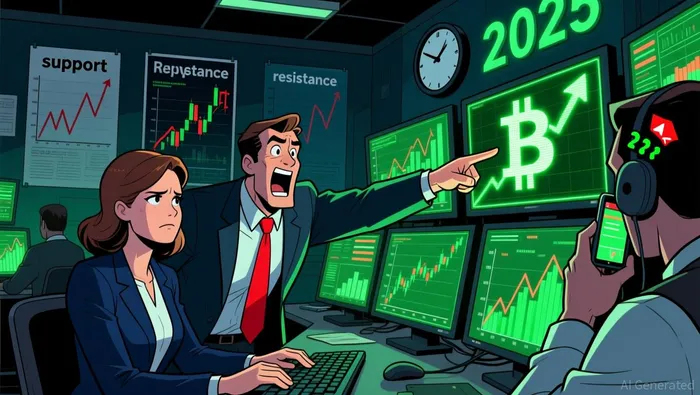
Bitcoin's post-October correction has stabilized around $108,982, a level now serving as a critical support zone. A break below this threshold could expose further downside to $105,000 and the psychological $100,000 barrier. Conversely, a sustained breakout above $115,000–$116,000 resistance would signal renewed strength, potentially retesting the $120,000–$123,000 supply zone from before the correction.
Technical indicators remain mixed but cautiously optimistic. The Relative Strength Index (RSI) hovers near 70, indicating strong positive momentum without immediate overbought conditions. The Moving Average Convergence Divergence (MACD) shows the MACD line holding above its signal line, reinforcing a bullish bias. Meanwhile, Bitcoin's price remains above key EMAs, suggesting the uptrend's structural integrity is intact.
 On-chain metrics add nuance. While the network hash rate declined by 4% in December 2025-a historically bullish contrarian signal-whale activity reveals a duality: older wallets are moving coins to exchanges for short-term profit-taking, while large accumulations by long-term holders suggest a bullish structural shift. This duality underscores the market's transition from speculative retail-driven dynamics to a more institutionalized framework.
Macroeconomic Catalysts: Dovish Policy and Institutional Adoption
Bitcoin's price has become increasingly sensitive to macroeconomic forces, particularly Federal Reserve policy. In 2026, analysts anticipate a dovish pivot as the U.S. economy softens, with the Fed potentially cutting interest rates by 125–150 basis points. Such easing would reduce real yields, making alternative assets like BitcoinBTC-- more attractive. This aligns with historical patterns where Bitcoin has outperformed during periods of monetary expansion.
Institutional adoption is another key driver. Over 76% of global investors plan to expand their digital asset exposure in 2026, supported by regulatory clarity from frameworks like the EU's Markets in Crypto-Assets (MiCA) and the U.S. Clarity Act according to CNBC analysis. Corporate treasuries and spot ETFs are also absorbing Bitcoin supply at unprecedented rates. For instance, in early 2026, institutions absorbed over 105% of new Bitcoin issuance, with firms like MicroStrategy amassing large holdings as strategic reserves. This structural demand creates a bullish bias by reducing circulating supply and reinforcing Bitcoin's store-of-value narrative.
Inflation trends further bolster Bitcoin's appeal. While global inflation remains a concern, disinflationary pressures-such as slowing wage growth and easing housing costs-are expected to persist. This environment strengthens Bitcoin's role as a hedge against fiat debasement, particularly as central banks continue to expand monetary bases.
Risks and Uncertainties
Despite these positives, risks remain. The October 2025 flash crash, triggered by trade-war fears and a $19 billion liquidation event, highlighted Bitcoin's vulnerability to macroeconomic shocks. Additionally, ETF outflows in late 2025-exceeding $1.3 billion-revealed fragility in retail-driven demand. While institutional adoption is growing, it may take time for these forces to fully offset speculative flows.
Conclusion: A Conditional Bull Case
Bitcoin's 2026 rally hinges on two pillars: technical resilience and macroeconomic alignment. Technically, holding above $108,000 is critical to maintaining the bullish case, while breaking through $115,000 could reignite the uptrend. On the macro side, Fed easing, institutional adoption, and disinflationary trends create a favorable backdrop. However, these catalysts must overcome lingering structural fragilities, such as ETF outflows and geopolitical risks.
If Bitcoin navigates this delicate balance, the stage is set for a 2026 rally driven not by speculative fervor but by institutional confidence and regulatory clarity. For investors, the key will be monitoring both price action and macroeconomic signals to time entry points in this evolving market.







Comentarios
Aún no hay comentarios