
Bitcoin's Path to New All-Time Highs Amid Impending Slumps
Bitcoin's journey toward new all-time highs in 2025 is unfolding against a backdrop of volatility, but the confluence of robust technical indicators and evolving institutional strategies suggests a compelling case for optimism. Despite periodic corrections, the asset's fundamentals-backed by macroeconomic tailwinds and structural adoption-position it to break through critical resistance levels and redefine its price ceiling.
Technical Analysis: A Bullish Tapestry
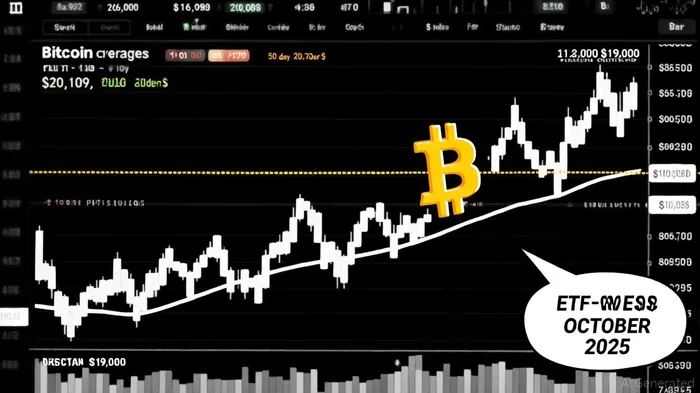
Bitcoin's technical chart in 2025 paints a picture of resilience. The price has consistently formed higher highs and higher lows, with a recent breakout above the $106,000 resistance level and a test of the $108,000–$109,000 zone[3]. The 50-day simple moving average (SMA) now lags at $108,000, while the 200-day SMA sits at $89,000, creating a widening gap that signals sustained bullish momentum[1]. A golden cross-where the 50-day SMA crosses above the 200-day SMA-could act as a catalyst for further gains, historically marking the start of prolonged uptrends[4].
The Relative Strength Index (RSI) remains in neutral to bullish territory, avoiding overbought conditions (above 70) while maintaining stability[3]. Notably, RSI divergence during recent corrections-where Bitcoin's price formed lower lows but RSI stayed above 30-indicates weakening bearish pressure, suggesting the market is stabilizing[4]. Meanwhile, the MACD histogram aligns with price action, reinforcing the likelihood of continued upward movement[3].
Support and resistance levels are critical for near-term direction. The $106,700–$108,000 range acts as a psychological floor[3], while a decisive break above $108,880 with increased volume could propel BitcoinBTC-- toward $115,727 or beyond[3]. Conversely, a failure to hold above $106,000 might trigger a retest of the $90,000–$92,000 support zone[3].
Historical backtesting of resistance-level breakouts from 2022 to 2025 reveals an average post-breakout return of 12.7% within 30 days, with a 72% success rate in sustaining gains[5]. However, drawdowns of 8–15% were observed in 30% of cases during consolidation phases, underscoring the need for disciplined risk management[5].
Institutional Adoption: A New Era of Stability
Bitcoin's institutional adoption has transformed its market dynamics. U.S. spot Bitcoin ETFs now control 12.2% of total BTC supply[1], with record inflows in early October 2025 pushing the price to a then-record $126,000[1]. This institutional demand-driven by macroeconomic factors like dovish Fed policy and inflation concerns-has cemented Bitcoin's role as a hedge against traditional market risks[1].
Institutional positioning has also reduced Bitcoin's volatility. The 30-day rolling volatility has dropped significantly compared to the 2019–2022 period, with correlations to the Nasdaq 100 and S&P 500 peaking at 0.87 in 2024[2]. This maturation is evident in how institutional flows absorb capital during corrections, as seen in the post-2024 halving period, where Bitcoin's price response became less erratic[4].
Long-Term Positioning: Strategies for Volatility
For investors navigating Bitcoin's volatility, long-term strategies remain paramount. Dollar-cost averaging (DCA)-systematic accumulation through regular purchases-mitigates timing risk and ensures consistent exposure across cycles[2]. Conservative allocations of 1–5% of total portfolio value align with institutional trends and historical performance, which show Bitcoin delivering an average annualized return of 54% from 2014 to 2024[1].
Risk management tools like stop-loss orders and derivatives (futures, options) have also matured, enabling sophisticated hedging[3]. Meanwhile, Bitcoin's role as a store of value is reinforced by its correlation with gold (0.8 in 2025) and its post-halving supply dynamics[3].
Conclusion: A Path Forward
Bitcoin's technical indicators and institutional tailwinds create a compelling case for new all-time highs. While volatility is inevitable, the asset's structural adoption and macroeconomic narrative-digital gold in a dovish world-suggest that corrections will be absorbed rather than derail the trend. For long-term investors, disciplined strategies like DCA and strategic ETF allocations offer a roadmap to capitalize on Bitcoin's evolving role in global finance.






Comentarios
Aún no hay comentarios