
Bitcoin's Path to a New All-Time High: Macroeconomic Catalysts and Network Fundamentals in November 2025
Macroeconomic Catalysts: Fed Policy and Inflation Dynamics
The U.S. Federal Reserve's pivot toward accommodative monetary policy remains a cornerstone of Bitcoin's bullish narrative. Recent CPI data, which showed a softer-than-expected inflation print, has intensified market expectations of rate cuts in 2025. According to Bitcoin Magazine, the Fed's decision to end quantitative tightening and resume Treasury purchases has injected liquidity into risk assets, with Bitcoin surging above $111,000 in response. This shift signals a broader easing of monetary conditions, historically correlated with crypto price rallies, according to a Coinotag report.
Moreover, the Fed's focus on stabilizing yields and reducing borrowing costs has created a favorable backdrop for Bitcoin. Analysts at the Coinotag outlook note that the easing cycle could amplify Bitcoin's appeal as a hedge against currency devaluation, particularly in a world where global inflation remains stubbornly elevated. The interplay between U.S.-China trade tensions and persistent inflation further underscores Bitcoin's role as a geopolitical risk hedge, as reported by Bitcoin Magazine.
Institutional Adoption and Derivatives Infrastructure
Institutional demand for Bitcoin has reached unprecedented levels, driven by the approval of spot ETFs and the development of derivatives tools. Michael Saylor has been a vocal advocate, predicting BTC could hit $150,000 by late 2025. His rationale hinges on the maturation of the crypto market, with banks like J.P. Morgan and Bank of America now offering crypto services, thereby enhancing Bitcoin's legitimacy as an institutional asset.
The approval of altcoin ETFs is expected to catalyze the next wave of institutional inflows, building on the success of Bitcoin and EthereumETH-- ETFs. As highlighted by Investor Empires, this regulatory clarity is fostering confidence among institutional investors, who are increasingly viewing Bitcoin as a core portfolio allocation. The integration of Bitcoin into global financial systems, coupled with risk-management tools, is reducing its volatility and making it a more attractive store of value, according to the Coinotag outlook.
Network Fundamentals: Hash Rate Diversification and Transaction Volume
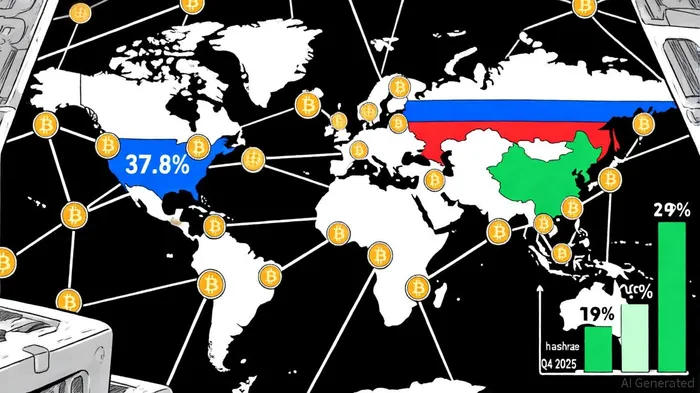
Bitcoin's network fundamentals are equally compelling. The Q4 2025 hash rate data reveals a significant geographical shift, with the United States now leading at 37.8% of the global hashrate, followed by Russia and China, according to a HashrateIndex update. This diversification reduces the risk of centralization and enhances the network's resilience. The U.S. has steadily increased its share over the past five quarters, while emerging markets like Paraguay and Ethiopia are gaining traction.
Transaction volume trends also signal growing adoption. While the number of transactions has stabilized, the total value moved has surged, with larger-scale capital flows dominating the network, per Bitget analysis. For instance, on-chain data from October 2025 shows an average transaction value of $70,605, reflecting increased institutional activity, according to BitInfoCharts. However, analysts caution that rising volume on centralized exchanges could indicate short-term selling pressure, as noted in the Bitget analysis.
The Road to $150,000: A Convergence of Factors
The convergence of macroeconomic easing, institutional adoption, and strong network fundamentals creates a powerful case for Bitcoin's next leg higher. Saylor's $150,000 target is not merely speculative; it is underpinned by tangible developments such as the CLARITY Act's anticipated passage, which could further reduce regulatory uncertainty, according to Coinbase research. Additionally, the October 10 crash on centralized exchanges, which saw a 14% drop, marked a structural shift toward institutional dominance, per a Tiger Research report. Institutions have since demonstrated resilience, continuing to buy during corrections-a sign of long-term conviction, as noted by Tiger Research.
Conclusion
Bitcoin's journey to a new ATH in November 2025 is being driven by a unique alignment of macroeconomic and on-chain factors. As the Fed's dovish stance fuels liquidity, institutional demand solidifies, and network activity reflects deepening adoption, the stage is set for a historic price move. While volatility remains a feature of the crypto market, the underlying trends suggest that Bitcoin's next all-time high is not a question of if, but when.





Comentarios
Aún no hay comentarios