
Bitcoin's Path to a New All-Time High in 2025
Bitcoin's journey toward a new all-time high in 2025 is being driven by a confluence of macroeconomic forces and institutional adoption that has transformed the digital asset from a speculative curiosity into a cornerstone of global finance. With institutional demand surging and governments redefining their approach to digital assets, the stage is set for BitcoinBTC-- to break through psychological and technical barriers that once constrained its price trajectory.
Macrotrends Reshaping Bitcoin's Valuation Framework
The macroeconomic environment in 2025 has created a perfect storm for Bitcoin's ascent. Persistent inflation, currency devaluation in emerging markets, and the erosion of trust in centralized financial systems have pushed Bitcoin into the spotlight as a hedge against systemic risk. According to a report by the Pinnacle Digest, 59% of institutional investors now allocate at least 10% of their portfolios to Bitcoin, a figure that underscores its growing role as a strategic asset class [1].
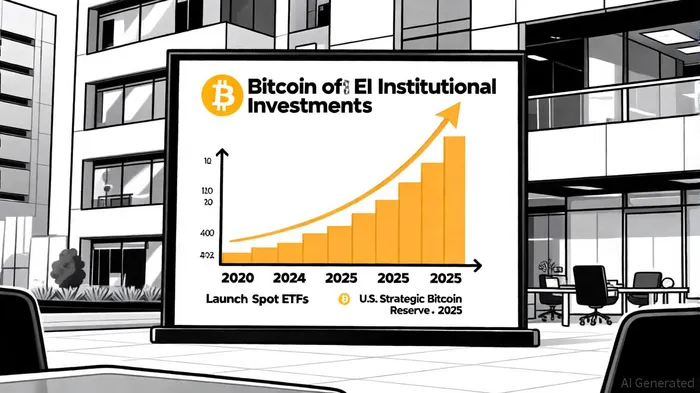
Government actions have further accelerated this shift. The U.S. Strategic Bitcoin Reserve, established in March 2025 under President Trump, has legitimized Bitcoin as a sovereign asset, while states like Texas and Arizona have launched their own Bitcoin reserve programs to diversify public treasuries [3]. Internationally, countries such as Bhutan and El Salvador are exploring Bitcoin as a tool for financial sovereignty, signaling a broader geopolitical realignment [3]. These developments have not only reduced regulatory uncertainty but also created a framework for sustained institutional demand.
Institutional Adoption: The Engine of Bitcoin's Bull Cycle
The institutionalization of Bitcoin has been the most transformative force in 2025. Spot Bitcoin ETFs, which debuted in early 2024, have become the primary vehicle for institutional access, with BlackRock's iShares Bitcoin Trust (IBIT) amassing $18 billion in assets under management (AUM) by Q1 2025 [1]. These products have provided a regulated, low-friction pathway for pension funds, endowments, and sovereign wealth funds (SWFs) to allocate capital to Bitcoin without navigating the complexities of direct custody.
SWFs, in particular, have emerged as a quiet but powerful driver of demand. Reports indicate that several state-owned entities have begun methodically accumulating Bitcoin as part of their diversification strategies, seeking to hedge against geopolitical instability and monetary expansion [1]. Even modest allocations from these entities—whose combined assets exceed $10 trillion—could create a floor for Bitcoin's price, ensuring long-term stability.
Corporate treasuries are also playing a pivotal role. Companies are increasingly allocating portions of their reserves to Bitcoin, leveraging institutional-grade custody solutions to mitigate risks associated with volatility. This trend is particularly pronounced in sectors exposed to currency instability, such as technology and multinational manufacturing [1].
Market Maturity and the Road to $200,000
Bitcoin's volatility profile has evolved dramatically in 2025, thanks to institutional participation. Studies suggest that annualized volatility has declined by 75% compared to earlier cycles, making Bitcoin a more palatable option for risk-averse investors [1]. This maturation has been accompanied by the development of new benchmarks and analytics tools, enabling institutions to systematically evaluate Bitcoin's role in diversified portfolios.
The implications for price are clear. Analysts project Bitcoin to reach $200,000 to $210,000 within 12 to 18 months, driven by continued institutional inflows and broader financial integration [1]. This trajectory is further reinforced by growing interest in stablecoins and tokenized assets, with 84% of surveyed institutions either utilizing or expressing interest in stablecoins for yield generation and transactional efficiency [2].
Conclusion
Bitcoin's path to a new all-time high in 2025 is not a speculative bet but a structural inevitability. The alignment of macroeconomic pressures, institutional adoption, and regulatory clarity has created a self-reinforcing cycle of demand that transcends traditional market dynamics. As governments and corporations continue to integrate Bitcoin into their financial strategies, the digital asset's role as a global store of value—and its price—will only continue to ascend.






Comentarios
Aún no hay comentarios