
Bitcoin's Path to Recovery: Is the $90K Threshold a Catalyst for Institutional Reentry?
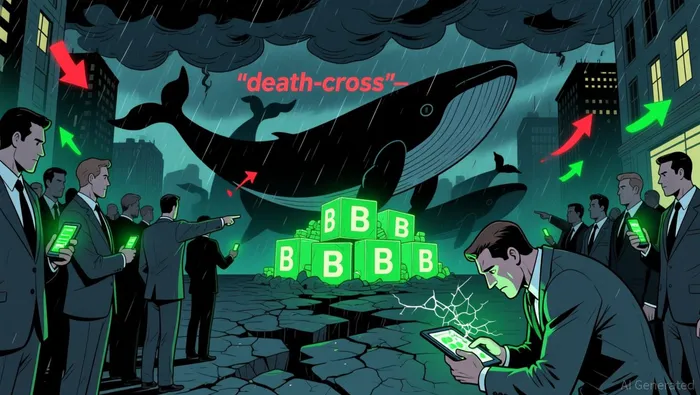
Bitcoin's price action around the $90,000 threshold in late 2025 has become a focal point for investors, traders, and institutional players alike. After a volatile year marked by macroeconomic uncertainty, ETF outflows, and shifting sentiment, the cryptocurrency now faces a critical juncture. The question looms: Can the $90K level act as a catalyst for institutional reentry, or will it signal further capitulation? To answer this, we must dissect the interplay between market sentiment, ETF inflow dynamics, and institutional behavior.
Market Sentiment: A Bearish Crossroads
Bitcoin's recent decline below $90,000 has intensified bearish sentiment, with traders pricing in a 50% probability that the asset will end 2025 below this level. This shift reflects broader macroeconomic concerns, including rising U.S. Treasury yields and uncertainty over the Federal Reserve's rate-cut timeline. The formation of a "death cross"-where the 50-day moving average fell below the 200-day average-has further amplified pessimism, historically signaling prolonged bearish momentum.
Retail sentiment has also deteriorated sharply. The crypto Fear & Greed Index hit an extreme fear level in late November, the lowest since 2022, as smaller traders de-risked positions. Meanwhile, long-term holders (LTHs) sold over 800,000 BTC in 30 days, indicating a rotation of capital from early adopters to newer institutional buyers. This internal market reallocation underscores a lack of consistent buying support, compounding downward pressure.
ETF Inflow Dynamics: A Tale of Two Trends
The U.S. spot BitcoinBTC-- ETF landscape has been equally volatile. While year-to-date inflows reached $23 billion as of November 2025, driven largely by BlackRock's IBIT, recent outflows have erased much of this progress. In late November alone, ETFs lost $3.5 billion, with IBIT recording a record $1.6 billion outflow. The flow-weighted average cost basis for these ETFs now sits at $89,600, meaning the price drop below this level has triggered widespread unrealized losses for both retail and institutional holders.
However, a glimmer of hope emerged in late November when ETFs recorded their first major inflow in weeks-$238 million on November 22-led by Fidelity's FBTC and Grayscale's Bitcoin Mini Trust. This rebound, though modest, suggests selective investor confidence. Yet, BlackRock's IBIT continued to hemorrhage assets, with a $122 million outflow on the same day, highlighting divergent institutional strategies.
Institutional Buying Activity: Contrarian Signals Amid the Chaos
Despite the selloff, some institutional players have taken a contrarian stance. BlackRock's acquisition of $62.23 million worth of Bitcoin through its subsidiaries in late November signaled long-term confidence. Similarly, Emory University increased its Bitcoin holdings via the Grayscale Bitcoin Mini Trust by $52 million. These moves contrast with broader outflows, suggesting that certain institutions view the current price as an attractive entry point.
Whale activity has also provided a counterbalance. Large Bitcoin holders accumulated nearly 45,000 BTC in recent days, indicating that long-term investors see value in the dip. This accumulation, however, has yet to offset the massive outflows from ETFs and corporate balance sheets, leaving the market in a fragile equilibrium.
The $90K Threshold: Catalyst or Crucible?
The $90K level holds both psychological and technical significance. Historically, it has served as a key resistance zone, and its breach in late 2025 has triggered a reevaluation of market fundamentals. For institutional reentry to occur, several conditions must align:
1. Stabilization of ETF Outflows: Sustained inflows, particularly from major players like BlackRockBLK--, would signal renewed institutional confidence.
2. Macro Support: A clearer Fed policy outlook or a pause in Treasury yield hikes could reduce risk-off behavior.
3. Whale Accumulation: Continued buying by large holders could provide a floor for prices, encouraging others to follow.
Analysts remain divided. Some argue that the $88K–$90K zone could act as a support level, with a potential retest or breakout depending on macroeconomic clarity. Others caution that the "death cross" and thin liquidity may prolong the downturn.
Conclusion: A Delicate Balance
Bitcoin's path to recovery hinges on whether the $90K threshold becomes a catalyst for institutional reentry or a symbol of capitulation. While recent outflows and bearish sentiment paint a grim picture, contrarian buying by whales and select institutions suggests that long-term conviction remains intact. The coming weeks will be critical: If ETF inflows stabilize and macroeconomic conditions improve, the $90K level could mark the beginning of a rebound. However, without a clear shift in institutional behavior, the market may remain in a consolidation phase, testing the resilience of both bulls and bears.





Comentarios
Aún no hay comentarios