
Bitcoin's Path to Parity with Gold: A Market Cap-Driven Investment Thesis
The debate between BitcoinBTC-- and gold as stores of value has intensified in 2025, as macroeconomic shifts and institutional adoption reshape their trajectories. While gold has long dominated with a $23.1 trillion market capitalization as of July 2025, according to a TalkMarkets report, Bitcoin's $2.4 trillion valuation-though smaller-has demonstrated exponential growth. This article examines Bitcoin's potential to narrow the gap with gold, driven by market cap trends, macroeconomic tailwinds, and evolving investor sentiment.
Market Cap Dynamics: A Tale of Two Assets
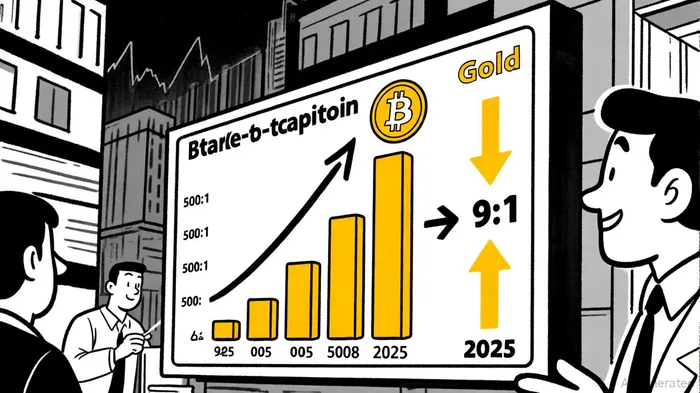
Gold's market cap, calculated by multiplying its above-ground supply (6.95 billion troy ounces) by its spot price ($3,387 per ounce as of October 2025, according to an EBC analysis), reflects its entrenched role as a global reserve asset. However, Bitcoin's market cap has surged by $124 billion in early October 2025 alone, as reported in a Cointelegraph report, fueled by spot ETF inflows and institutional demand. The gold-to-bitcoin ratio-a metric measuring how many ounces of gold are needed to buy one Bitcoin-has collapsed from over 500:1 in 2013 to 9:1 in 2025, according to a PocketOption analysis, signaling growing acceptance of Bitcoin as a digital alternative to gold.
Despite Bitcoin's rapid ascent, gold remains a safer bet in volatile markets. Its 15.44% volatility rate, according to a 99Bitcoins analysis, pales in comparison to Bitcoin's 24.58%, making gold a preferred hedge during geopolitical crises or economic downturns. Yet Bitcoin's 952% 5-year return far outpaces gold's 104%, attracting younger investors and speculative capital. Analysts project Bitcoin could capture 20% of gold's market cap by year-end 2025, but achieving parity would require a fundamental shift in institutional and retail adoption.
Macro Tailwinds: Dovish Policy and Dollar Weakness
The U.S. Federal Reserve's dovish pivot in 2025 has amplified demand for both assets. A 0.25% rate cut in September 2025, with further cuts expected in October and December, has weakened the U.S. dollar, making Bitcoin and gold more attractive as inflation hedges. The DXY index, which tracks the dollar's strength, has historically shown a stronger negative correlation with Bitcoin than with gold, suggesting Bitcoin's price is more sensitive to monetary policy.
Bitcoin ETFs have further accelerated this trend. U.S.-listed spot Bitcoin ETFs have attracted $14.2 billion in inflows by early October 2025, with BlackRock's iShares Bitcoin Trust alone adding $177.1 million in a single day. These inflows have notNOT-- only boosted Bitcoin's price but also reduced its volatility, signaling maturation of the asset class. Meanwhile, gold's rally to an all-time high of $4,000 per ounce in October 2025 reflects central banks' shifting reserves away from the dollar, particularly in emerging markets.
Expert Projections: A Future of Digital Gold?
ARK Invest's bullish 2030 forecast-$2.4 million per Bitcoin-hinges on Bitcoin capturing 60% of gold's $18 trillion market cap. This scenario assumes widespread institutional adoption, regulatory clarity, and Bitcoin's continued role as a decentralized store of value. Conversely, skeptics argue gold's physical tangibility and centuries-old utility in central bank reserves will ensure its dominance.
Historical adoption rates underscore Bitcoin's potential. From 2015 to 2025, Bitcoin delivered a 34,340% return, dwarfing gold's 203%. However, Bitcoin's volatility-exemplified by an 83% drawdown in 2018-remains a barrier for risk-averse investors. Gold, by contrast, has maintained stability, with drawdowns rarely exceeding 15%, as noted in the TalkMarkets report.
The Investment Thesis: Diversification in a New Era
Bitcoin's path to parity with gold is neither linear nor guaranteed. While macroeconomic factors and ETF-driven inflows favor Bitcoin's growth, gold's role as a stable, universally accepted asset is unlikely to diminish. Investors seeking asymmetric upside potential may overweight Bitcoin, while those prioritizing capital preservation may lean on gold. A balanced portfolio could leverage both assets: Bitcoin for its high-growth, low-correlation potential and gold for its resilience during systemic shocks.
As the Fed's dovish stance and dollar weakness persist, the race between Bitcoin and gold will hinge on institutional trust, regulatory frameworks, and global macroeconomic stability. For now, the market cap gap remains vast, but history shows that disruptive assets can redefine paradigms-especially when backed by innovation and demand.





Comentarios
Aún no hay comentarios