
Bitcoin's Path to $150,000 by 2026: A Macro-Driven Bull Case
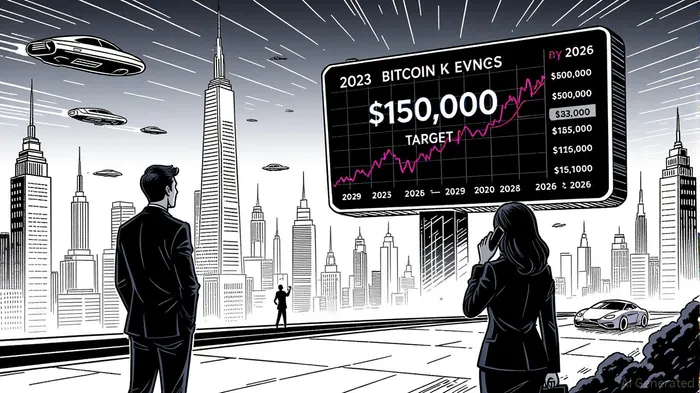
The convergence of global liquidity dynamics and accommodative monetary policy is creating a powerful tailwind for Bitcoin’s ascent toward $150,000 by 2026. As central banks pivot to ease financial conditions amid moderating inflation and geopolitical uncertainty, Bitcoin’s role as a hedge against fiat devaluation and a store of value is gaining institutional traction. Let’s break down the macroeconomic forces at play and why this trajectory is not just plausible but increasingly probable.
Global Liquidity Expansion: A Tailwind for Risk-Assets
Central banks have become the ultimate liquidity backstops in 2025, with the Federal Reserve, European Central Bank (ECB), and Bank of England (BoE) collectively slashing rates by 100–400 basis points to stabilize economies. The Fed maintained its federal funds rate at 4.25–4.5% through Q3 2025 while slowing its balance sheet runoff to $40 billion monthly (Treasury securities) and $35 billion (MBS), providing markets with much-needed flexibility [1]. Meanwhile, the ECB and BoE cut rates by 100 bps each, bringing policy rates closer to neutral levels [2]. These actions reflect a global shift toward liquidity expansion, which historically favors assets like BitcoinBTC-- that thrive in low-interest, inflationary environments.
Lower rates reduce the opportunity cost of holding non-yielding assets like Bitcoin, while quantitative easing (QE)-style balance sheet growth injects capital into markets. As noted by a 2025 BIS report, central banks are increasingly prioritizing financial stability over strict inflation targeting, a trend that amplifies Bitcoin’s appeal as a diversifier [3].
Bitcoin’s Institutional Adoption: A Self-Fulfilling Prophecy
Bitcoin’s Q2 2025 surge to $111,000 was fueled by institutional adoption, including the SEC’s approval of Ether ETF options and a record number of companies reporting Bitcoin holdings on balance sheets [4]. This trend is accelerating: Coinbase’s inclusion in the S&P 500 and Circle’s IPO signaled mainstream acceptance of crypto infrastructure, while tokenized assets like PAXG and real-world asset (RWA) products expanded Bitcoin’s utility beyond speculative trading [4].
The maturation of the crypto market is also evident in reduced volatility. Bitcoin’s average annualized volatility has fallen below 50% since 2023, compared to 70% during 2020–2022 [5]. This stability, combined with regulatory clarity (e.g., EU’s MiCA framework and the U.S. crypto task force under President Trump), is attracting institutional capital that prioritizes risk-adjusted returns over short-term speculation [6].
The 2024 Halving and Supply Dynamics: A Scarcity Premium
The 2024 Bitcoin halving, which reduced block rewards by 50%, is already influencing long-term price dynamics. With a 20% drop in new Bitcoin issuance, the network’s scarcity profile has strengthened, historically preceding multi-year bull runs. By 2026, this supply shock will compound with institutional demand, particularly as Bitcoin ETFs (approved in 2025) enable retail and institutional investors to gain exposure without holding private keys [7].
Macro Risks and the $150,000 Target
While risks like persistent inflation or geopolitical shocks remain, the macroeconomic tailwinds are robust. By late 2025, Bitcoin had already hit $111,842, with analysts forecasting a move toward $150,000 by year-end 2026 [8]. This projection hinges on three factors:
1. Continued rate cuts: The ECB and BoE are expected to ease further in 2026, while the Fed may follow if inflation remains below 3%.
2. Liquidity-driven capital flows: Central banks’ balance sheet expansions will likely persist, fueling demand for alternative assets.
3. Regulatory normalization: Clearer frameworks (e.g., MiCA, U.S. executive orders) will reduce friction for institutional entry.
Conclusion: A Macro-Driven Bull Case
Bitcoin’s path to $150,000 is not a speculative gamble but a logical outcome of global liquidity dynamics and institutional adoption. As central banks continue to act as liquidity providers of last resort, Bitcoin’s role as a hedge against fiat devaluation and a store of value will only strengthen. For investors, the question is no longer if Bitcoin can reach $150,000—it’s when.
Source:
[1] Monetary Policy Report – June 2025 [https://www.federalreserve.gov/monetarypolicy/2025-06-mpr-part2.htm]
[2] Global Liquidity EMEA Mid-Year Investment Outlook 2025 [https://am.jpmorganJPM--.com/us/en/asset-management/liq/insights/liquidity-insights/updates/global-liquidity-emea-mid-year-investment-outlook-2025/]
[3] New roles in central bank cooperation: towards a global ... [https://www.tandfonline.com/doi/full/10.1080/13563467.2025.2504400]
[4] 2025 Crypto Market: Q2 Review and Forecast [https://www.nasdaq.com/articles/2025-crypto-market-q2-review-and-forecast]
[5] Guide to Crypto Markets: Q1 2025 [https://www.coinbaseCOIN--.com/institutional/research-insights/research/market-intelligence/guide-to-crypto-markets-q1-2025]
[6] What to expect in crypto in 2025 - MastercardMA-- [https://www.mastercard.com/us/en/news-and-trends/stories/2025/what-to-expect-in-crypto-in-2025.html]
[7] Top 7 Cryptocurrency Trends (2025 and Beyond) [https://explodingtopics.com/blog/cryptocurrency-trends]
[8] Bitcoin Price Targets $150000 In 2025, But This Favoured Altcoin at $0.10 Could Surge Above $2 [https://coincentral.com/bitcoin-price-targets-150000-in-2025-but-this-favoured-altcoin-at-0-10-could-surge-above-2/]





Comentarios
Aún no hay comentarios