
Bitcoin's Path to $120,000: Can the Bulls Break the $113,000 Resistance and Ignite a New Bull Run?
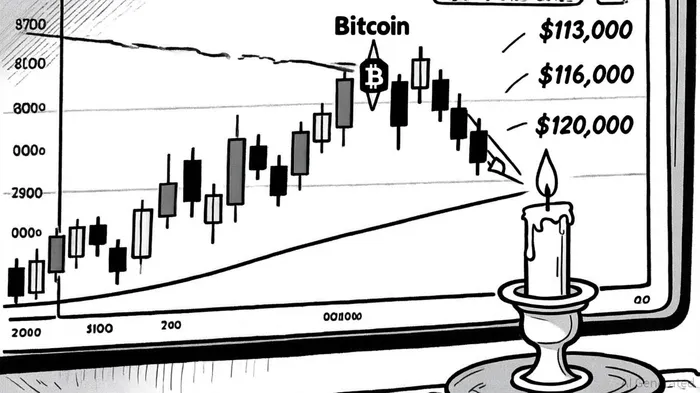
Bitcoin's price trajectory in late 2025 has become a focal point for traders and investors, with the $113,000 resistance level emerging as a critical battleground between bulls and bears. Technical analysts and macroeconomic observers alike are closely monitoring whether the cryptocurrency can overcome this psychological and structural barrier to reignite a bull run toward $120,000.
Technical Analysis: A Pivotal Resistance and Pattern Confirmation
From a technical perspective, the $113,000 level has acted as a dynamic inflection point. Rekt Capital notes that this price represents the neckline of an inverse Head and Shoulders pattern, a classic bullish reversal formation[1]. A daily close above $113,000 would confirm the pattern's validity, potentially propelling BitcoinBTC-- toward $116,000 and beyond. This projection aligns with Ali Martinez's analysis, which emphasizes that breaking through $113,000 could trigger a cascade of institutional buying and retail momentum, pushing the price toward $119,000[2].
However, Bitcoin's struggle to surpass $113,000 in recent weeks suggests a tug-of-war between buyers and sellers. Economies.com highlights that the resistance has “acted as a significant barrier,” with price action reflecting exhaustion in the bullish trend[3]. The consolidation phase, marked by declining volatility and rising institutional interest, indicates that market participants are awaiting a decisive catalyst to break the stalemate[4].
Macroeconomic Drivers: Policy, Inflation, and Institutional Adoption
Beyond technical indicators, Bitcoin's trajectory is deeply intertwined with macroeconomic forces. The U.S. Federal Reserve's policy decisions remain a linchpin. In early 2025, delayed rate cuts contributed to a sharp correction from $109,000 to $90,000 as investors adopted a risk-off stance[6]. Conversely, the Trump administration's pro-crypto executive order—announcing a Strategic Bitcoin Reserve—provided a tailwind, reinforcing investor confidence[2].
Inflation and interest rates continue to shape Bitcoin's narrative. Lower inflationary pressures, expected to ease by late 2025, could prompt rate cuts, increasing liquidity and potentially fueling altcoin rallies[5]. Meanwhile, Bitcoin's integration into traditional finance via ETFs and spot products has attracted institutional capital, offering a stabilizing effect[2]. This institutional adoption, coupled with reduced volatility, suggests a maturing market less susceptible to abrupt macro-driven shocks[4].
Geopolitical risks, such as new tariffs and geopolitical tensions, remain wild cards. These events have historically triggered sell-offs, underscoring the need for macroeconomic resilience to sustain a breakout above $113,000[4].
Convergence of Technical and Macro Signals
The interplay between technical and macroeconomic factors creates a compelling case for a potential $120,000 target. If Bitcoin closes above $113,650—a slight refinement of the $113,000 neckline—it could validate the inverse Head and Shoulders pattern and align with favorable macroeconomic conditions[6]. Institutional adoption and declining volatility further support the likelihood of a sustained rally, provided macroeconomic headwinds remain manageable.
However, risks persist. A failure to break above $113,000 could see Bitcoin retest lower support levels, particularly if inflationary pressures or geopolitical tensions resurge. Traders must also monitor the 200-day moving average and on-chain metrics like the MVRV ratio to gauge market sentiment[4].
Conclusion: A High-Stakes Inflection Point
Bitcoin's pathPATH-- to $120,000 hinges on its ability to conquer the $113,000 resistance—a level that encapsulates both technical significance and macroeconomic symbolism. While the technical setup and institutional tailwinds are encouraging, success will depend on a confluence of factors: a confirmed breakout, favorable Fed policy, and continued institutional adoption. Investors should remain vigilant, balancing optimism with risk management as the market approaches this pivotal juncture.






Comentarios
Aún no hay comentarios