
Bitcoin's Panic-Driven Sell-Off: A Strategic Buying Opportunity for Long-Term Investors
On-Chain Metrics Confirm Retail Capitulation and Institutional Accumulation
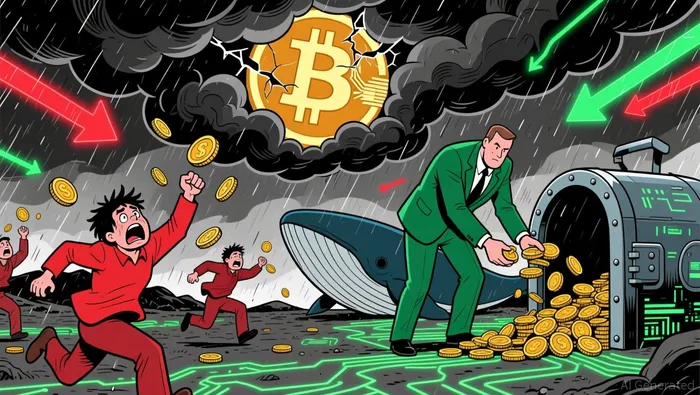 The current sell-off is characterized by classic capitulation patterns. Short-term holders (STHs)-investors holding Bitcoin for less than 155 days-have exhibited panic selling, with on-chain data revealing a surge in outflows from this cohort. Conversely, large holders ("whales") have accumulated over 375,000 BTC during the past 30 days of price weakness, while wallets holding 100 BTC (a proxy for institutional activity) have surged, indicating a transfer of wealth from retail to sophisticated investors.
Historically, such divergences precede major rallies. For instance, the 2018 bear market bottom saw similar STH outflows and whale accumulation before Bitcoin rebounded to $64,000 by 2021. Additionally, the Adjusted Spent Output Profit Ratio remains compressed between converging trendlines, suggesting the euphoria typically seen at cycle tops has not yet materialized-a divergence from prior bull runs that leaves room for a mid-cycle shakeout rather than a terminal bear market.
Macroeconomic Catalysts: Liquidity Squeezes and Policy Uncertainty
The sell-off is not purely crypto-driven. Broader macroeconomic factors, including the Federal Reserve's tightening policy and persistent inflation, have exacerbated Bitcoin's decline. The probability of a December rate cut has fallen below 40%, while a U.S. government shutdown has delayed critical economic data, amplifying uncertainty. However, these same conditions often create buying opportunities.
Bitcoin's historical performance shows it thrives in environments of monetary easing and geopolitical stability. For example, the 2020-2021 bull run coincided with unprecedented fiscal stimulus and a reduction in U.S.-China trade tensions. Similarly, the 2024 ETF-driven rally, which saw $4.5 billion in inflows, occurred amid a Fed pivot toward rate cuts. If and when policy makers signal a shift toward accommodative monetary conditions, Bitcoin's liquidity-squeeze phase-marked by a daily RSI of 18.8 and ETF outflows-could reverse.
Historical Precedents: Capitulation Phases as Tactical Lows
Bitcoin's history is defined by sharp corrections followed by explosive recoveries. The 2018 crash, which erased 84% of Bitcoin's value, was followed by a 20-fold rally into 2021. Similarly, the 2022 mid-cycle correction gave way to a 2024-2025 bull run fueled by spot ETFs. These rebounds were catalyzed by extreme fear metrics: in 2018, the Fear & Greed Index hit 10, while in 2022, it fell to 15. Today's reading of 21, while not an all-time low, aligns with historical levels that have historically preceded 50-100% price recoveries.
Moreover, miner behavior-a key on-chain indicator-suggests the worst may be over. Daily outflows from Satoshi-era miners have plummeted to 150 BTC in 2025, a fraction of the prior year's levels, indicating reduced selling pressure from early adopters. This contrasts with 2018 and 2022, when miner outflows spiked during capitulation phases.
Strategic Implications for Long-Term Investors
For long-term investors, the current environment presents a compelling case for accumulation. The combination of retail capitulation, whale accumulation, and macroeconomic uncertainty mirrors prior cycle bottoms, with Bitcoin's on-chain metrics suggesting the market is nearing a point of maximum pessimism. While the Fed's policy path remains uncertain, history shows Bitcoin's cycles are ultimately driven by liquidity and institutional adoption rather than short-term macro noise.
Investors should consider dollar-cost averaging into Bitcoin as the Fear & Greed Index remains in extreme fear territory and aSOPR divergences persist. Positioning now could capitalize on the next leg of the bull cycle, particularly if ETF inflows resume or a Fed rate cut is announced in early 2026.
Conclusion
Bitcoin's November 2025 sell-off, while painful for short-term holders, is a textbook capitulation phase marked by divergent on-chain behavior and macroeconomic headwinds. For long-term investors, this volatility is not a warning sign but a signal to act. As history demonstrates, the most significant returns in Bitcoin come from buying during moments of panic, not euphoria.






Comentarios
Aún no hay comentarios