
Bitcoin's Oversupply Crisis: Is $10,000 the New Floor?
The year 2025 marked a seismic shift in Bitcoin's trajectory, as the cryptocurrency faced its most brutal correction since the 2018 bear market. Amid a confluence of macroeconomic headwinds, geopolitical tensions, and structural vulnerabilities in the crypto ecosystem, Bitcoin's price plummeted from a peak of $126,080 to below $80,000 by year-end, erasing over $1 trillion in market value. This collapse has reignited debates about Bitcoin's role as a store of value, its susceptibility to speculative excess, and whether its fundamental scarcity can withstand the pressures of a maturing market.
Speculative Excess and the Fragility of Leverage
The October 2025 flash crash, which saw BitcoinBTC-- drop nearly 10% in a single day, exposed the fragility of leveraged positions in the crypto market. Over $19 billion in liquidations were triggered as funding rates surged to 30% due to prior overleveraging in EthereumETH-- and cross-margin systems. Unlike traditional markets, where deleveraging is gradual, crypto's unified margin models amplified the crisis, as losses in one asset cascaded across portfolios. This dynamic, combined with a 100% tariff threat on China and synchronized global liquidity unwinding, created a perfect storm of risk-off sentiment.
The speculative fervor leading up to the crash was fueled by bullish forecasts, including Bitwise's projection of $1.3 million by 2035. However, the market's reliance on leveraged retail and institutional speculation left it vulnerable to sudden macroeconomic shifts. As Tom Lee of Fundstrat noted, the death cross-a bearish technical signal-emerged as Bitcoin traded below its 50-day and 200-day EMAs, signaling a structural breakdown.
Liquidity Constraints and the Limits of Institutional Buffers
While spot Bitcoin ETFs and Digital Asset Treasuries (DATs) provided a partial buffer, liquidity constraints during the October crash revealed critical weaknesses. Intraday order-book depth for Bitcoin plummeted by 90%, forcing market makers to widen spreads or exit entirely. This fragmentation of liquidity contrasted sharply with the 2020-2023 downturns, where central bank interventions and gradual deleveraging mitigated volatility.
Institutional buyers, however, demonstrated resilience. DATs accumulated 42,000 BTC in December 2025, bringing their holdings to 1.09 million BTC. These purchases, coupled with ETF inflows, acted as a floor near $81,000, the aggregate cost basis for spot ETFs. Yet, the market's reliance on such buffers raises questions about its long-term stability. As VanEck's Matthew Sigel observed, the hash rate drop-a contrarian bullish signal-suggests weaker miners have exited the network, potentially signaling a bottom.
Safe-Haven Reassessment: Bitcoin vs. Gold
The October 2025 crash also upended traditional safe-haven narratives. Gold, long considered a reliable hedge, lost $2.5 trillion in market capitalization over two days-a decline exceeding Bitcoin's entire market cap at the time. This event challenged gold's status as a stable reserve asset and highlighted Bitcoin's unexpected resilience. While gold faltered, Bitcoin maintained a price above $100,000 during the crisis, suggesting a shift in investor preferences toward digital assets.
This shift is supported by Bitcoin's structural advantages. Its fixed supply of 21 million coins, combined with declining issuance post-halving, creates a scarcity profile that diverges from fiat currencies. On-chain metrics like the MVRV ratio further reinforce this narrative. Short-term holders' realized price of $113,000 acts as a critical support level, while long-term holders' unrealized gains suggest a potential peak near $165,000.
Investor Preparedness and the Path Forward
The November 2025 price drop, which erased 32% of Bitcoin's value, tested investor resolve. Institutional outflows, such as the $2.2 billion exodus from the iShares Bitcoin Trust, underscored the fragility of demand. Yet, on-chain data revealed a counter-trend: Coin Days Destroyed (CDD) spiked as older holders sold, but the Hodler Net Position Change turned positive as long-term investors began accumulating. This duality suggests a market in transition, where speculative trading is giving way to strategic, long-term positioning.
For 2026, the focus will shift to macroeconomic reflation and institutional adoption. Grayscale anticipates continued ETF inflows, which could stabilize Bitcoin's valuation. Meanwhile, Bitcoin's integration with energy markets-52.4% of mining now powered by renewables-positions it as a sustainable store of value.
Scarcity vs. Oversupply: A Tenuous Balance
Bitcoin's fundamental scarcity remains its most compelling argument. The 2025 halving reduced miner rewards, tightening supply and increasing the cost of production. Yet, the market's oversupply crisis-exacerbated by weak miner profitability and a $0.077 breakeven electricity cost for S19 XP ASICs- highlights the tension between scarcity and operational realities.
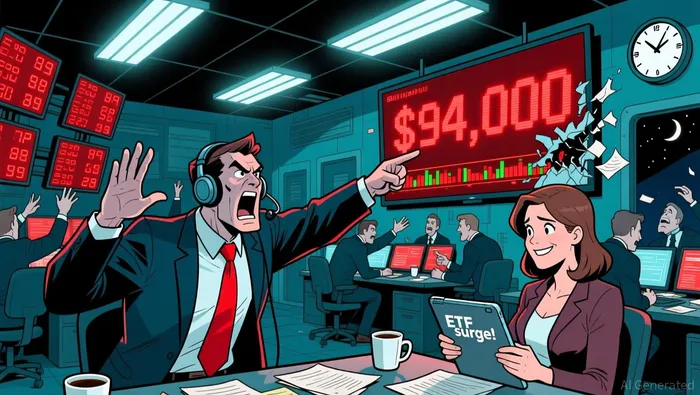
The path to $10,000, while extreme, is not inconceivable in a worst-case scenario. However, historical patterns and institutional adoption suggest a more likely floor near $80,000, supported by ETF cost bases and DAT accumulation. Bulls must reclaim the $94,000 resistance level to signal a recovery, but the broader narrative hinges on Bitcoin's ability to transition from speculative asset to strategic reserve.
Conclusion
Bitcoin's 2025 correction has laid bare the risks of speculative excess and liquidity fragility. Yet, its structural advantages-scarcity, institutional adoption, and a maturing market-suggest a resilient floor above $80,000. While $10,000 may represent a theoretical bottom in a catastrophic scenario, the data points to a more nuanced outcome: a consolidation phase where Bitcoin's role as a store of value is redefined. For investors, the key lies in balancing caution with conviction, recognizing that the crypto market's evolution is far from complete.







Comentarios
Aún no hay comentarios