
Why Bitcoin Still Outpaces XRP and Other Altcoins for Long-Term Accumulation
Institutional Adoption: Bitcoin's Unshakable Foundation
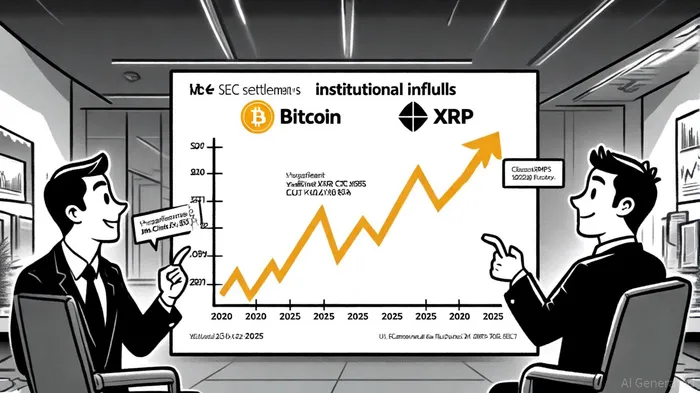
According to a Coingape report, Bitcoin attracted a staggering $724 million in weekly inflows in 2025, dwarfing XRP's $6.7 million inflow and Ethereum's $86 million outflow. This trend reflects institutional confidence in Bitcoin's proven track record as a store of value and hedge against macroeconomic volatility.
XRP, while showing promise in niche sectors like cross-border payments, faces headwinds. Despite CME Group's dominance in XRP futures (32% of open interest, or $1.47 billion in volume), institutional adoption remains fragmented, according to a U.Today report. Ripple Labs' ongoing $125 million SEC settlement further complicates XRP's appeal, creating regulatory uncertainty that deters large-scale investors, an Economic Times article notes. In contrast, Bitcoin's regulatory clarity-bolstered by ETF approvals and growing acceptance among traditional financial institutions-positions it as a safer bet for long-term allocation.
Strategic Asset Allocation: Store of Value vs. Speculative Utility
Strategic asset allocation hinges on balancing risk and reward. Bitcoin's role as "digital gold" aligns with conservative, long-term strategies, whereas altcoins often prioritize speculative utility. For instance, XRP's focus on cross-border payments has been undermined by competition from stablecoins and Central Bank Digital Currencies (CBDCs), as noted by the Economic Times. Meanwhile, projects like Remittix (RTX) and Best Wallet (BEST) are capturing early-stage value by offering decentralized, multi-chain solutions, according to a Cryptopolitan article.
Data from Cryptopolitan highlights this shift: Remittix's PayFi protocol, which enables real-time conversion between 40+ digital assets and 30+ currencies, has raised $14.2 million in its presale, challenging XRP's legacy in the payments sector. Similarly, Best Wallet's non-custodial platform and integrated crypto debit card have attracted $11 million in investor interest. These innovations underscore a growing preference for altcoins with decentralized governance and broader utility, yet Bitcoin's scarcity and first-mover advantage ensure it remains the default asset for institutional portfolios.
Early-Stage Value Capture: Bitcoin's Proven Track Record
While altcoins often promise exponential returns, Bitcoin's early-stage value capture remains unmatched. From 2020 to 2025, Bitcoin's price surged over 500%, driven by macroeconomic tailwinds and adoption by corporations like MicroStrategy and Tesla. In contrast, XRP's price stagnation-despite its $6.7 million inflow-reflects lingering doubts about its utility beyond niche use cases, as highlighted in the Coingape report.
Emerging altcoins like RTX and BEST are capitalizing on gaps in XRP's ecosystem. For example, Best Wallet's integration of portfolio management tools and real-time market insights appeals to retail investors seeking active participation, a trend the Economic Times has covered. However, these projects remain high-risk, with valuations heavily dependent on speculative demand. Bitcoin, by contrast, offers a more predictable trajectory, with its supply capped at 21 million and its value increasingly tied to global monetary policy.
Conclusion: Bitcoin's Enduring Edge
Bitcoin's dominance in institutional adoption, strategic asset allocation, and early-stage value capture is not a temporary phenomenon but a reflection of its unique position in the crypto ecosystem. While XRP and altcoins like RTX and BEST offer innovation, they struggle to match Bitcoin's regulatory resilience, liquidity, and institutional trust. For investors prioritizing long-term accumulation, Bitcoin remains the bedrock of a diversified crypto portfolio.






Comentarios
Aún no hay comentarios