
Bitcoin's Open Interest Drop: A Buying Opportunity or a Bearish Signal?
Bitcoin's open interest (OI) has experienced a dramatic contraction in late 2025, with over $8 billion in leveraged positions liquidated during a sharp correction. This decline, coupled with a 30% drop in Bitcoin's price from its October peak of $126,000 to below $90,000, has sparked debate: is this a bearish signal of speculative exhaustion, or a buying opportunity for long-term investors? To answer this, we must dissect the interplay between market dynamics, protocol-driven resilience, and institutional behavior.
The Bearish Case: Deleveraging and Liquidity Challenges
The late 2025 OI drop reflects a painful but necessary cleansing of excessive speculation. Over $19 billion in open interest vanished in a single 24-hour period in early October, driven by cascading liquidations as Bitcoin's price plummeted. This deleveraging event normalized leverage levels, but it also exposed fragility in the derivatives market. Stablecoin supply contracted by $4.6 billion since November 1, and ETF outflows reached $3.5 billion in the same month, signaling reduced institutional cushioning for price stability.
Negative funding rates in perpetual futures markets further underscored bearish sentiment. These metrics suggest a maturing market, where sharper volatility becomes the norm as BitcoinBTC-- transitions from speculative asset to institutionalized store of value. However, the immediate pain of liquidations and liquidity crunches cannot be ignored.
The Bullish Case: Institutional Accumulation and Protocol-Driven Resilience
While the OI drop signals short-term pain, it also reveals long-term opportunity. Institutional and "whale" investors have increased their share of total supply, strategically accumulating Bitcoin at discounted levels. This contrasts with the capitulation of leveraged funds and retail traders, who now account for a smaller portion of market activity. Historically, such redistribution phases have preceded multi-month base formations, provided ETF flows stabilize and spot demand holds above $84,000.
Bitcoin's protocol-driven resilience further supports a bullish outlook. 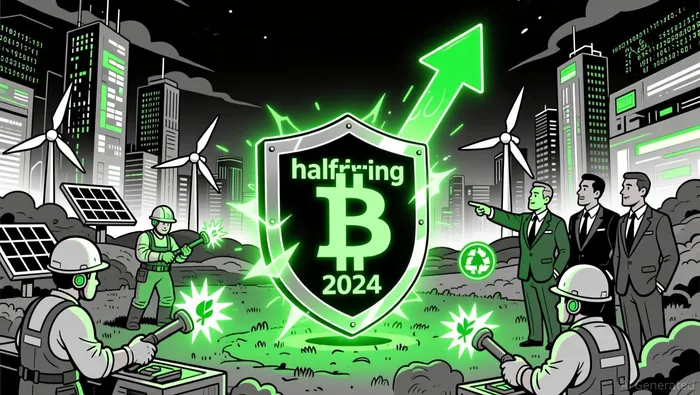 The 2024 halving, which cut block rewards from 6.25 BTC to 3.125 BTC, reinforced Bitcoin's scarcity model. This event temporarily alleviated miner margin pressures and triggered a price surge from $64,000 to $109,000. While smaller miners exited the market, larger operations adapted through M&A and next-generation ASICs, ensuring network security and hash rate growth. Over 55% of mining now runs on renewable energy, enhancing Bitcoin's environmental and economic sustainability.
Protocol Upgrades: Enhancing Resilience Beyond Scarcity
Beyond halvings, Bitcoin's 2024–2025 protocol upgrades have bolstered its long-term value proposition. The Taproot upgrade (2021), which introduced Schnorr signatures and improved privacy, enabled more efficient multi-signature transactions. However, it also inadvertently facilitated the creation of Ordinals and BRC-20 tokens, which strained block space and fees. Despite these challenges, the Bitcoin community adapted, demonstrating resilience in governance and innovation.
Layer-2 solutions, such as the Lightning Network, have also expanded Bitcoin's utility as a payment rail. These upgrades reduce reliance on on-chain transactions, lowering fees and improving scalability. For long-term investors, this means Bitcoin's role as both a store of value and a medium of exchange is becoming increasingly decoupled from short-term volatility.
Investor Behavior: HODLing Through the Storm
Historical patterns suggest that Bitcoin's price corrections often precede recovery phases. Since 2017, the asset has experienced over ten drops exceeding 25%, yet its long-term trend remains upward. Institutional actors, including El Salvador and MicroStrategy, have continued accumulating Bitcoin during the 2025 downturn, signaling enduring conviction. Meanwhile, the "HODL" mindset-rooted in the 2012 halving-has evolved into a strategic approach, with investors prioritizing long-term value retention over short-term speculation.
Conclusion: A Buying Opportunity for the Patient
Bitcoin's open interest drop in late 2025 is a bearish signal in the short term, reflecting speculative exhaustion and liquidity challenges. However, for long-term investors, it represents a buying opportunity. Institutional accumulation, protocol-driven scarcity, and network resilience-bolstered by halvings and upgrades-create a foundation for sustained value retention. While volatility persists, the maturing market is increasingly dominated by strategic, non-speculative actors who view Bitcoin as a hedge against inflation and currency depreciation.
As the market consolidates around $100K–$105K, patient investors may find themselves positioned for a potential rally to $120K–$140K by year-end. The key lies in distinguishing between temporary pain and permanent value-a lesson Bitcoin's protocol and history have taught time and again.







Comentarios
Aún no hay comentarios