
Bitcoin OG Whale Activity and Its Implications for Market Volatility
On-Chain Signals: Structural Shifts and Selling Pressure
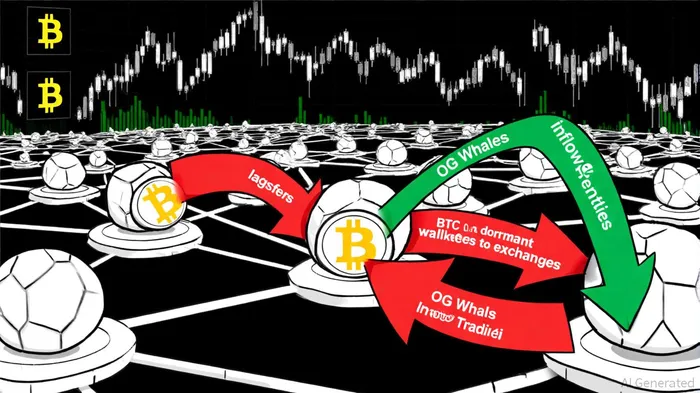
Bitcoin OG whales have demonstrated a clear trend of transferring dormant holdings to active wallets and exchanges. Over 240,000 BTC-valued at hundreds of millions of dollars-was moved from wallets inactive for over seven years in a 30-day window in Q4 2025, signaling a structural shift toward traditional finance (TradFi) absorption, according to a Coinotag report. This activity has created resistance near key price levels, capping Bitcoin's upside momentum and contributing to a range-bound trajectory.
A notable example is the reactivation of a 14-year-old wallet holding 80,000 BTC, which was transferred during a price peak, as Coinotag noted. Such movements reflect a broader trend: OG whales are not liquidating entirely but instead leveraging their holdings through staking, lending, or strategic sales to traditional institutions. This shift reduces immediate liquidity risk but introduces complexity in predicting short-term price action.
Liquidity Risk Frameworks: Institutional Strategies
Institutional investors have adapted to these dynamics by integrating on-chain whale activity into liquidity risk management frameworks. When whales move large quantities of Bitcoin to exchanges, it often signals potential selling pressure, prompting automated trading algorithms to adjust bids or trigger stop-loss orders, according to a OneSafe analysis. Conversely, withdrawals to cold storage are interpreted as long-term bullish signals, stabilizing market sentiment.
For instance, Owen Gunden's aggressive offloading of 5,803 BTC to Kraken-worth $649.6 million-highlighted liquidity risks as a major holder shifted from cold storage to an exchange, according to a Yahoo Finance report. Meanwhile, other whales, like the "100% win rate whale," have adopted leveraged strategies, such as a $250.7 million 13x long BTC position, showcasing the sophistication of institutional-grade crypto trading in a LookOnChain feed. These diverging approaches underscore the dual nature of liquidity risk: profit-taking by some whales can coexist with speculative bets by others.
Quantitative models from 2025 further refine these strategies. Whale transactions exceeding 1,000 BTC are now correlated with 0.5–2% price swings, depending on market liquidity, according to Yellow research. ETF inflows, meanwhile, have introduced smoother demand patterns; that research finds flows generating a 1.2% price increase over 3–4 days compared to the acute volatility caused by whale-driven sales. Institutions now use a hybrid approach, monitoring both whale activity and ETF flows to balance short-term volatility with medium-term trends.
Case Studies: The August 2025 Flash Crash and Portfolio Rotation
The August 2025 flash crash, triggered by a 24,000 BTC sale, serves as a cautionary tale. The transaction consumed $550 million in order-book depth, leading to a 5% price drop and triggering leveraged liquidations, as noted in Yellow research. This event reinforced the need for robust risk management tools, such as dynamic stop-loss orders and portfolio diversification across stablecoins and traditional assets, according to the OneSafe analysis.
Conversely, Jump Crypto's swap of 1.1 million SOL for 2,455 BTC ($265 million) exemplifies strategic portfolio rotation toward Bitcoin, reducing exposure to volatile altcoins while capitalizing on Bitcoin's scarcity, as Blockonomi reported. Such moves highlight how whales are adapting to macroeconomic factors, including Fed rate decisions, to mitigate liquidity risks.
Conclusion: Navigating the New Landscape
Bitcoin OG whale activity in 2025 has redefined liquidity risk and volatility dynamics. While structural shifts toward TradFi absorption reduce immediate selling pressure, the coexistence of leveraged strategies and ETF-driven demand creates a complex environment. Investors must adopt frameworks that combine on-chain monitoring, quantitative models, and macroeconomic analysis to navigate this landscape. As the market evolves, the interplay between OG whales and institutional players will remain a defining factor in Bitcoin's trajectory.







Comentarios
Aún no hay comentarios