
Bitcoin's November 2025 Pullback: Tactical Entry Points Amid Fragile Liquidity and Key Support Levels
Bitcoin's 2025 November selloff-a 23% collapse from $126,000 to $80,553-has created a volatile but potentially lucrative environment for risk-managed investors. While the market grapples with thinning liquidity, bearish derivatives positioning, and macroeconomic headwinds, on-chain data and structural fundamentals suggest a tactical opportunity for those willing to navigate the chaos. This analysis synthesizes price structure, liquidity profiles, and institutional dynamics to identify key support levels and entry strategies ahead of a potential rebound.
Key Support Levels: The $89,400 and $82,400 Anchors
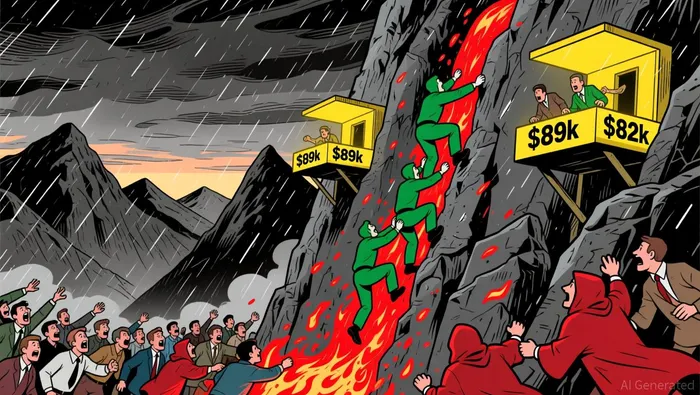
Bitcoin's recent price action has been defined by two critical support zones: $89,400 (Active Realized Price) and $82,400 (True Market Mean Price) identified by analyst Joao Wedson of Alphractal. These levels, identified by analyst Joao Wedson of Alphractal, represent historical inflection points where buying pressure has historically materialized.
- $89,400: This level served as a strong support during prior cycles and was tested in late November as BitcoinBTC-- failed to reclaim the $93,000–$94,000 resistance band according to analysis. A successful hold here could trigger a short-term rally toward $93,000, while a breakdown would likely target $85,000 as analysts predict.
- $82,400: A deeper structural support level, this represents the true average cost of Bitcoin's circulating supply. If Bitcoin breaches $89,400, this level becomes the next critical line of defense. A worst-case scenario, modeled via Cumulative Value Days Destroyed (CVDD), suggests a potential slide toward $45,500 as analysts report, though such a move would require a systemic collapse in macroeconomic conditions.
On-chain data reinforces the fragility of Bitcoin's current range. The asset is trading within a $81,000–$91,000 band, with cost-based support levels being tested by aggressive selling from short-term holders according to on-chain analysis. This volatility reflects a "final shakeout" phase, where weak hands are flushed out before a potential trend reversal as analysts observe.
Liquidity crisis: Thin order books and bearish derivatives
Bitcoin's liquidity profile in November 2025 has deteriorated sharply. Market depth across the top 30 exchanges has fallen by 25% in two months, reaching its lowest point of 2025 according to CEX.io analysis. This thinning has amplified price swings, with even minor sell orders triggering outsized downward moves as market data shows.
Derivatives markets further underscore the bearish sentiment. Funding rates for perpetual contracts normalized during November 18–19, but open interest fluctuated wildly, driven by short positions according to research. The collapse of synthetic stablecoins like USDeUSDe-- (which briefly de-pegged to $0.65) exacerbated liquidations, exposing leveraged positions and compounding downward pressure as market analysis indicates.
However, institutional adoption offers a counterbalance. U.S. spot Bitcoin ETFs have injected $732 billion in net new capital since 2022, tightening spreads and smoothing price movements according to 247WallSt. This institutional inflow, combined with long-term holder accumulation including "Great Whales" adding 36,000 BTC and El Salvador purchasing $100 million in Bitcoin, suggests the market is not yet in a full bear phase but rather undergoing a mid-cycle reset.
Tactical Entry Points: Risk-Managed Strategies for a Rebound
For investors seeking to capitalize on Bitcoin's pullback, the following strategies align with the current price structure and liquidity dynamics:
- $89,400–$88,000 Range:
- Rationale: This zone represents a high-probability area for a short-term rebound. If Bitcoin holds above $89,400, it could retest $93,000–$94,000 resistance.
Execution: Use limit orders or small-position entries with tight stop-losses below $88,000. Position sizing should reflect the elevated volatility and liquidity risks.
$82,400–$80,000 Range:
- Rationale: A breakdown to this level would signal a deeper correction but could attract institutional buyers seeking discounted entry points.
Execution: Consider dollar-cost averaging into this range, prioritizing liquidity (e.g., using ETFs or centralized exchanges with deeper order books).
Macro-Driven Catalysts:
- Fed Policy Shifts: A December rate cut currently priced at 22% could trigger a short-covering rally. Monitor Fed statements and economic data for timing.
- ETF Flows: While November saw $3.5 billion in ETF outflows according to market data, a reversal in this trend could signal renewed institutional confidence.
Conclusion: Navigating the Chaos for Long-Term Gains
Bitcoin's November 2025 selloff has created a high-risk, high-reward environment. While liquidity fragility and macroeconomic uncertainty persist, the structural fundamentals-ETF adoption, long-term holder accumulation, and a resilient on-chain network-suggest this is a mid-cycle correction rather than a bear market.
For risk-managed investors, the key is to balance caution with conviction. Entering near $89,400 or $82,400 requires discipline, but the potential reward-a rebound toward $93,000 or higher-justifies the tactical approach. As always, position sizing, stop-loss orders, and macroeconomic monitoring are critical to surviving the volatility and capitalizing on the inevitable rebound.






Comentarios
Aún no hay comentarios