
Bitcoin's November 2025 Outlook: Navigating Fed Uncertainty and Seasonal Strength
The Fed's Shadow Over Consolidation
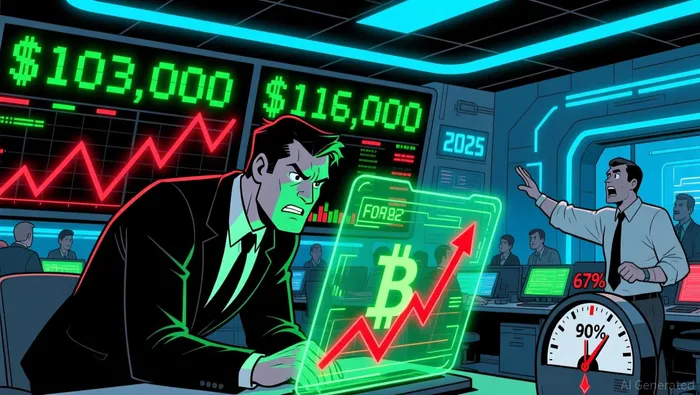
Bitcoin's recent 11.09% decline over 30 days, despite a 3.6% 24-hour rally, underscores the market's struggle to balance bullish narratives with Fed-driven caution, according to Sherwood News. The CME FedWatch Tool now assigns a 67.9% probability to a December rate cut-a sharp drop from near 90% in prior months, as reported by Coinotag. This uncertainty has shifted capital toward safer assets like bonds, dampening Bitcoin's risk-on appeal. Bitfinex analysts argue that this sideways movement is a "stabilizing precursor to renewed volatility," but failure to reclaim the $116,000 level could erode bullish sentiment, as Coinotag noted.
The Fed's September 2025 rate cut, however, has paradoxically bolstered Bitcoin's case as a digital safe-haven asset. With core inflation persisting in developed economies and geopolitical tensions escalating, investors are increasingly viewing BitcoinBTC-- as an alternative to traditional safe-haven assets like gold, according to Bitget. This duality-Bitcoin as both a speculative play and a macro hedge-creates fertile ground for contrarian strategies.
Contrarian Positioning: Derivatives and Institutional Hedges
Institutional investors are adopting nuanced tactics to navigate this environment. Derivatives markets have become a key battleground, with put options and over-the-counter (OTC) trades offering downside protection. For instance, IcoBeast's $1 million MegaETH allocation was revoked after he openly discussed hedging via put options-a move that projects short-termism, as Coinotag reported. This highlights a growing trend: institutional allocations increasingly penalize hedging, favoring long-term commitment.
Contrarians, however, may find value in this pullback. If Bitcoin's 30-day decline reflects overcorrection, the $103,000 level could serve as a strategic entry point. Cathie Wood's revised 2030 target of $1.2 million (down from $1.5 million) underscores the long-term narrative, though stablecoin competition remains a wildcard, as Fool reported. Meanwhile, Ether ETF inflows of $9.6 billion and JPMorgan's BTC accumulation via BlackRock's trust signal institutional confidence, as Bitget reported.
Seasonal Strength vs. Macro Realities
November has historically been Bitcoin's strongest month, averaging a 41.78% gain since 2013, according to Coinotag. Yet 2025's context is unique: geopolitical instability and Fed ambiguity are reshaping risk appetites. The Senate's shutdown resolution and Trump's political influence have briefly reignited optimism, but these factors are volatile. Investors must weigh short-term catalysts against the likelihood of prolonged consolidation.
A contrarian approach here involves dollar-cost averaging into Bitcoin during pullbacks, while using derivatives to hedge against Fed-driven volatility. For example, a long Bitcoin position paired with a short Treasury futures contract could profit from divergent macro outcomes, as Coinotag noted. This strategy mirrors how traditional investors hedge equity portfolios during earnings seasons.
Conclusion: A Delicate Balance
Bitcoin's November 2025 outlook is a study in contrasts. The cryptocurrency's historical seasonal strength and institutional adoption offer compelling long-term arguments, but Fed uncertainty and macroeconomic fragility demand caution. Contrarian investors who position against the prevailing narrative-buying during consolidation while hedging against rate hikes-may find themselves well-placed for a potential rebound. As always, the key lies in aligning tactical flexibility with a clear-eyed assessment of both risks and rewards.







Comentarios
Aún no hay comentarios