
Bitcoin News Today: Whales Accumulate Bitcoin as Fear Index Hits 20, Signaling Potential Rally
Bitcoin's recent price movements have drawn attention as CryptoQuant highlights a notable buying phase by large investors, commonly referred to as whales. These investors are accumulating BitcoinBTC-- during a period of market volatility, signaling potential for a future price rally. The firm's CEO, Ju Ki-young, noted that whale activity has increased significantly since early 2025, with larger transactions appearing on major exchanges according to the firm's data.
Retail investors, meanwhile, are displaying a contrasting pattern, often buying at peaks and selling during downturns, contributing to the cryptocurrency's overall instability. This dynamic has been reflected in the Crypto Fear & Greed Index, which currently sits at 20-indicating an environment of extreme fear according to market analysis. Traditional investors, by contrast, have shown resilience, continuing to invest in Bitcoin through exchange-traded funds (ETFs) even amid uncertainty.
The market's behavior underscores a growing divergence in strategies between retail and crypto-native investors. The latter often act impulsively during downturns, while traditional investors take a more calculated approach. This behavioral difference is shaping market sentiment.
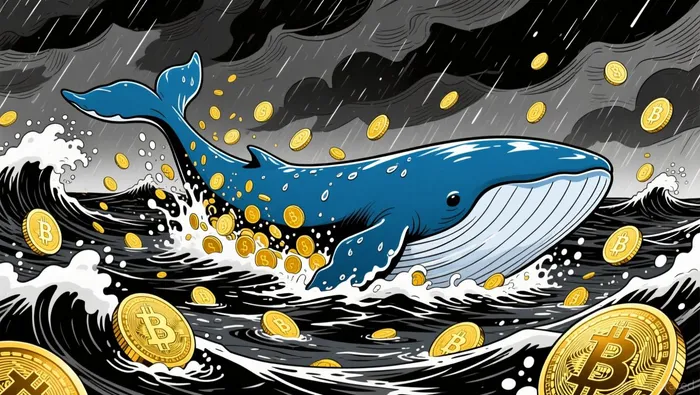
Whale Accumulation and Historical Precedents
Whale accumulation has historically signaled potential bullish phases for Bitcoin. In previous cycles, large investors began buying during market bottoms, eventually driving the price higher. For instance, during the 2018–2019 bear market, whale activity preceded Bitcoin's recovery from $3,200 to $14,000. A similar pattern was observed in early 2020 before the asset surged to $64,000 in April 2021 according to market data. CryptoQuant's analysis suggests that the current whale accumulation appears more measured than in past cycles, possibly reflecting the increased sophistication of institutional investors according to their framework.
The firm's market cycle framework outlines six distinct phases, and according to their latest analysis, the market has transitioned from a retail capitulation phase to a whale accumulation phase. This shift is significant because it typically precedes a period of reduced selling pressure and renewed demand from large holders.
Market Psychology and Institutional Influence
Market psychology plays a key role in investor behavior during transitions between market phases. Retail investors often feel fear during early accumulation periods, especially when price appreciation is gradual. This psychological dynamic can create opportunities for more patient investors while testing the resolve of those with shorter time horizons. Institutional adoption has also changed the landscape, with traditional financial firms and asset managers entering the space in greater numbers since 2020. This increased presence may moderate price volatility and extend accumulation and appreciation phases according to market reports.
In addition, macroeconomic factors such as the potential approval of more Bitcoin ETFs and regulatory clarity are creating favorable conditions for whale activity. The upcoming Bitcoin halving event, expected in 2024, is another factor influencing investor strategies. Historically, halving events have led to supply constraints, which large investors often anticipate through pre-halving accumulation.
Risks and Uncertainties in the Outlook
Despite the optimism surrounding whale activity, several risks remain. Regulatory developments, macroeconomic conditions, and technological advancements could influence market trajectories in unpredictable ways. For example, Federal Reserve policies and global trade tensions are currently keeping risk appetite subdued, contributing to the current climate of fear. Additionally, the increasing sophistication of market participants means that historical patterns may not repeat exactly according to market analysis.
Investors should remain cautious, as whale activity does not guarantee a price increase. Market dynamics involve numerous variables beyond large investor behavior, including technological innovations and global economic shifts. Retail investors are advised to consider whale accumulation as one data point within a broader investment strategy and to maintain disciplined approaches aligned with their financial goals.
Implications for the Broader Market
The current phase of whale accumulation is occurring within a more mature market structure. Institutional participation has risen sharply, with corporations and traditional financial players building significant positions in Bitcoin. This trend is likely to continue, driven by the growing availability of custody solutions, regulatory frameworks, and trading mechanisms according to market data. The derivatives market, in particular, has expanded significantly, providing sophisticated tools for risk management that were less available in previous cycles according to industry analysis.
Market infrastructure improvements have also made large-scale accumulation more feasible for institutional investors. These include better custody solutions and the development of more advanced trading platforms. As a result, whales are better positioned to execute long-term strategies without the same level of operational risk they faced in earlier cycles according to industry reports.
What This Means for Investors
For investors, the current market environment offers both opportunities and challenges. On one hand, whale accumulation suggests a potential for future price appreciation. On the other, the market remains subject to volatility and uncertainty, especially with ongoing regulatory and macroeconomic uncertainties. Investors should focus on long-term strategies and remain attuned to market dynamics while avoiding attempts to time the market precisely.
CryptoQuant's analysis underscores the importance of understanding behavioral dynamics in the market. By recognizing the psychological effects of prolonged fear-such as panic selling and herd behavior-investors can make more rational decisions. Focusing on diversified portfolios and hedging strategies can also help mitigate risks associated with market swings.







Comentarios
Aún no hay comentarios