
Bitcoin News Today: VanEck's Sigel Says MARA Trades at Bitcoin Premium Despite Debt Load
MARA Holdings (MARA) is under growing scrutiny as some investors perceive it as undervalued. Matthew Sigel, head of digital assets research at VanEck, argues otherwise, saying the company is actually trading at a premium to its bitcoinBTC-- holdings after factoring in its debt according to the report. With $3.3 billion in convertible debt and $4.9 billion in bitcoin holdings, MARA's net value is significantly lower than its $4.7 billion market cap as reported. Sigel's analysis suggests that MARA's capital structure is a key driver of its volatility.
The company recently reported a record second-quarter revenue of $238.5 million, a 64% increase year-over-year, driven by a 50% rise in the average bitcoin price. Despite the strong earnings, Sigel emphasizes that MARA's performance is less tied to bitcoin's price and more to its complex financing structure according to research. This distinction has raised questions about the stock's true exposure to the cryptocurrency market.
MARA's high short interest, currently at 27%, is also a focal point. Sigel points out that this figure drops to about 15% when adjustments for delta hedging are considered as data shows. Unlike MSTR, which has $8 billion in convertible debt but a $53 billion market cap, MARA's leverage appears more structural according to analysis. This dynamic highlights the unique risk profile of the two companies in the bitcoin space.
Capital Structure and Short Interest
MARA's capital structure is a major factor in its stock volatility. Sigel notes that over half of the company's equity volatility stems from its financing dynamics rather than pure exposure to bitcoin according to findings. 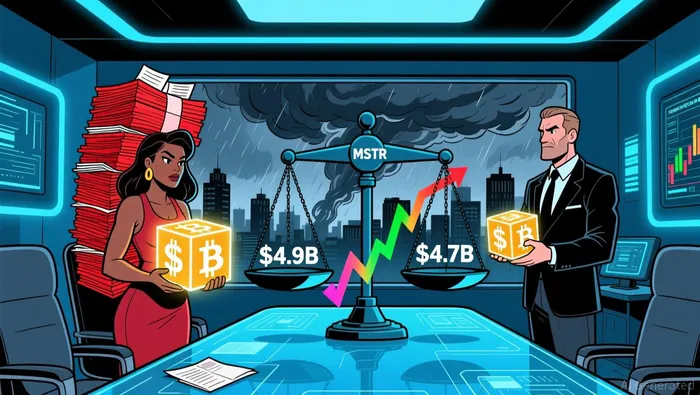 With $3.3 billion in convertible debt, MARA's net bitcoin value is significantly reduced, standing at around $1.6 billion before accounting for mining liabilities as calculated. This means the stock is actually trading at a premium compared to its net bitcoin holdings.
Short interest is another key indicator. While MARA's short interest is high at 27%, Sigel argues that this is more structural compared to MSTR's, which he attributes to fundamentals according to analysis. After accounting for delta hedging, MARA's short interest falls to about 15%, a reduction of 44% as noted. This suggests that the market is more cautious about MARA's capital structure than its core business operations.
Market Dynamics and Investor Sentiment
MARA's recent earnings report highlights the company's resilience in the face of market volatility. The firm's Q2 revenue of $238.5 million beat Wall Street expectations, driven by a 50% increase in the average bitcoin price. MARAMARA-- mined 2,358 bitcoin in the quarter, with its energized hashrate rising by 6% to 57.4 EH/s as reported. The company holds nearly 50,000 BTC, worth almost $6 billion at current prices as estimated. These figures underscore MARA's significant presence in the bitcoin mining sector.
Despite these positive metrics, Sigel maintains that MARA's stock is not as attractive as it seems. The company's market cap of $4.7 billion is higher than its net bitcoin value after accounting for debt according to analysis. This discrepancy suggests that investors are overvaluing the company relative to its actual holdings. Sigel's analysis points to a need for greater caution among investors considering MARA as a discounted bitcoin play.
Risks to the Outlook
MARA's capital structure poses a significant risk to its long-term outlook. The company's $3.3 billion in convertible debt creates a structural imbalance that affects its stock performance as found. Unlike MSTR, which has a much higher market cap relative to its debt, MARA's leverage is more pronounced according to data. This dynamic could lead to greater volatility and higher risk for investors.
The structural nature of MARA's short interest also adds to its risk profile. While the short interest is high at 27%, the reduction to 15% after hedging adjustments indicates a level of market uncertainty as observed. This uncertainty is compounded by the company's complex capital structure, which can create mismatches between equity value and underlying asset performance.
Sigel's analysis highlights the importance of understanding capital structures when evaluating publicly traded companies that hold bitcoin according to research. Investors should be wary of perceived discounts, as they may not accurately reflect the company's true value when debt is factored in. This insight is particularly relevant for MARA, given its current valuation and market dynamics.





Comentarios
Aún no hay comentarios