
Bitcoin News Today: Tether's High-Risk Reserves Test Stablecoin Stability
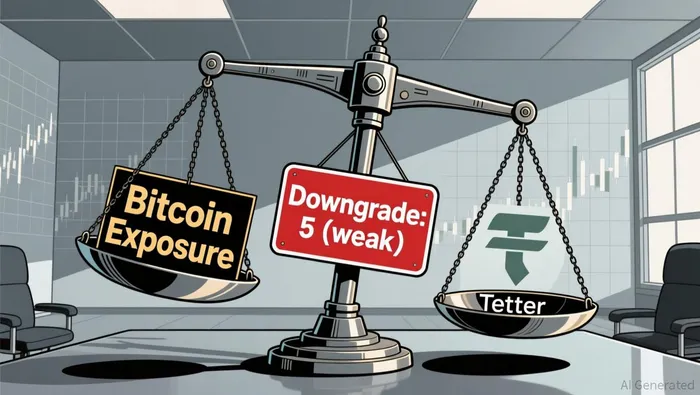
Tether's USDTUSDT--, the world's largest stablecoin, has been downgraded to the lowest possible rating of "5 (weak)" by S&P Global, a move that underscores growing scrutiny over its reserve composition and transparency. The ratings agency cited an increase in high-risk assets within Tether's reserves-such as BitcoinBTC--, gold, secured loans, and corporate bonds-and "persistent gaps in disclosure" as key factors in the downgrade. This marks a significant shift from its previous "4 (constrained)" rating, reflecting concerns that Tether's exposure to volatile or illiquid assets could undermine its ability to maintain a stable peg to the U.S. dollar.
The downgrade arrives as TetherUSDT-- faces broader challenges in its operations. The firm, which claims to hold $184 billion in USDT in circulation, has expanded its exposure to Bitcoin, with the cryptocurrency now accounting for 5.6% of its reserves- a level exceeding the 3.9% overcollateralization margin outlined by S&P analysts. This dynamic, they warned, could leave the stablecoin undercollateralized if Bitcoin's value declines further, potentially destabilizing the peg. Tether, however, has defended its practices, emphasizing quarterly independent attestations since 2021 and stating it has never refused a redemption request from a verified user.
Tether's recent financial maneuvers also highlight its evolving strategy. In November, the firm resumed buying shares in Bitdeer, a Bitcoin miner turned AI factory, acquiring 1.89 million shares in open-market purchases after earlier selling 7.7 million shares for $166 million in a move that contrasts with Bitdeer's recent struggles, including a $266.7 million net loss in Q3 and delays in launching its SEAL04 miner due to technical challenges. Tether's investment reflects a broader industry trend of crypto firms navigating declining mining economics, with the Bitcoin mining sector losing $32 billion in market capitalization since October.
The downgrade and operational shifts have broader implications for the stablecoin market, which has faced volatility in the past. In 2023, Circle's USDCUSDC-- briefly fell to 87 cents per token after revelations about its ties to Silicon Valley Bank, while Terra's UST collapsed in 2022, erasing $40 billion in value. S&P analysts noted that Tether's limited transparency around custodians, counterparties, and redemption processes amplifies these risks. Despite these concerns, Tether reported a $10 billion profit in 2025, with CEO Paolo Ardoino dismissing the downgrade as a product of "legacy rating models" unsuited for digital assets.
The firm's resilience amid crypto market turbulence-such as its stability during the 2022 crisis-has bolstered its reputation, but S&P's assessment signals a critical juncture. As institutional investors increasingly scrutinize stablecoin backing, Tether's ability to balance growth in higher-risk assets with transparency will determine whether it can retain its dominance in the $184 billion stablecoin ecosystem.







Comentarios
Aún no hay comentarios