
Bitcoin News Today: Internal Fed Discord and Delayed Data Push December Rate Cut into Question
The Federal Reserve's December rate cut prospects have dimmed significantly, with financial markets now pricing in less than a 50% chance of a 25-basis-point reduction at the central bank's year-end policy meeting. The shift reflects a confluence of hawkish signals from Fed officials, delayed economic data, and growing concerns over inflation persistence, according to multiple market analyses and central bank communications.
The CME FedWatch Tool, a widely followed gauge of rate expectations, showed the probability of a December cut falling to 44% as of November 17, down from 67% a week earlier. Meanwhile, prediction market platform Polymarket data highlighted an even starker divergence, with a 53% chance of no rate cut at all by December 2025—the first time no-change odds have surpassed cut odds since the year began. This development has bolstered the U.S. Dollar Index (DXY), which traded near 99.50, as investors recalibrated expectations for tighter monetary policy.
Fed officials have been instrumental in curbing optimism for a rate reduction. Kansas City Fed President Jeffrey Schmid emphasized the need to "lean against demand growth," describing current policy as "modestly restrictive" but appropriate according to reports. St. Louis Fed President Alberto Musalem added caution, warning of "limited room to ease without risking overly accommodative policy" despite noting rates are closer to neutral according to central bank communications. The divide within the Federal Open Market Committee (FOMC) was underscored by minutes from the October meeting, which revealed "strongly differing views" on December's course, with "many participants" advocating for rate stability.
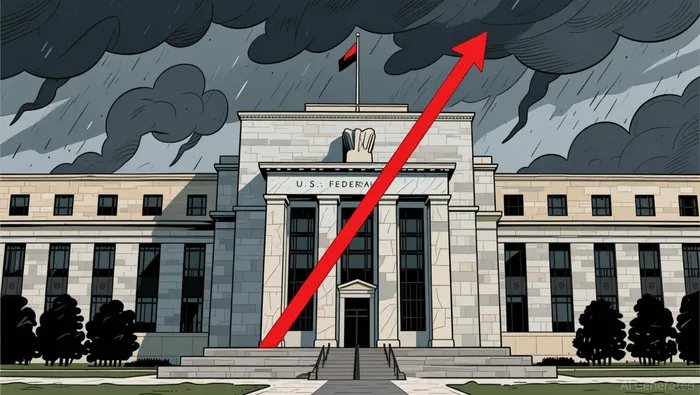 Compounding the uncertainty, the U.S. government shutdown disrupted data collection, delaying key economic indicators. The Bureau of Labor Statistics (BLS) announced it would not publish October's unemployment rate and will combine nonfarm payrolls data for October and November, releasing it on December 16—after the Fed's December 9-10 meeting according to economic reports. This lack of timely data has forced policymakers to rely on alternative metrics, further complicating their decision-making.
Stock markets have mirrored the Fed's cautious stance. Dow Jones futures edged higher as traders awaited corporate earnings and the delayed data, though sentiment remained fragile amid inflation worries according to market analysis. The S&P 500 and Nasdaq faced pressure from AI valuation concerns, while cryptocurrencies like BitcoinBTC-- (BTC) and EthereumETH-- (ETH) saw mixed reactions. With no-cut odds rising to 53%, BTCBTC-- tested support near $90,000, while ETHETH-- traders hedged against volatility through options strategies according to Polymarket data.
The Fed's internal debate has intensified as it balances inflation risks against labor market softness. While officials like Christopher Waller argue for a December cut to "provide insurance against a weakening labor market," others, including Vice Chair Philip Jefferson, have stopped short of endorsing immediate action, citing downside risks to employment according to market analysis. The October meeting minutes revealed a 10-2 vote to cut rates, with dissenters split between tighter and looser policy, underscoring the FOMC's fractured consensus according to Reuters reporting.
With the September nonfarm payrolls report due on November 20 and Fed minutes set for release on November 21, markets will closely watch for clarity. However, the absence of October data and the extended delay on November's report mean policymakers will face a high-stakes decision with limited real-time economic signals. As one analyst noted, the Fed's December meeting could mark a "pause" in its easing cycle rather than a reversal, with long-term rate declines still anticipated according to economic analysis.






Comentarios
Aún no hay comentarios