
Bitcoin News Today: The Great Shift: Bitcoin Miners Transform into AI Infrastructure Giants
Bitcoin mining firms are accelerating their pivot to artificial intelligence infrastructure as margins contract amid surging energy costs and post-halving challenges, according to industry leaders and analysts. The shift, once a niche strategy, is now a full-scale industry migration, with companies like Core ScientificCORZ--, Iris Energy, and Cipher MiningCIFR-- repurposing their data centers to capitalize on AI's voracious demand for computing power, as reported by CCN.
The pivot follows Bitcoin's April 2024 halving, which reduced block rewards and drove average hash prices—the daily revenue per terahash—below $0.05 by mid-2025, a 60% drop from pre-halving levels, as CCN notes. 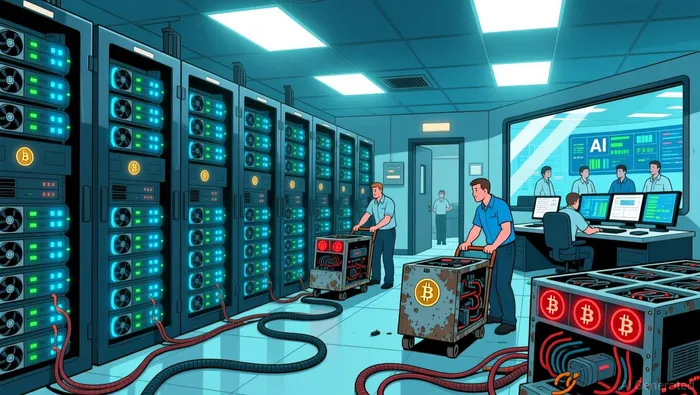 With electricity accounting for up to 90% of operating costs, miners are turning to AI workloads, which generate 25 times more revenue per megawatt than traditional BitcoinBTC-- mining, as CCN explains. This has triggered a wave of long-term contracts, including a $5.5 billion, 15-year lease agreement between Cipher Mining and Amazon Web Services (AWS) to provide 300 MW of AI infrastructure starting in 2026, as detailed by Yahoo Finance.
"Miners are no longer just Bitcoin miners—they're digital infrastructure providers," said one industry analyst, noting that seven of the top ten miners now derive revenue from AI or high-performance computing (HPC) initiatives, as Bitbo reports. Cipher Mining, for instance, has secured a $1.4 billion lease guarantee from Google for its Texas-based Colchis site, while Iris Energy signed a $9.7 billion deal with Microsoft for 200 MW of AI capacity, as CCN reports. These contracts, backed by stable revenue streams and high margins, contrast with the volatile economics of Bitcoin mining.
The transition is reshaping market dynamics. Miners such as TeraWulf and Core Scientific have prioritized AI expansion over Bitcoin hashrate growth, with TeraWulf's $3.7 billion Fluidstack deal alone projected to generate $1.85 million per MW annually, as Forklog notes. Meanwhile, Marathon Digital, which acquired 64% of Exaion for $168 million, is experimenting with immersion-cooled HPC sites, as CCN notes. Analysts warn, however, that the pivot carries risks, including high capital costs ($8–11 million per MW) and technical challenges in balancing AI workloads with Bitcoin's 24/7 consistency requirements, as CCN notes.
The shift has also altered valuation metrics. Investors now prioritize contracted AI megawatts and revenue per MW over hash rates, with AI-focused miners like Core Scientific and TeraWulf outperforming pure-play Bitcoin peers, as Forklog notes. However, Marathon Digital CEO Fred Thalheimer cautioned that shrinking margins and rising competition could undermine long-term profitability. "The economics of mining are deteriorating faster than expected," he said, highlighting the need for strategic diversification, as CCN notes.
Market observers note that the pivot could slow Bitcoin's hashrate growth, as power is redirected to GPU clusters for AI. This trend, combined with surging demand from tech giants like Microsoft and Google, has already pushed AI's power consumption past Bitcoin mining in the U.S., as Forklog reports. While Bitcoin's price volatility and occasional fee spikes offer some respite, the industry's identity is shifting—from digital gold to a broader digital infrastructure sector, as CCN notes.
---





Comentarios
Aún no hay comentarios