
Bitcoin News Today: Bitcoin Traders Braced for Breakout as ETF Outflows and Options Loom
Bitcoin's price remains locked in a critical standoff at $87,800 as traders await a decisive move amid a storm of macroeconomic and market pressures. The cryptocurrency has traded in a narrow range of $86,500 to $90,000 for weeks, with technical indicators and on-chain data suggesting growing tension between bulls and bears. Analysts warn that the next major shift could come either from a breakdown below key support levels or a breakout driven by institutional inflows and regulatory developments.
Institutional demand for BitcoinBTC-- continues to weaken, with spot ETFs experiencing their fifth consecutive day of net outflows. BlackRock's iShares Bitcoin ETFIBIT-- (IBIT) alone recorded $91.4 million in withdrawals, signaling waning confidence among large investors. These outflows, combined with thin liquidity and looming options expiries, have left the market vulnerable to sudden price swings.
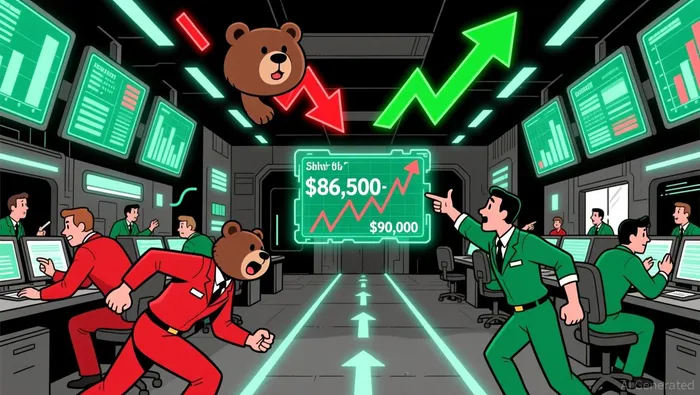
The December 26 options expiry event saw over $23 billion in Bitcoin options contracts set to expire, with many concentrated around higher strike prices. Deribit data shows a put-call ratio of 0.35, indicating a heavily bullish bias among option holders, though the "maximum pain point" at $95,000 suggests sellers are hoping to drive the price toward that level.
Why the Standoff Happened
The current standoff reflects broader uncertainty in the cryptocurrency market. Bitcoin's volatility has been exacerbated by macroeconomic headwinds, including elevated U.S. real yields and a contracting Federal Reserve balance sheet. Real yields averaged between 1.6% and 2.1% in 2025, while the Fed's balance sheet shrank from $6.8 trillion to $6.5 trillion according to data. These conditions have created a structurally restrictive environment for risk assets like Bitcoin.
On-chain data also points to a bearish buildup. Short-term holder (STH) supply, typically a bullish indicator, has risen as investors who bought during the October rally now face unrealized losses. This shift has turned the STH cohort into a ceiling rather than a floor for the price, with repeated sell-offs at breakeven points. Meanwhile, exchange balances have fallen 15% year-to-date, signaling a shift toward self-custody and long-term holding strategies.
How Markets Reacted
The crypto market reacted sharply to the recent price swings, with a $116 million short squeeze wiping out significant bearish bets on Bitcoin. The squeeze occurred after BTC surged past key resistance levels, triggering forced liquidations across perpetual futures markets. While the event briefly pushed Bitcoin higher, it also exposed the fragility of leveraged positions in a low-liquidity environment.
Ethereum and SolanaSOL-- were also affected, with EthereumETH-- seeing $29.66 million in liquidations and Solana experiencing $10.75 million according to data. The varied nature of these losses highlights the uneven impact of price volatility across different crypto assets.
Investor sentiment remains mixed, with fear metrics hitting extreme levels even as HODLer conviction holds firm. Open interest in Bitcoin derivatives has dropped by $40 billion in Q4 alone, indicating a market reset in leverage. This cooling of speculative activity could help stabilize Bitcoin ahead of potential breakouts in 2026.
What Analysts Are Watching
Analysts are closely monitoring several key factors that could determine Bitcoin's near-term direction. One of the most important is the impact of ETF outflows on price. Some experts warn that continued redemptions could push BTC below $80,500, with further declines potentially reaching $71,000 in the March–April period. This scenario would require a significant shift in macroeconomic conditions or regulatory sentiment.
Exchange balances and open interest metrics are also in focus. The drop in exchange balances by 15% suggests that long-term holders are accumulating, which could reduce immediate downside risks. However, the market's demand vacuum remains a concern, with thin order books making even small sell pressures more impactful.
Finally, the implementation of EU's DAC8 rules in early 2026 is expected to impact the broader crypto market by requiring exchanges to report transaction data to tax authorities. While the short-term effects remain uncertain, the long-term impact could include increased regulatory clarity and broader institutional adoption.
Risks to the Outlook
The current price standoff carries multiple risks. A breakdown below $86,500 could trigger a cascade of selling, with support levels at $83,000 and $80,000 next in line. If Bitcoin breaks through these levels, it could signal a continuation of the year's downtrend, potentially reaching $75,000. This would align with bearish patterns like the rising wedge and bearish pennant visible in the three-day chart according to analysis.
On the other hand, a breakout above $90,000 could reignite bullish momentum. Traders are watching for a retest of this level, which would need to surpass the 20-day moving average to confirm a reversal. A successful move to $105,000 would require renewed institutional demand and favorable macroeconomic conditions, such as rate cuts or improved global liquidity.
What This Means for Investors
For investors, the current market environment demands caution. With leverage retreating and volatility rising, the risks of over-leveraged positions have increased significantly. Analysts recommend maintaining disciplined risk management, including prudent stop-loss orders and diversified portfolios.
Long-term holders, however, appear to be building a foundation for a potential 2026 rally. The combination of falling exchange balances, stable open interest, and institutional accumulation suggests that Bitcoin's fundamentals remain intact despite short-term turbulence. Institutional players, including Metaplanet, are also doubling down on Bitcoin, with ambitious accumulation plans targeting 210,000 BTC by 2027.
Retail investors and traders should keep a close eye on the next major catalysts, including the March–April correction risks and potential ETF inflows in 2026. While the road to $105,000 may be long, the current consolidation phase could set the stage for a powerful breakout in the coming months.





Comentarios
Aún no hay comentarios