
Bitcoin News Today: Bitcoin Slumps Below 365-Day Average as ETFs Sell, Bearish Signals Intensify
Bitcoin's Price Faces Bearish Outlook as Demand Wanes, Analysts Warn of Downturn to $70K or Lower
A major on-chain analytics firm has issued a warning that BitcoinBTC-- is likely entering a new bear market phase. According to CryptoQuant, a significant slowdown in Bitcoin demand growth since early October 2025 signals a shift from bull to bear territory. This follows three major demand waves from earlier in the year, driven by the launch of U.S. spot ETFs, the U.S. presidential election, and the Bitcoin treasury company bubble according to CryptoQuant.
Bitcoin's price has already fallen below the 365-day moving average, a key technical indicator of market conditions. The firm highlighted that this decline marks a clear separation from bull market dynamics and into a bearish regime. 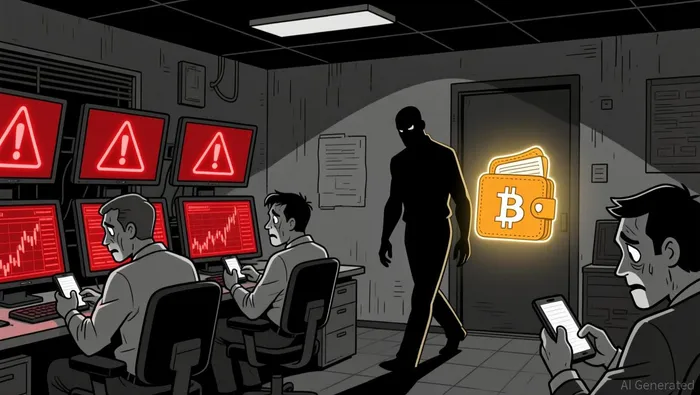 Historical patterns suggest that such a drop often precedes a period of price correction and downward momentum based on historical patterns.
CryptoQuant's report indicates that Bitcoin's price could face a near-term decline toward $70,000. If the current trend continues, the cryptocurrency may test support levels as low as $56,000 by the second half of 2026. Julio Moreno, head of research at CryptoQuant, noted that a drop to $70,000 could occur within three to six months, depending on market conditions according to CryptoQuant.
Why the Bearish Outlook?
The weakening demand for Bitcoin has been driven by several key factors. U.S. spot Bitcoin ETFs, which were strong net buyers in the previous year, have turned into net sellers in the fourth quarter of 2025. These ETFs have offloaded around 24,000 BTC, a sharp reversal from the year-ago period when they were major accumulation sources according to data.
Additionally, addresses holding between 100 and 1,000 BTC—often associated with institutional investors and corporate treasuries—have shown sub-trend growth. This mirrors patterns observed at the end of 2021, which led into the 2022 bear market. The decline in funding rates for perpetual futures markets also reflects reduced willingness among traders to maintain long positions, another sign of a bearish shift according to market data.
Market Sentiment and Macro Factors
Bitcoin's price is trading below its 365-day moving average, currently around $98,172. This technical breakdown is considered a critical signal for bear market conditions. Meanwhile, derivatives data shows that funding rates for perpetual futures have fallen to their lowest levels since December 2023, indicating fading bullish sentiment.
Market sentiment remains firmly in "fear" territory, with only 22.1% of investors expecting the Federal Reserve to cut interest rates in its January 2026 meeting. This uncertainty adds to the bearish outlook, as lower-than-expected rate cuts could prolong the current downtrend. Additionally, U.S. President Donald Trump's recent comments pressuring Federal Reserve Chair Jerome Powell to cut rates have added political uncertainty to the mix according to market analysis.
Analysts Watch for Recovery Signals
Despite the bearish signals, some analysts still see potential for a recovery in 2026. However, such a rebound would depend on renewed institutional demand and favorable macroeconomic conditions. CryptoQuant emphasized that Bitcoin's cyclical behavior is primarily driven by demand growth, not by the timing of the halving event or past price performance. A return to bullish momentum would require a reacceleration in demand from key players, including ETFs and corporate treasuries according to CryptoQuant.
Investors are closely watching on-chain metrics for early signs of demand recovery. If ETF inflows pick up and institutional buying resumes, this could signal the end of the current bear phase. However, without a clear turnaround in demand, the market remains vulnerable to further price declines.
Risks to the Outlook
The bear market scenario assumes that current demand weakness persists without any major positive catalysts. If institutional investors pull back further or if macroeconomic conditions worsen, Bitcoin could see deeper declines. Additionally, the lack of clarity around U.S. interest rate policy and geopolitical tensions adds to the uncertainty.
CryptoQuant also pointed out that Bitcoin's current price action aligns with realized price levels, which have historically marked the bottom of bear markets. This suggests that a 55% drawdown from the recent all-time high is possible if the market continues to contract. However, this level has not been reached yet, and a rebound could still occur if demand stabilizes according to market analysis.
As Bitcoin faces renewed bearish pressure, market participants are bracing for potential volatility in the coming months. The path ahead remains uncertain, but historical patterns and on-chain indicators suggest that the current downturn could persist into 2026.







Comentarios
Aún no hay comentarios