
Bitcoin News Today: Bitcoin Long-Term Sellers Fuel $138 Billion Market Exit Wave
Bitcoin's long-term holders have intensified selling pressure in recent months, signaling a significant phase of distribution that could reshape market dynamics. Research from K33 indicates that roughly 1.6 million BTC-worth approximately $138 billion-has returned to circulation since 2024. This volume of activity suggests intentional selling rather than routine technical movements according to the firm. The firm points to factors like institutional liquidity and corporate treasury demand as key enablers of these sales, which have driven much of Bitcoin's relative underperformance in 2025.
The selling activity has been widespread among large holders, with several notable transactions highlighting the trend. An 80,000 BTC over-the-counter sale by Galaxy in July, a whale swapping 24,000 BTC for etherETH-- in August, and another selling roughly 11,000 BTC between October and November have all contributed to the trend. 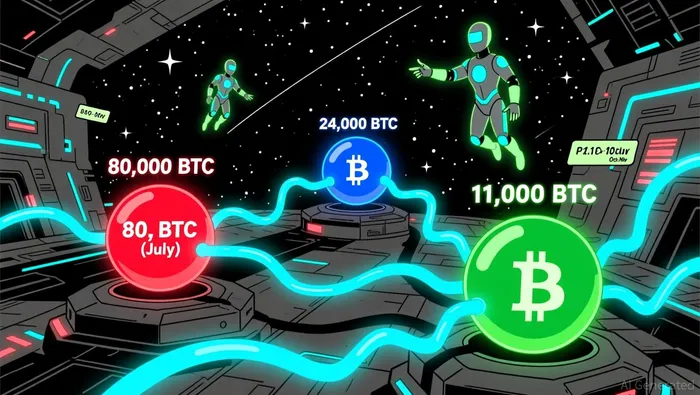 K33 estimates that about $300 billion worth of BitcoinBTC-- aged one year or more has been revived this year alone according to K33. This has allowed long-term holders to exit positions at six-digit prices, reducing ownership concentration and reshaping the cost base of the market.
Meanwhile, the U.S. Federal Reserve and upcoming macroeconomic events are shaping investor sentiment. President Donald Trump is set to interview Christopher Waller for the next Fed Chair role, a decision seen as critical for crypto markets. Binance has also taken steps to combat fraud, offering a $5 million reward for tips on fake intermediaries facilitating fraudulent listings. The platform has blacklisted several entities, emphasizing the importance of direct engagement with its official channels.
Why the Standoff Happened
K33 argues that the current wave of selling from long-term holders is distinct from past cycles. In 2017, such distribution was driven by altcoin speculation and ICO participation. Today, however, the trend is fueled by direct selling into institutional liquidity, particularly through U.S. spot Bitcoin ETFs and corporate treasury demand. The growth of these ETFs has made it easier for long-term holders to exit positions without significantly impacting the broader market. This shift has allowed early investors to capitalize on high prices and reduce their ownership stakes.
The scale of the distribution is notable, with 2024 and 2025 ranking as the second- and third-largest years on record for long-term supply reactivation. While some movements can be attributed to technical factors like Grayscale's Bitcoin Trust conversion into an ETF or wallet consolidation, K33 maintains that these alone cannot account for the sheer volume of transactions. The firm sees this as a deliberate effort to offload holdings rather than passive reshuffling.
How Markets Reacted
Bitcoin's price has reflected the impact of this sustained selling pressure. As of late December 2025, BTC was trading around $85,000–$86,000, down roughly 30% from its peak of $126,200 in early October. The market has shown signs of fear, with the Crypto Fear & Greed Index reaching an extreme fear level of 11. Liquidations in the derivatives market have also accelerated, with approximately $583 million in long positions liquidated over the past 24 hours.
The decline has been mirrored in institutional flows, with Bitcoin ETFs seeing a recent outflow of $277 million on December 16, led by BlackRock's iShares Bitcoin Trust (IBIT). This outflow highlights the waning institutional sentiment and increased volatility in the lead-up to key macroeconomic events, including U.S. CPI data and a potential BoJ rate hike.
Risks to the Outlook
Despite the current bearish momentum, K33 remains cautiously optimistic about a potential shift in market dynamics. "With 20% of BTC's supply reactivated over the past two years, we expect onchain sell-side pressure to approach saturation," K33's Head of Research Vetle Lunde stated. The firm anticipates that the two-year supply metric will stabilize and end 2026 above its current level of 12.16 million BTC. This would suggest that the current wave of selling is nearing its peak.
However, the path is not without risks. Historical patterns show that supply reactivation often peaks near market tops rather than bottoms, raising concerns about further downside. Analysts like Peter Brandt have warned of an 80% drop in Bitcoin from current levels, citing past correlations with macroeconomic events. Additionally, the recent accumulation by mid-sized holders-referred to as "sharks"-has not been enough to counterbalance the selling from larger whales. Entities holding 10,000–100,000 BTC have offloaded around 36,500 BTC (≈$3.4 billion) since December 1, indicating a shift from accumulation to distribution.
What This Means for Investors
The current phase of distribution presents both risks and opportunities for investors. On one hand, the increased selling pressure has led to heightened volatility and downward price pressure, which may test key support levels in the near term. On the other hand, the accumulation by mid-sized holders suggests that some buyers still see value in Bitcoin at current levels. The Crypto Fear & Greed Index at extreme fear levels historically signals potential capitulation by short-term traders, leaving only long-term holders in the market.
For institutional investors, the availability of deeper liquidity through ETFs and corporate treasury demand provides a more viable exit strategy than in previous cycles. This has enabled large holders to offload significant amounts without triggering massive market disruptions. However, as K33 notes, the market may soon shift toward net buy-side demand as the current wave of selling subsides.
The coming months will be crucial in determining whether Bitcoin can stabilize and regain upward momentum. If institutional buyers and mid-sized investors continue to accumulate, it could signal the end of the current bear phase and the start of a new accumulation cycle. For now, the market remains in a state of flux, with the next few weeks likely to provide clearer signals on the path forward.






Comentarios
Aún no hay comentarios