
Bitcoin News Today: Bitcoin Dips on Rising Fears of Quantum Computing Threat
Anxiety Over Quantum Risk Weighs on Bitcoin Amid Diverging Expert Views
Bitcoin's price has been under pressure in recent days, with some analysts attributing the decline to mounting fears about the long-term risks posed by quantum computing according to Grayscale. While the technology remains years from practical application, the potential for quantum computers to break Bitcoin's cryptographic protections has sparked a debate within the crypto community.
Grayscale, one of the largest digital asset managers, has downplayed the immediate threat, stating in its "2026 Digital Asset Outlook" that quantum computing will not meaningfully influence cryptocurrency markets in the near term according to Grayscale's report. The firm noted that while the risk to blockchain cryptography is real, it is unlikely to impact prices before 2030.
Meanwhile, others are more cautious. Charles Edwards, founder of Capriole Investments, warned that without a quantum-resistant fix by 2028, BitcoinBTC-- could trade below $50,000. He estimated a 34% chance that quantum computing will undermine Bitcoin's cryptography within the next three years, urging urgent action.
Why the Standoff Happened
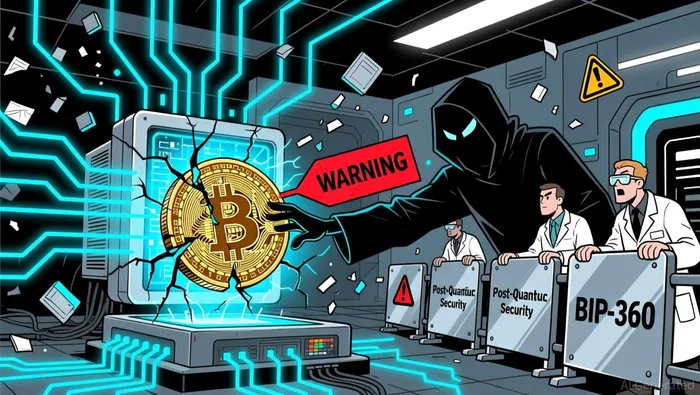
The debate centers on the vulnerability of Bitcoin's cryptographic algorithms to quantum computing. Quantum computers, if sufficiently advanced, could theoretically decode public keys and access private keys, allowing attackers to steal funds or alter transactions. This scenario hinges on the development of a functional quantum computer capable of running algorithms like Shor's, which could break the encryption securing Bitcoin.
Josh Otten, an English YouTuber, highlighted the potential for a quantum computer to expose the public key of Satoshi Nakamoto's wallet, which holds 1.096 million BTC. While this remains speculative, the mere possibility has fueled anxiety among investors and developers.
Jameson Lopp, co-founder of Casa, noted that about 25% of Bitcoin's total supply has already had its public addresses exposed, increasing the urgency for a solution. He estimated a greater than 50% chance that it will take at least another decade before a quantum computer powerful enough to break Bitcoin's cryptography becomes a reality.
How Markets Reacted
The uncertainty has already had a visible effect on Bitcoin's price. At the time of writing, BTC was trading at $86,050.51, down 4.01% over the last 24 hours. Analysts suggest that while quantum risk is not the only factor driving the decline, it is contributing to a broader sense of unease in the market.
Grayscale's report, which called quantum computing a "red herring" for 2026, aims to reassure investors that the threat is not immediate. The firm emphasized that market performance in the coming year will be driven by adoption rates, regulatory developments, and capital flows rather than fears about quantum computing.
However, Capriole's Edwards painted a more dire picture. He argued that a major bear market might be necessary to motivate developers to implement a quantum-resistant fix, warning that without action Bitcoin could face its most significant bear market in history.
What Analysts Are Watching
Experts are divided on the timeline and severity of the quantum threat. Justin Thaler, a research partner at Andreessen Horowitz, explained that a quantum computer could forge digital signatures and compromise Bitcoin transactions. However, he noted that such a development remains decades away.
On the other hand, Adam Back, an early Bitcoin figure, dismissed near-term concerns as fear, uncertainty, and doubt (FUD). He argued that Bitcoin does not rely on encryption for its core security model and that digital signature schemes and cryptographic hash functions are not imminently threatened by practical quantum computers according to Cointelegraph.
In response to the growing concerns, some blockchain projects have already begun preparing for the quantum era. SolanaSOL--, for example, has partnered with Project Eleven to develop post-quantum digital signatures and test quantum-resistant transactions on a testnet according to BitcoinSistemi. Similarly, AptosAPT-- has introduced post-quantum signatures ahead of any urgent need, positioning itself for future cryptographic challenges.
Risks to the Outlook
Despite the progress in post-quantum cryptography, experts warn that implementation could be slow. The proposed Bitcoin Improvement Proposal (BIP-360) aims to introduce quantum-resistant signature options, but it is still in its early stages and faces significant debate within the community according to Cointelegraph.
The post-quantum cryptography market is expected to grow rapidly, with the global market projected to reach USD 22.68 billion by 2033. This growth is driven by rising quantum computing threats and increasing adoption in the banking, defense, and critical infrastructure sectors.
As the industry grapples with the quantum threat, the coming years will likely see increased research, collaboration, and standardization efforts. The ability of the crypto community to implement timely and effective solutions will be critical in determining Bitcoin's long-term security and market resilience.






Comentarios
Aún no hay comentarios