
Bitcoin News Today: Bitcoin Bearishness Balances on Precipice of Short Squeeze Risk
Bitcoin Perpetual Futures Signal Bearish Sentiment Amid Mixed Exchange Dynamics
The cryptocurrency market is witnessing a notable shift in positioning, with BitcoinBTC-- perpetual futures data revealing a bearish tilt across major exchanges. Short positions currently dominate 52.5% of the aggregate perpetual futures market, outpacing longs at 47.5%, according to recent analysis. This trend, while not extreme, suggests growing caution among institutional and sophisticated traders, who often act as barometers for broader market sentiment.
Exchange-specific breakdowns highlight divergent strategies. Binance shows the most pronounced short bias, with 52.94% of perpetual futures positions held short versus 47.06% long according to recent data. Bybit follows closely with 51.2% shorts, while Gate.io exhibits the most balanced ratio at 50.45% shorts according to data. These variations underscore differing risk appetites and trading philosophies across platforms, with Gate.io's near-parity ratio indicating a more neutral outlook compared to its peers.
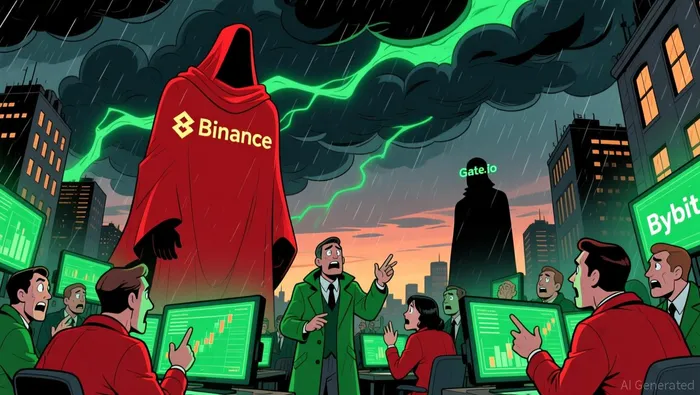
The implications of this short-heavy environment are multifaceted. While bearish sentiment typically correlates with downward price pressure, the current ratios-particularly on Binance-also raise the risk of short squeezes should Bitcoin rally unexpectedly. Traders are advised to monitor volatility triggers, as sharp reversals could force short sellers to cover positions, accelerating upward momentum.
The trend aligns with broader indicators of market stress. Bitcoin futures recently entered backwardation, a rare condition where futures prices trade below spot levels, signaling acute fear and capitulation. This pattern has historically preceded major market bottoms, such as those seen in November 2022 and March 2023. Currently, the three-month annualized basis has compressed to 4%, the lowest level since the FTX collapse. Meanwhile, spot Bitcoin ETFs recorded $450 million in outflows on November 19, 2025, reflecting a risk-off stance among institutional players.
Retail and institutional investors alike face mounting pressure, with losses exceeding 13% for those who bought at higher prices. However, historical precedents suggest that such periods of capitulation often pave the way for rebounds. In 80% of backwardation events since 2017, the basis flipped positive within a month, leading to average gains of 45% over three months.
For traders, the data underscores the importance of hedging and dynamic risk management. While short dominance indicates near-term caution, the proximity of ratios to equilibrium levels suggests the market is not yet at an extreme. Analysts recommend combining perpetual futures data with on-chain metrics and macroeconomic signals to avoid over-reliance on any single indicator.
The path forward remains uncertain. If spot prices stabilize, short sellers could face margin calls, potentially fueling a short squeeze. Conversely, prolonged macroeconomic turbulence might push Bitcoin toward $85,000, challenging the four-year cycle's traditional support levels.






Comentarios
Aún no hay comentarios