
Bitcoin News Today: Bears Dominate Crypto Futures as Funding Rates Dip Below 0.005%
Crypto markets continued to face bearish pressure on Dec. 15 as funding rates for leading cryptocurrencies remained below key thresholds across major centralized and decentralized exchanges. The bearish trend followed a week of mixed signals from traders and retail investors, with Open Interest declining and triggering liquidation fears in some major assets. Analysts noted that the current funding rates reflect a broader risk-averse stance from both retail and institutional participants in the space according to data.
Traders on both CEX and DEX platforms are now closely monitoring these metrics, which have historically acted as reliable indicators of sentiment shifts. The data suggests a lack of confidence in near-term price recovery for top assets like BitcoinBTC-- and EthereumETH--, despite ETF inflows into the crypto space. Meanwhile, the approval of new crypto futures by CME GroupCME--, including XRPXRP-- and SOLSOL--, signals growing institutional interest.
Regulatory developments also stirred mixed reactions, particularly around the Office of the Comptroller of the Currency's decision to grant preliminary trust charters to digital asset firms. While the move represents a step toward broader integration of crypto into the traditional financial system, it has drawn sharp criticism from traditional banks and state regulators, who fear erosion of their authority.
Bearish Sentiment Reinforced by Funding Rates
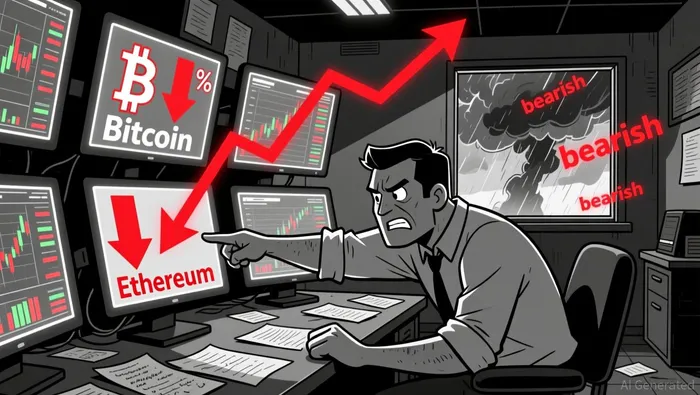
Funding rates for perpetual futures contracts on major cryptocurrencies remained below the 0.005% threshold, reinforcing bearish market sentiment as of Dec. 15. This is significant because when funding rates fall below this level, it typically indicates that short positions are dominating the market, suggesting traders expect a continued decline in asset prices. The negative rates act as a transfer from long to short traders, effectively incentivizing further downward price action.
The broader bearish backdrop is also being supported by declining Open Interest, which has raised concerns about market liquidity and increased the likelihood of further price corrections. Analysts at Coinglass noted that these rates are consistent with a market that is more focused on risk management than speculative trading according to Coinglass data. As such, many traders are advised to remain cautious and monitor liquidity and volatility trends closely.
Institutional Moves and Market Access
Despite the bearish signals from funding rates, institutional players continued to expand their crypto offerings. CME Group launched spot-quoted futures for XRP and SolanaSOL-- (SOL), joining its existing Bitcoin and Ethereum derivatives. This move is part of a broader trend of traditional financial institutions seeking to tap into growing demand for crypto-based products. The contracts are designed to provide greater accessibility and flexibility, with longer expiries and smaller contract sizes to appeal to a wider range of traders according to CME Group analysis.
The expansion into new assets by CME Group also aligns with recent regulatory developments, such as the approval of Bitcoin spot ETFs in January 2024, which opened the door for institutional capital to flow into the crypto market. These products are now being widely viewed as a bridge between traditional finance and the digital asset ecosystem.
Risks to the Outlook
While funding rates and institutional developments may point to a bearish near-term outlook, analysts caution that market dynamics could shift quickly. For example, sustained inflows into crypto ETFs continue to support some level of demand for assets like Bitcoin and Ethereum, even as prices remain under pressure. Additionally, technical levels for certain assets like XRP suggest that a breakout above key resistance could signal a potential trend reversal according to technical analysis.
However, headwinds such as regulatory uncertainty and macroeconomic pressures remain a drag on investor sentiment. The recent backlash from traditional banks to the OCC's decision to grant trust charters to crypto firms has highlighted ongoing tensions between legacy institutions and emerging digital asset players according to financial analysts. These tensions could delay further regulatory progress and limit the pace of mainstream adoption.
What This Means for Investors
For retail and institutional investors, the current bearish signals and regulatory developments suggest a need for a defensive approach. Traders are being encouraged to monitor both funding rates and Open Interest for early signs of a reversal, while also considering the broader macroeconomic context. Investors with exposure to crypto assets are advised to hedge their positions and avoid overleveraging, given the heightened volatility and uncertainty.
On the product side, new platforms like GeeFi and BexBack are offering alternative ways to engage with the market, including no-KYC access, referral bonuses, and high leverage options and 100x leverage and 100 deposit bonus for global users. These platforms highlight the ongoing innovation in the sector and the push to make crypto more accessible and user-friendly.





Comentarios
Aún no hay comentarios