
Bitcoin as the Native Currency of the AI Agent Economy
The AI agent economy is poised to redefine global automation, with machine-to-machine (M2M) transactions forming its backbone. By 2025, the agentic AI market has already reached USD 7.29 billion and is projected to surge to USD 88.35 billion by 2032, driven by automation demands and advancements in natural language processing. At the heart of this transformation lies a critical question: Which currency will power these autonomous transactions? The answer, increasingly, is BitcoinBTC-- and stablecoins.
The Technical Imperatives of M2M Transactions
M2M AI agent transactions require a financial infrastructure that is programmable, low-cost, and decentralized. Traditional finance, with its reliance on intermediaries, high fees, and slow settlement times, is ill-suited for the speed and scale demanded by autonomous systems. For instance, in finance and healthcare, AI agents already process invoices, manage inventory, and automate patient triage with 90%+ accuracy. These systems demand real-time settlements and frictionless value transfer-capabilities that Bitcoin and stablecoins uniquely provide.
Stablecoins, in particular, have emerged as the preferred medium for agentic AI due to their price stability and programmability. Unlike Bitcoin's volatility, stablecoins enable predictable value exchange, critical for AI agents executing tasks like inventory forecasting or DeFi yield optimization according to industry analysis. Platforms like Fetch.ai and DeFAI leverage stablecoins to automate cross-chain liquidity management and collateral adjustments, achieving efficiency gains of 30-80%.
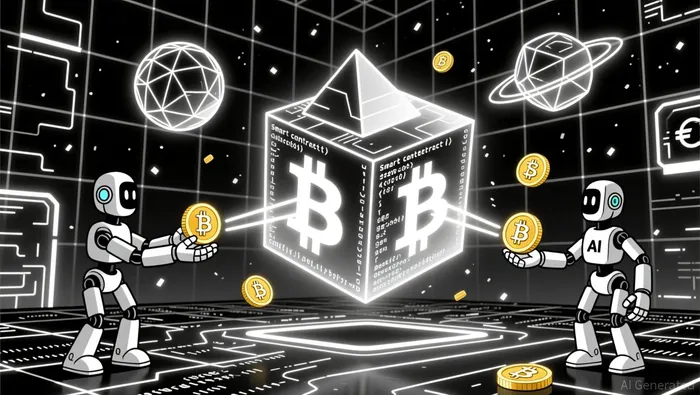
Bitcoin's Decentralized Edge
While stablecoins dominate for stability, Bitcoin's role in the AI agent economy is equally vital-as a decentralized, trustless layer. Traditional finance's reliance on centralized institutions introduces bottlenecks and counterparty risks, which Bitcoin eliminates through its proof-of-work consensus. For AI agents operating globally, this means unhackable settlement finality and censorship resistance.
Bitcoin's layer-2 solutions, such as the Lightning Network, further enhance its utility. These networks enable micropayments at near-zero fees, a necessity for AI agents executing thousands of microtransactions per second according to market reports. For example, platforms like CYBRO aggregate multichain portfolios and execute real-time trades using Bitcoin's layer-2 infrastructure, reducing costs by 90% compared to traditional systems.
Real-World Use Cases: From DeFi to Fraud Detection
The synergy between Bitcoin, stablecoins, and AI agents is already evident in real-world applications. In DeFi, AI agents automate yield farming and liquidity provision across EthereumETH-- and SolanaSOL-- ecosystems, using stablecoins for stable settlements and Bitcoin for secure, decentralized asset management. Projects like BittensorTAO-- (TAO) and Render Network (RENDER) tokenize AI models and GPU resources, enabling agents to trade computational power autonomously according to industry experts.
In fraud detection, AI agents integrated with Chainalysis Reactor and Elliptic Lens use Bitcoin's immutable ledger to trace illicit flows, assigning risk scores to wallets in real time. This level of transparency is unattainable in traditional finance, where opaque intermediaries delay compliance processes.
Why Traditional Finance Can't Compete
Traditional financial systems are fundamentally incompatible with the AI agent economy. Banks and payment processors impose high transaction fees (typically 2-5%) and slow settlement times (hours to days), according to industry analysis, which are untenable for AI agents operating at machine speed. Moreover, their lack of programmability stifles innovation-smart contracts on Bitcoin and stablecoin blockchains enable self-executing agreements that traditional systems cannot replicate.
Conclusion: A New Financial Paradigm
The AI agent economy demands a financial infrastructure that is as autonomous, scalable, and secure as the agents themselves. Bitcoin and stablecoins meet these requirements through decentralization, programmability, and low-cost transactions, outpacing traditional finance in every dimension. As agentic AI becomes the backbone of industries from healthcare to DeFi, the adoption of Bitcoin and stablecoins will accelerate, cementing their status as the native currencies of this new era.
For investors, the implications are clear: Bitcoin and stablecoins are not just speculative assets-they are foundational infrastructure for the AI-driven future.






Comentarios
Aún no hay comentarios