
Bitcoin at a Multi-Year Low vs. Gold: Is This the Setup for a Major BTC Rally?
The year 2025 has marked a historic divergence between BitcoinBTC-- and gold, two assets long positioned as competing "stores of value." While gold surged to record highs above $4,000 per ounce, driven by central bank demand and geopolitical uncertainty, Bitcoin closed the year with a rare negative return of -1.2%, its worst performance in a decade. This stark contrast has sparked a critical question: Is Bitcoin's multi-year low a buying opportunity, or does it signal a deeper structural shift in how these assets function within global markets?
Macroeconomic Realignment: Gold as Sovereign Reserve, Bitcoin as Liquidity Barometer
The 2025 performance gap reflects a fundamental realignment in macroeconomic dynamics. Gold's dominance was fueled by central bank accumulation, particularly in BRICS nations and the Global South, which added over 1,000 tonnes annually to diversify reserves and hedge against de-dollarization. This institutional demand created a price-insensitive floor for gold, insulating it from traditional drivers like real interest rates. In contrast, Bitcoin's price trajectory became increasingly tied to global liquidity cycles and regulatory sentiment. A flattening M2 money supply and elevated real rates in 2025 exacerbated Bitcoin's decline, exposing its vulnerability to monetary policy shifts.
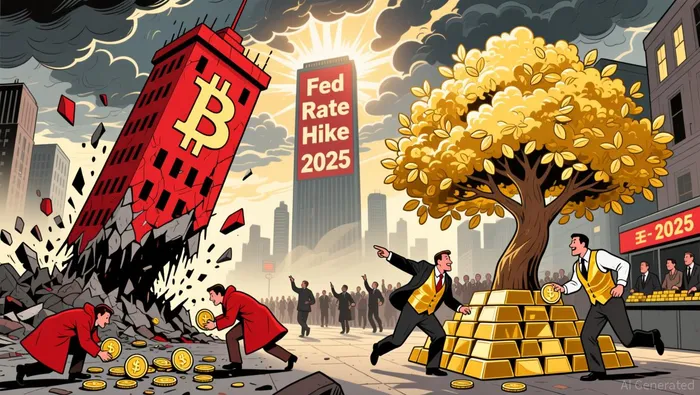 Bitcoin's role as a "risk-on" asset-sensitive to leverage and institutional flows-contrasts sharply with gold's "risk-off" appeal. While Bitcoin had historically outperformed gold during bull markets, 2025 saw it underperform during periods of macroeconomic stress, such as U.S.-China tariff threats and Fed rate uncertainty. This reversal underscores a maturing market dynamic: gold is now the default hedge for sovereign and institutional players, while Bitcoin's volatility and regulatory challenges limit its adoption in crisis scenarios.
Technical Divergence: Oversold Conditions and Rotational Opportunities
Technical analysis reveals a compelling case for Bitcoin's potential rebound. The BTC/XAU ratio has reached three-year lows, signaling oversold conditions and a classic bottoming pattern. Analysts like Michaël van de Poppe highlight bullish divergence on daily timeframes, suggesting short-term upside as capital rotates from gold to Bitcoin during policy normalization.
Bitcoin's standalone RSI of 47.6 indicates neutrality, but its 50-day moving average falling below the 200-day line-a bearish "death cross"-highlights lingering bearish sentiment. Meanwhile, gold's technicals remain robust, with its October 2025 surge to $4,381 per ounce reflecting strong safe-haven demand. However, Bitcoin's resilience during gold's pauses-such as its rebound in late 2025-suggests an evolving rotational dynamic. Portfolio managers are increasingly viewing Bitcoin as a secondary hedge, capturing anti-fiat flows when gold's rally stalls.
Macro Asset Rotation: The Case for a BTC Rally
The key to Bitcoin's potential rally lies in macro asset rotation. In 2025, capital shifted from speculative crypto to traditional safe havens, with gold outperforming all major assets. Yet, this rotation may now be reversing. As the Fed signals rate cuts and global liquidity improves, Bitcoin's sensitivity to monetary easing could drive a rebound. Historical patterns show Bitcoin outperforming gold during policy normalization, as seen in its 135% surge in 2024 compared to gold's 35% gain.
Moreover, Bitcoin's deflationary supply model-fixed at 21 million coins-creates a unique value proposition. While gold's annual supply growth of 1.6% dilutes its scarcity premium, Bitcoin's halving events (next scheduled in 2028) reinforce its store-of-value narrative. Institutional adoption, including PayPal's expanded Bitcoin access and JPMorgan's $165,000 price target, further supports long-term bullish sentiment.
Risks and Considerations
Despite these factors, Bitcoin's path to recovery is not without risks. Regulatory scrutiny, particularly in the U.S., remains a headwind, while gold's centuries-old trust as a crisis hedge ensures its dominance in extreme macroeconomic stress. Additionally, Bitcoin's volatility-exacerbated by leverage and liquidations-means a rally could be abrupt and short-lived if macro conditions deteriorate.
Conclusion: A Tenuous Setup for BTC
The current setup for Bitcoin-a multi-year low against gold, oversold technicals, and improving macroeconomic conditions-suggests a potential rally, but success hinges on broader asset rotation. If global liquidity expands and central banks pivot from gold accumulation to digital experimentation, Bitcoin could reclaim its role as a high-growth store of value. However, gold's entrenched position as a sovereign reserve asset means Bitcoin's resurgence will likely be cyclical rather than structural. For now, investors must balance Bitcoin's speculative upside with gold's proven resilience in a world of persistent uncertainty.






Comentarios
Aún no hay comentarios