
Bitcoin as a Modern Store of Value: How BlackRock's Larry Fink is Reshaping Institutional Perceptions of Digital Assets
In 2025, the financial world is witnessing a seismic shift in how digital assets are perceived. At the center of this transformation is Larry Fink, CEO of BlackRockBLK--, whose evolving stance on BitcoinBTC-- has catalyzed a broader institutional embrace of cryptocurrencies. Once a vocal skeptic, Fink now calls it "not a bad asset" and likens its role to gold-a hedge against inflation and a tool for portfolio diversification. This pivot, driven by regulatory clarity and market dynamics, is reshaping the narrative around Bitcoin's legitimacy as a store of value.
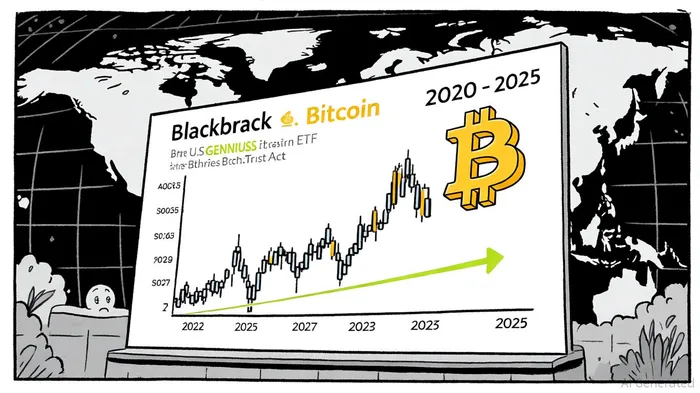
Fink's Pivot: From Skepticism to Strategic Embrace
Fink's 2025 remarks in his 60 Minutes interview marked a dramatic departure from his earlier dismissal of Bitcoin as "the domain of money launderers and thieves." His current view-that Bitcoin could serve as a "safe alternative investment like gold"-reflects a recalibration of risk and opportunity in an era of global economic uncertainty, a point he calls Bitcoin a safe alternative on repeatedly. This shift is not merely rhetorical. BlackRock's launch of the iShares Bitcoin Trust (IBIT) spot ETF has drawn over $90 billion in assets under management, signaling institutional confidence in Bitcoin's utility as a portfolio diversifier.
The market has responded accordingly. Bitcoin's price surged nearly 4% following Fink's comments, while broader crypto adoption metrics hit record highs, a clear market response to his endorsement. Analysts speculate that Fink's validation could prompt other financial giants to allocate 2%–5% of their portfolios to Bitcoin, further normalizing its role in institutional finance, according to analysts speculate.
Bitcoin vs. Gold: A Tale of Two Stores of Value
Bitcoin's ascent as a store of value is often framed against gold, the traditional benchmark. In 2025, both assets have demonstrated resilience, but their trajectories diverge sharply. Bitcoin, now trading near $123,000, has delivered a 120% year-to-date return, fueled by regulatory breakthroughs like the U.S. GENIUS Act and institutional demand, a trend some describe as the Bitcoin supercycle 2025. Gold, meanwhile, has appreciated steadily, reaching $3,500 per ounce amid geopolitical tensions and central bank accumulation, according to a Certuity report.
The key distinction lies in volatility. Bitcoin's price swings-up to 80% drawdowns in five years-contrast with gold's historically stable performance, where drawdowns rarely exceed 15%, as shown in a volatility comparison. Yet both assets share a common function: hedging against inflation and currency devaluation. Fink's analogy to gold is apt, as Bitcoin's scarcity (21 million supply cap) and decentralized nature position it as a modern alternative to the yellow metal, a point reflected in the BlackRock CIO recommendation.
Institutional Validation and Portfolio Strategy
BlackRock's CIO has explicitly recommended including Bitcoin in 2025 portfolios, citing its potential for asymmetric upside. This aligns with broader institutional analyses, which increasingly view Bitcoin as a complementary asset to gold. For instance, a 2025 report by Certuity highlights that Bitcoin and gold can coexist in diversified portfolios-Bitcoin for growth, gold for preservation.
However, Fink cautions against overexposure. He advises treating Bitcoin as a small portion of a portfolio, emphasizing its role as a "diversifier" rather than a core holding, a stance he reiterated in public remarks. This balanced approach mirrors BlackRock's broader strategy: integrating Bitcoin as an alternative asset while mitigating its inherent risks.
Risks and the Road Ahead
Despite institutional enthusiasm, Bitcoin's future remains contingent on macroeconomic and regulatory factors. While Fink predicts a potential price surge to $700,000 if sovereign wealth funds adopt Bitcoin en masse, as noted in Fink's price prediction, skeptics warn of regulatory headwinds and market corrections. Gold, by contrast, is seen as a safer bet in times of crisis, with central banks continuing to bolster reserves.
For investors, the takeaway is clear: Bitcoin and gold are not substitutes but complementary tools. As Fink aptly noted, "the market teaches you to always relook at your assumptions." In 2025, the market is teaching institutions-and by extension, retail investors-that Bitcoin's role as a store of value is no longer a fringe idea but a strategic consideration.





Comentarios
Aún no hay comentarios