
Bitcoin Mining's Structural Pivot: From Commodity Play to Infrastructure Asset
The BitcoinBTC-- mining sector is caught in a stark and defining tension. On one side, the raw economics of the business are in their most unprofitable stretch in a decade. In the U.S., the cost to mine a single Bitcoin has surged to , a figure that now exceeds the asset's current trading value of roughly . This fundamental squeeze, driven by high electricity costs and a permanent block reward reduction, means that for every coin produced, miners are burning cash. Yet, on the other side of the ledger, the market is re-rating companies based on a completely different metric: strategic vision and execution beyond Bitcoin.
This divergence is laid bare in the stock performance of 2025. The year saw a clear bifurcation. Every public miner that posted positive returns secured a major, multi-billion-dollar deal with a hyperscaler or AI infrastructure client. Names like Applied Digital (APLD) and Cipher MiningCIFR-- (CIFR) saw their valuations explode, . In contrast, pure Bitcoin miners, despite expanding their hashrate, were left behind, posting negative YTD returns. The market is now pricing in a 'HPC/AI pivot' premium, where the narrative of diversified, higher-margin revenue streams matters more than the raw scale of Bitcoin mining capacity.
The lesson is unambiguous: in the current environment, hashrate alone is not a moat. The data shows that several of the sector's largest operators by hashrate, including MARA HoldingsMARA-- (MARA) and BitdeerBTDR-- (BTDR), underperformed. Meanwhile, smaller miners with growing HPC operations saw outsized gains. This suggests that simply having an AI position is not enough; investors demand visible execution and a clear pathway to monetizing infrastructure for non-crypto workloads. The case of CleanSparkCLSK-- is instructive. Its stock languished for much of the year as a pure Bitcoin play, but a strategic pivot signaled by new leadership and tangible steps toward HPC revenue drove a reversal in sentiment.
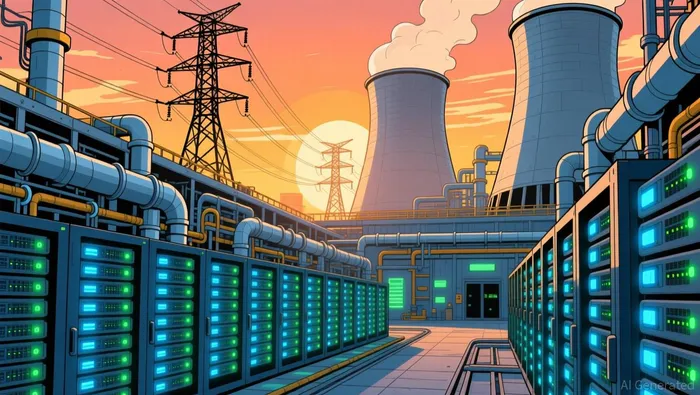
The bottom line is a sector in transition. The core mining business is currently unprofitable, a fact that will pressure cash flow and capital allocation. Yet, the market's re-rating is a vote for the future-companies that can successfully repurpose their energy-intensive data centers for high-performance computing and AI services. For investors, the choice is between betting on a cyclical recovery in Bitcoin's price, which would restore mining profitability, or betting on the strategic execution of a pivot that could create entirely new revenue streams. The market's verdict in 2025 was clear: the future is not in mining Bitcoin, but in what you do with the machines that mine it.
The Infrastructure Pivot: Monetizing Power and Data Center Assets
The strategic pivot from Bitcoin mining to AI infrastructure is no longer a niche experiment; it is a defining sector-wide shift. As the profitability of pure crypto mining has eroded, companies are leveraging their core asset-massive, power-intensive data center sites-to capture the booming demand for high-performance computing. The landmark deal signed by Hut 8 Corp. with cloud provider Fluidstack is the clearest signal yet of this new economic model. The company secured a , for its River Bend campus in Louisiana, locking in 245 megawatts of compute power dedicated to AI workloads. This agreement, backed by a financial backstop from Google, transforms Hut 8 from a miner into a long-term infrastructure provider, with the first data hall slated for operation by early 2027.
This move exemplifies a broader trend where miners monetize their greenfield sites, built for energy-hungry ASICs, to serve the AI compute boom. The infrastructure is a perfect match: both Bitcoin mining and AI workloads require enormous power delivery, advanced cooling systems, and vast physical space. As one miner noted, scaling frontier AI is fundamentally a power challenge, and companies with a power-first, innovation-driven development model are uniquely positioned to originate and develop these sites at the pace required by leading AI developers. The financial logic is compelling. A 15-year lease provides a predictable, stable revenue stream that diversifies away from the volatile income of Bitcoin mining, which has seen block rewards cut in half and costs rise.
The sector is following this playbook. Other former miners are locking in major HPC pipelines. TeraWulf has secured for high-performance computing infrastructure in Texas, while Cipher Mining has added a 200-megawatt site, . This strategic shift is already reflected in capital markets, where public miners with multi-billion-dollar hyperscaler agreements have delivered outsized returns, while pure Bitcoin plays have struggled. The pivot is a response to a harsh reality: the industry is entering its most unprofitable stretch in a decade. Yet, by leasing their power-first assets, miners are converting a costly, volatile business into a durable, infrastructure-driven one. The bottom line is a sector redefining its value proposition, where the real asset is not the hash rate, but the megawatts of power and the data center space to run the next generation of AI.
Financial Impact and Valuation Scenarios
The pivot from pure Bitcoin mining to AI infrastructure is a strategic shift with profound financial implications. For companies like Hut 8, the deal with Fluidstack represents a direct path to higher-margin, long-term contracted revenue. The , backed by a financial guarantee from Google, provides a stable cash flow stream that is decoupled from the volatile price of Bitcoin. This transforms the business model from one exposed to commodity price swings and rising electricity costs to one with predictable, contracted income. The bottom line is a balance sheet stabilized by diversified, higher-quality revenue.
Yet this transition is not without significant cost. The pivot requires substantial new CAPEX to build out data centers and upgrade infrastructure for AI workloads. This capital intensity creates a clear bifurcation in the market. Performance in 2025 starkly illustrated the premium placed on execution. Miners with multi-billion-dollar hyperscaler agreements, like IREN, APLD, and CIFR, . Even Hut 8 and TeraWulf, with major HPC contracts, . In contrast, pure Bitcoin miners and those with unclear AI narratives saw negative returns. This dispersion shows that the market is rewarding a clear, bankable path to diversified revenue, not just the mere presence of an AI segment.
A key catalyst for the broader sector is the potential for a "miner capitulation" signal. The network's hashrate fell , . Historical analysis suggests such drops are a , . This pattern is tied to weaker operators exiting the network under financial stress, which can precede a bottom in Bitcoin prices. For miners, this dynamic underscores the structural squeeze they face: as Bitcoin's price weakens, breakeven electricity costs for mining rigs have fallen, forcing only the lowest-cost operators to survive. The pivot to AI infrastructure is, in part, a response to this pressure, offering a way to monetize stranded assets and avoid the cycle of capitulation.
The bottom line is a sector in transition. The financial impact of the pivot is a move toward more stable, contracted cash flows, but it demands significant capital and clear execution. The valuation landscape reflects this reality, with the market rewarding those who have secured long-term AI deals while punishing those stuck in a volatile, high-cost mining cycle. The path forward for miners is one of managed diversification, where the ability to convert power and data center capacity into a reliable revenue stream will determine financial resilience and investor returns.
Catalysts and Risks: The Path to 2026
The investment thesis for Bitcoin miners hinges on a critical tension between near-term price pressure and long-term infrastructure value. The primary risk is that Bitcoin's price remains range-bound, preventing the re-rating of miners even as they lock in massive infrastructure deals. Despite a steady drumbeat of expansion news, stock prices continue to drift lower alongside Bitcoin's sluggish action. As of early 2026, the price hovers near , . This stark divergence creates a market that treats miners as leveraged beta to Bitcoin's price, not as growth infrastructure plays. Until Bitcoin regains a clear trend, the capital markets will remain skeptical of the narrative, no matter how many megawatts are signed.
A key near-term catalyst is the January 2026 . Bitcoin's mining difficulty is on track to rise again, with projections suggesting it could climb to around 149 trillion. This adjustment, which occurs roughly every two weeks, is a direct response to faster-than-target block times. Higher difficulty means the cryptographic puzzle becomes tougher, forcing miners to deploy more powerful machines and consume more energy to compete for the same block rewards. For an industry already defined by thin margins, this will further compress profitability and pressure weaker operators, testing the resilience of balance sheets funded by optimistic cash-flow projections.
The path to separating strategic winners from mere narrative chasers lies in the execution of announced AI deals and the ability to secure similar long-term contracts. The market has already begun to reward miners with diversified revenue streams. In 2025, every public miner with positive YTD returns had either generated HPC revenue or made visible strategic moves toward AI. The standout example is Hut 8, which secured a , with Fluidstack to provide data center space for AI workloads. This deal, backed by Google, provides a long-term, predictable revenue stream that diversifies away from volatile mining income. The bottom line is that the sector is bifurcating. Miners that can successfully pivot their energy infrastructure and data centers to serve the AI compute boom are building a durable, higher-margin business. Those that remain pure Bitcoin plays are being punished for their exposure to a stagnant price. The coming months will test whether these strategic pivots can translate into sustained financial performance, or if they remain just another layer of complexity on an unprofitable core.







Comentarios
Aún no hay comentarios