
Bitcoin Mining's Strategic Shift: Hosted Hashrate and AI Diversification as Pathways to Survival
The BitcoinBTC-- mining industry is undergoing a seismic transformation. The 2024 halving event, which slashed block rewards by 50%, has forced miners to confront a harsh reality: profitability is no longer guaranteed by raw hashrate alone. With network difficulty surging and energy costs climbing, companies are pivoting to hosted hashrate services and AI/high-performance computing (HPC) diversification to reallocate capital and mitigate risks. These strategies are not just survival tactics-they are redefining the industry's long-term value proposition.
Hosted Hashrate: A Hedge Against Volatility
Bitcoin mining's inherent volatility-driven by price swings, difficulty adjustments, and energy cost fluctuations-has made hosted hashrate services a critical risk mitigation tool. By outsourcing infrastructure to third-party providers, miners avoid the capital expenditures and operational complexities of owning and maintaining hardware. BitMine ImmersionBMNR-- Technologies, for instance, partnered with Luxor to lock in a fixed hashprice via a 12-month hashrate forward contract. This allowed the company to triple its ASIC fleet without traditional capital constraints, achieving financial predictability in a turbulent market according to a case study.
The benefits extend beyond cost savings. Soluna's renewable-powered hosting infrastructure, co-located with wind and solar farms, offers miners access to low-cost energy and modular scalability. By combining Soluna's infrastructure with Luxor's hedging tools, BitMine reduced deployment timelines and optimized equipment lifespans. Such partnerships are becoming table stakes in an industry where operational efficiency now outweighs sheer hashrate dominance.
AI/HPC Diversification: Capital Reallocation in Action
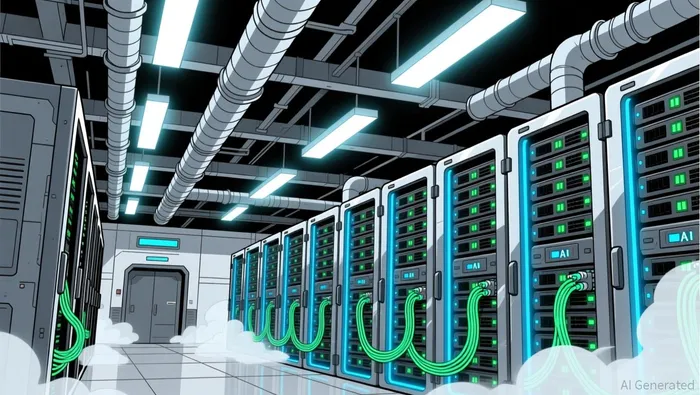
As Bitcoin's block rewards shrink, miners are repurposing their infrastructure for AI and HPC workloads-a move that transforms stranded assets into high-margin revenue streams. The transition leverages existing power infrastructure, cooling systems, and data center expertise to meet surging demand for AI-ready computing. For example, Hut 8HUT-- secured a $7 billion, 15-year lease with Fluidstack (backed by Google) to convert its River Bend campus into an AI hub according to a report. Similarly, CoreWeave has fully pivoted from crypto mining to AI, operating over 250,000 GPUs and securing a $11.9 billion deal with OpenAI.
This shift is not merely opportunistic-it's a response to economic realities. Bitcoin mining costs are projected to exceed $70,000 per BTC in Q2 2025, up from $64,000 in Q1. By contrast, AI services offer multiyear contracts with major tech firms, providing stable, scalable returns. Iris Energy, for instance, reported $184.1 million in Bitcoin mining revenue in 2025 but projects its AI cloud services to hit $500 million in annualized run rate by early 2026. The profit margins here are stark: Iris's AI segment boasts a 98% profit-to-revenue ratio, compared to 75% for mining according to financial analysis.
Financial Metrics and Strategic Outcomes
The financial implications of these strategies are profound. Hosted hashrate adoption reduces capital expenditures by shifting from CAPEX to OPEX models. BitMine's forward contract, for example, enabled rapid scaling without upfront hardware costs. Meanwhile, AI diversification allows miners to reallocate capital from volatile Bitcoin operations to predictable, high-margin workloads. CleanSpark's hybrid model-selling portions of its Bitcoin production to fund operations while retaining reserves-exemplifies this balance according to industry analysis.
Moreover, the transition to AI reduces dependence on Bitcoin's price cycles. Companies like TeraWulfWULF--, which signed a $3.7 billion hosting agreement with Fluidstack and secured $1.8 billion in Google funding, are positioning themselves as digital infrastructure providers. This shift aligns with investor priorities, which now prioritize operational resilience and treasury strategy.
The Path Forward
Bitcoin mining's survival hinges on adaptability. Hosted hashrate services and AI/HPC diversification are not just mitigating risks-they are unlocking new value. As the industry consolidates and smaller players exit, those that embrace these strategies will dominate. The key lies in leveraging existing infrastructure for dual purposes: mining during low-demand periods and AI/HPC during peak loads.
For investors, the message is clear: the future of Bitcoin mining is not in chasing hashrate but in reimagining digital infrastructure. The companies that succeed will be those that treat Bitcoin as one piece of a broader, diversified ecosystem.







Comentarios
Aún no hay comentarios