
Bitcoin Mining's Strategic Shift Toward Climate-Aligned Operations: A New Era of ESG-Driven Growth
The BitcoinBTC-- mining industry is undergoing a profound transformation, evolving from an energy-intensive, speculative asset class into a climate-aligned, ESG-conscious sector. This shift is driven by three interlocking forces: the rapid adoption of renewable energy, the emergence of demand-responsive operational models, and the integration of blockchain technology to enhance transparency. For investors, this evolution presents a compelling case for Bitcoin mining as a strategic, future-proof asset class that aligns with global sustainability goals while maintaining economic viability.
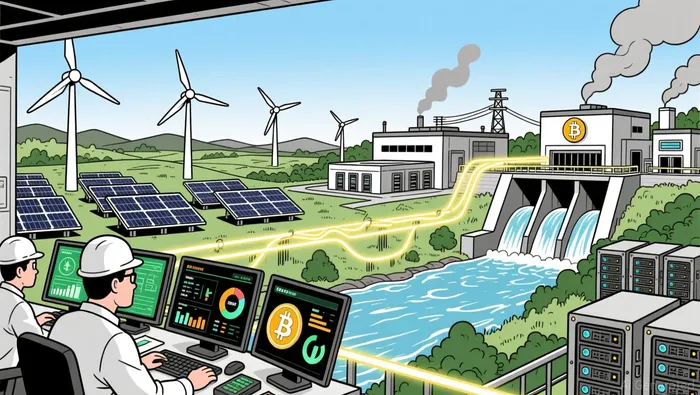
1. Renewable Energy Integration: From Cost Arbitrage to Climate Leadership
Bitcoin mining's energy consumption has long been a point of contention, but recent trends reveal a dramatic pivot toward renewable energy. By 2025, global sustainable energy use in mining reached , up from 37.6% in 2022. This growth is not merely a response to regulatory pressure but a calculated economic strategy. Electricity costs account for , creating strong incentives for operators to locate in regions with cheap, abundant renewables.
Case studies illustrate this shift:
- Bhutan leverages surplus hydroelectric power to fuel mining operations, transforming stranded energy into economic value.
- Ethiopia has expanded green infrastructure through Bitcoin mining, using solar and wind to power grids previously underserved by traditional utilities.
- Marathon Digital Holdings in the U.S. has repurposed flared natural gas from shale regions, reducing reliance on grid electricity and minimizing environmental impact.
These examples underscore a broader trend: Bitcoin mining is becoming a flexible load that stabilizes energy grids and monetizes otherwise wasted resources. As renewable energy costs continue to decline, the economic and environmental case for sustainable mining will only strengthen.
2. Demand Responsiveness and Operational Efficiency: The New Metrics of Success
Bitcoin mining's demand responsiveness has evolved beyond raw hash power to prioritize energy efficiency and ESG alignment. By 2025, Application-Specific Integrated Circuit (ASIC) miners achieved efficiencies exceeding , rendering older hardware obsolete and accelerating the need for continuous innovation. This technological leap has been paired with a strategic pivot in investor priorities.
Where once the focus was on maximizing Bitcoin production, , and . For instance:
- CleanSpark and MARA Holdings have adopted diversified treasury strategies, balancing Bitcoin HODLing with selective sales to fund operations.
- The industry is diversifying into , leveraging existing infrastructure for stable, non-crypto revenue streams.
This shift is not just about sustainability-it's about risk mitigation. As regulatory scrutiny intensifies and energy markets fluctuate, miners that prioritize efficiency and ESG alignment are better positioned to withstand volatility.
3. Blockchain Transparency: The ESG Accountability Revolution
Blockchain technology itself is emerging as a tool to enhance ESG accountability in mining. By providing immutable, transparent records, blockchain enables stakeholders to track energy sources, verify sustainability claims, and automate ESG reporting. For example:
- Smart contracts streamline ESG data collection, reducing administrative burdens and improving accuracy.
- Tokenized carbon credits prevent double-counting and fraud, ensuring the integrity of carbon offset programs.
However, challenges remain. Energy-intensive Proof of Work (PoW) protocols still raise concerns, though the industry is increasingly and other energy-efficient consensus mechanisms. This transition, coupled with real-time ESG dashboards, is reshaping Bitcoin mining into a transparent, auditable asset class.
4. Regulatory and Governance Frameworks: The Road to Institutional Legitimacy
Regulatory developments from 2023 to 2025 have further cemented Bitcoin mining's ESG credentials. In the U.S., the Securities and Exchange Commission (SEC) has issued no-action letters for tokenization pilots, signaling a nuanced approach to innovation. Meanwhile, the EU's Markets in Crypto-Assets (MiCA) regulation has provided a comprehensive framework, encouraging institutional adoption.
Corporate governance certifications are also playing a role. Programs like the Certified Compliance Professional in Cryptocurrency Financial Crimes (CCPC™) and Professional Certificate in ESG are equipping professionals to navigate the intersection of crypto and sustainability. These certifications ensure that miners not only comply with regulations but also integrate ESG principles into their core operations.
Conclusion: A Climate-Aligned Future for Bitcoin Mining
Bitcoin mining's transformation into an ESG-friendly asset class is no longer speculative-it's a reality driven by economics, technology, and regulatory momentum. By 2025, the industry's renewable energy adoption, demand responsiveness, and blockchain transparency have created a blueprint for sustainable growth. For investors, this shift offers a unique opportunity: to participate in a sector that is not only resilient but also aligned with the global transition to clean energy and ethical governance.
As the market projects a 28.9% CAGR in Bitcoin miner value from 2024 to 2032, the question is no longer whether Bitcoin mining can be ESG-compliant-it's how quickly investors can adapt to this new paradigm.





Comentarios
Aún no hay comentarios