
Bitcoin Mining Stocks' Divergence from BTC: A Warning Sign or Strategic Buying Opportunity?
The Underperformance Conundrum
Bitcoin's price surged over 450% from 2022 to early 2025, yet top mining stocks like Mara Holdings (MARA) and Riot Platforms (RIOT) lagged far behind. MARA's stock rose less than 50%, while RIOTRIOT-- gained just 240% during the same period according to analysis. JPMorgan analysts describe this as a "clear breakdown" in historical correlation, driven by rising operational costs and the 2024 halving, which increased mining difficulty and cash costs to $74,600 per bitcoin (excluding non-cash expenses like depreciation).
The sector's struggles are compounded by broader market dynamics. During a recent crypto sell-off, Bitcoin mining stocks lost $8 billion in market cap in a single day, with AI-focused miners like TeraWulf seeing double-digit declines. This volatility highlights the sector's sensitivity to both crypto market sentiment and equity market trends.
The AI Pivot: A New Revenue Paradigm
To counter Bitcoin's volatility, miners are increasingly repurposing hardware for AI and high-performance computing (HPC). TeraWulf, for instance, reported $50.6 million in Q3 2025 revenue, with $43.4 million from Bitcoin mining and expanding AI lease income. Meanwhile, Bitfarms is transitioning entirely to AI infrastructure, securing a $128 million deal to convert its Washington facility into an Nvidia GPU-as-a-Service hub.
The shift is accelerating: 70% of the top ten Bitcoin miners by hashrate now generate AI/HPC revenue, with annualized income per megawatt from AI operations exceeding traditional mining by 50%. This pivot is not just diversification-it's a strategic repositioning. AI hosting offers higher margins and predictable cash flows, contrasting with Bitcoin's feast-or-famine economics.
Diversification Risks and Strategic Uncertainties
Yet the AI pivot is not without risks. C3.ai, a key player in enterprise AI, reported a 19% year-over-year revenue drop and a $117 million net loss in Q1 2025, prompting a potential sale. Regulatory ambiguities, like the pending CLARITY Act, further cloud the AI sector's outlook. For Bitcoin miners, competition for rack space is intensifying: AI workloads require specialized GPUs and liquid cooling, which may strain infrastructure and capital budgets.
Moreover, not all miners are equal. Firms like American Bitcoin Corp (ABTC) have scaled Bitcoin mining operations profitably, reporting 453% year-over-year revenue growth in Q3 2025. However, those clinging to pure-play mining models face existential threats as energy costs rise and Bitcoin's block rewards shrink post-halving.
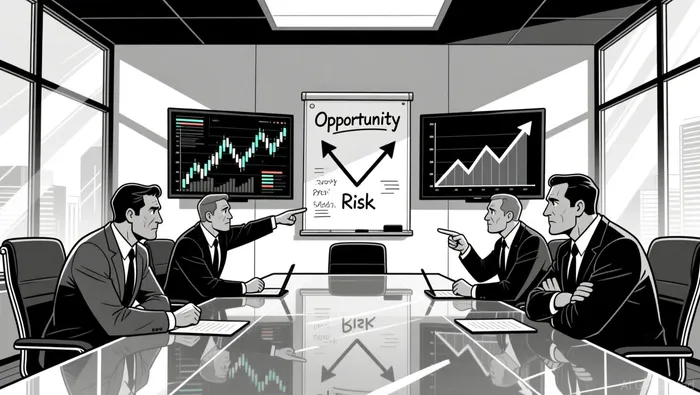
Is This a Warning Sign or a Buying Opportunity?
The divergence between Bitcoin mining stocks and BTC itself reflects a fundamental shift in valuation logic. Investors are now pricing miners based on AI potential rather than Bitcoin exposure-a narrative that could unlock long-term value. For example, Bit Digital pivoted to EthereumETH-- staking and AI infrastructure, with Ethereum staking revenue surging 542% year-over-year.
However, the sector's underperformance underscores operational challenges. High cash costs, capital intensity, and regulatory risks mean that not all AI pivots will succeed. The key differentiator will be execution: Can miners secure profitable AI contracts, optimize energy efficiency, and navigate regulatory hurdles?
For risk-tolerant investors, undervalued miners with strong AI partnerships (e.g., Core Scientific, Marathon Digital) may offer compelling upside. But for others, the sector's volatility and structural risks suggest caution. The coming months will test whether this divergence is a temporary correction or a permanent re-rating of the industry.
Conclusion
Bitcoin mining stocks are at a crossroads. The decoupling from BTC is neither a clear warning nor a guaranteed opportunity-it's a reflection of the sector's evolution. While AI diversification offers a path to stability, it also introduces new risks. Investors must weigh the potential for innovation against the perils of execution gaps and regulatory uncertainty. In this high-stakes environment, the most successful miners will be those that balance Bitcoin's promise with AI's pragmatism.







Comentarios
Aún no hay comentarios