
Bitcoin Mining Resilience Amid Regulatory Volatility: Is Now the Time to Invest?
The BitcoinBTC-- mining industry has long been a study in paradoxes: a sector built on decentralized ideals yet shaped by centralized regulatory forces, driven by technological innovation but constrained by energy economics, and resilient in the face of crackdowns yet vulnerable to sudden policy shifts. As we approach the end of 2025, the industry finds itself at a crossroads, navigating the aftermath of China's 2021 mining ban, a partial resurgence of activity in the world's largest energy-rich regions, and a global realignment of capital and infrastructure. For investors, the question is no longer whether Bitcoin mining can survive regulatory volatility but how it might thrive through strategic repositioning.
China's Uneasy Comeback and the Shadow of Crackdowns
China's role in Bitcoin mining has been a rollercoaster. By October 2025, the country had clawed back a 14% global market share, driven by cheap surplus electricity in provinces like Xinjiang and Sichuan. 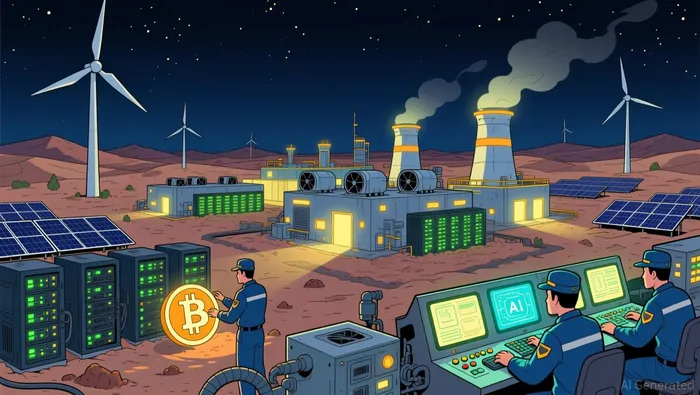 Yet this recovery has been fragile. A late-2025 regulatory crackdown shuttered an estimated 400,000 miners in Xinjiang, triggering a sharp drop in hashrate and forcing operators to liquidate Bitcoin holdings to cover costs. Experts remain skeptical about a full reversal of the 2021 ban, as Beijing continues to prioritize financial stability and environmental goals over the industry's profitability. This duality-of a market that can rebound quickly but remains subject to abrupt intervention-highlights the risks of overreliance on any single jurisdiction.
Geographic Diversification: The New Frontier
The cracks in China's dominance have accelerated a global redistribution of mining activity. The United States has emerged as a dominant player, leveraging deregulated energy markets and stranded natural gas to attract capital. El Salvador and Paraguay, meanwhile, are positioning themselves as ESG-friendly hubs, using renewable energy to court institutional investors. Conversely, regions like Kazakhstan and parts of Europe face headwinds from energy rationing and regulatory constraints(https://www.chainup.com/blog/crypto-mining-industry-trends-insights/). This fragmentation creates both opportunities and challenges: while diversification reduces exposure to any one government's whims, it also fragments economies of scale and increases operational complexity.
Technological Adaptation: From Mining to Digital Infrastructure
The industry's survival hinges not just on geography but on innovation. Bitcoin miners are increasingly rebranding as digital infrastructure providers, repurposing their energy-intensive operations to serve AI-driven data centers and high-performance computing (HPC) workloads. Companies like CoreWeave and BitfarmsBITF-- exemplify this pivot, with the latter reporting a 87% year-over-year revenue surge in Q2 2025 despite a decline in gross mining margins. This shift is not without risks. Transitioning to AI infrastructure requires navigating power contracts, firmware systems, and hosting agreements-areas where miners may lack expertise compared to traditional data center operators. Yet it also offers a path to diversify revenue streams and mitigate the volatility of Bitcoin's price cycles.
Financial Realities and Institutional Legitimacy
The financial performance of key players underscores the sector's evolving dynamics. Bitfarms, for instance, has committed to expanding its energy portfolio to 50 MW by 2026 and 300 MW by 2027, part of a broader U.S. pivot that includes adopting U.S. GAAP accounting and establishing a New York office(https://investor.bitfarms.com/news-releases/news-release-details/bitfarms-reports-second-quarter-2025-results). Such moves signal a desire to align with institutional investor expectations, a trend amplified by the introduction of Bitcoin ETFs and the U.S. government's endorsement of Bitcoin as a national reserve asset(https://www.cbh.com/insights/articles/cryptocurrency-market-trends-updates-for-2025/). However, declining hash prices, transaction fees, and block rewards remain structural headwinds, forcing miners to optimize efficiency through AI-driven operations and advanced cooling technologies(https://www.chainup.com/blog/crypto-mining-industry-trends-insights/).
Is Now the Time to Invest?
For investors, the Bitcoin mining sector presents a high-stakes proposition. On one hand, the industry's resilience-evidenced by its rapid geographic and technological adaptation-suggests a capacity to endure regulatory turbulence. On the other, the very factors that drive innovation (e.g., AI infrastructure) also introduce new uncertainties. The key lies in identifying firms that can balance short-term profitability with long-term strategic flexibility. Those that can secure stable energy contracts, navigate ESG mandates, and pivot seamlessly between Bitcoin mining and alternative workloads may emerge as winners.
Yet caution is warranted. Regulatory environments remain fluid, and the environmental scrutiny facing miners-particularly in markets like Australia and China-could intensify(https://www.chainup.com/blog/crypto-mining-industry-trends-insights/). Moreover, the sector's reliance on energy economics means that any spike in power costs or supply disruptions could erode margins. For now, the industry's survival hinges on its ability to reinvent itself-not just as a Bitcoin miner, but as a versatile player in the broader digital infrastructure ecosystem.
In the end, the question of whether to invest in Bitcoin mining in 2025 is less about the cryptocurrency itself and more about the adaptability of the companies and regions that power it. As the sector continues to evolve, the most compelling opportunities will belong to those who can navigate the intersection of regulation, technology, and energy with both agility and foresight.







Comentarios
Aún no hay comentarios