
Bitcoin Mining's Resilience Amid AI-Driven Market Shifts
The BitcoinBTC-- mining industry is navigating a complex landscape shaped by energy efficiency challenges, post-halving market dynamics, and the explosive growth of artificial intelligence (AI). As the sector grapples with declining profitability and environmental scrutiny, miners are leveraging AI technologies to enhance operational efficiency and diversify revenue streams. This analysis explores how Bitcoin mining remains resilient in a post-AI bubble world, focusing on cost structures, energy optimization, and strategic pivots to AI infrastructure.
Operational Efficiency: Energy, Hash Rate, and Cost Structures
Bitcoin mining remains energy-intensive, with global consumption estimated at 173–211.58 TWh annually in 2025-equivalent to the power usage of nations like Thailand or Vietnam. While 52.4% of mining operations now utilize non-fossil fuel sources, including hydropower and solar, the sector still relies heavily on natural gas (38.2%) and coal (8.9%) according to energy reports. This energy mix underscores the urgency for efficiency improvements, particularly as hardware advancements have been offset by rising network difficulty. The Bitcoin network's hash rate reached 1.12 billion TH/s in 2025, with mining difficulty hitting 136.04 trillion TH/s.
Cost structures further complicate profitability. Electricity accounts for 60–80% of operational expenses, with mining one Bitcoin costing between $1,324 in Iran and over $321,112 in Ireland. As of November 2025, Bitcoin's price correction to $91,654 and a hashprice of $43.1 per petahash/second (PH/s) have squeezed margins. For example, a 100 TH/s miner earns $3.78 daily but faces energy costs of $3.66 at $0.05/kWh, leaving a narrow $0.12 profit according to mining reports. These figures highlight the critical role of energy optimization in sustaining operations.
AI Integration: Efficiency Gains and Revenue Diversification
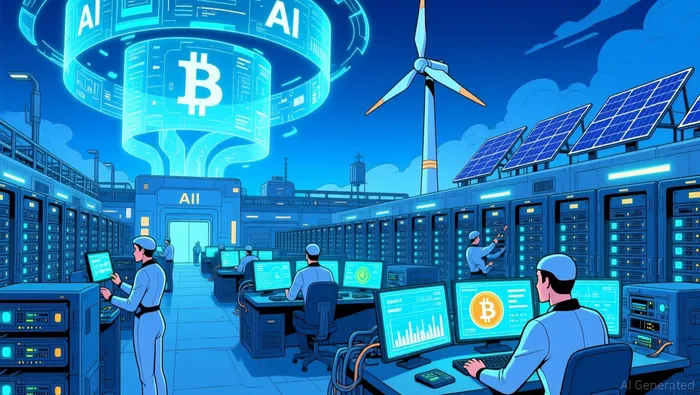
Bitcoin miners are increasingly repurposing their infrastructure to serve AI demand, a shift driven by declining crypto profitability and surging demand for high-performance computing (HPC). Companies like Core Scientific, BitfarmsBITF--, and Hive Digital TechnologiesHIVE-- have converted facilities into AI data centers, leveraging their expertise in power procurement, cooling systems, and automated operations. This pivot aligns with Wall Street's valuation shift, where miners are now valued based on AI contracts and power assets rather than Bitcoin mining performance.
AI technologies are also enhancing mining efficiency. Predictive algorithms optimize energy consumption by adjusting hardware parameters, reducing downtime, and managing thermal loads. For instance, AI-driven predictive maintenance has cut equipment downtime by 30%, while real-time load balancing and renewable energy integration have lowered energy costs. Additionally, miners are using AI to hedge revenue volatility through hash rate derivatives and dynamic resource allocation according to industry analysis. These innovations position Bitcoin mining as a flexible, AI-ready industry.
Post-AI Bubble Dynamics: Market Corrections and Mining Viability
The post-AI bubble environment has introduced volatility, with AI valuations detaching from revenue fundamentals. Institutions like the Bank of England and IMF have warned of a potential 10–20% sector correction, driven by circular financing and speculative overvaluation. Bitcoin's price has mirrored these dynamics, dropping to a six-month low of $95,885.33 in November 2025 amid macroeconomic pressures and risk-off sentiment.
However, Bitcoin miners are adapting. By diversifying into AI infrastructure, they mitigate exposure to crypto price swings. For example, Core Scientific's 590MW power contract with CoreWeave is projected to generate $10 billion in revenue over 12 years. Similarly, Riot PlatformsRIOT-- and TeraWulf have secured long-term AI infrastructure agreements, ensuring stable cash flows. These strategies highlight the sector's resilience, as miners pivot from speculative crypto assets to high-margin AI services.
Long-Term Viability: Sustainability and AI-Driven Growth
While AI integration offers short-term relief, long-term viability hinges on sustainability. AI systems are projected to surpass Bitcoin mining in electricity demand by 2025, consuming nearly half of global data center energy. This trend raises concerns about grid stability and environmental impact, particularly as AI models grow larger. However, miners are addressing these challenges by prioritizing stranded energy sources (e.g., flared natural gas) and renewable power according to industry analysis.
The AI/HPC market is expected to expand at a 33% annual growth rate from 2023 to 2030, creating opportunities for Bitcoin miners to scale their infrastructure. By leveraging their low-cost power assets and technical expertise, miners can position themselves as key players in the AI value chain. For example, companies like CleanSparkCLSK-- and Marathon Digital Holdings are already repurposing mining facilities for AI training workloads.
Conclusion: Strategic Adaptability as a Competitive Edge
Bitcoin mining's resilience lies in its ability to adapt to market shifts. While energy costs and hash rate challenges persist, AI integration and AI infrastructure pivots are transforming the sector. By optimizing operational efficiency, diversifying revenue streams, and aligning with AI-driven demand, miners are not only surviving but thriving in a post-AI bubble world. As the industry evolves, strategic adaptability will remain its most valuable asset.







Comentarios
Aún no hay comentarios