
Bitcoin Mining Profitability and Operational Volatility: Analyzing Riot's October 2025 Production Decline and Its Impact on Mining Stock Valuations
Q3 2025: Record Profits Amid Rising Costs
Riot's third-quarter 2025 results underscored its ability to scale amid a challenging environment. The company reported a record net income of $104.5 million, driven by $93.3 million in Bitcoin mining revenue and 1,406 BTC mined-a 27% increase from Q3 2024, according to a CoinPaper report. However, rising operational costs, including a 52% surge in the global network hashrate, pushed the average cost to mine each Bitcoin (excluding depreciation) to $46,324, up from $35,376 in 2024, as reported by CoinPaper. This highlights a critical tension in the sector: while higher Bitcoin prices and scale drive revenue, increased competition and energy demand erode margins.
October 2025 Production Decline: A Mixed Signal
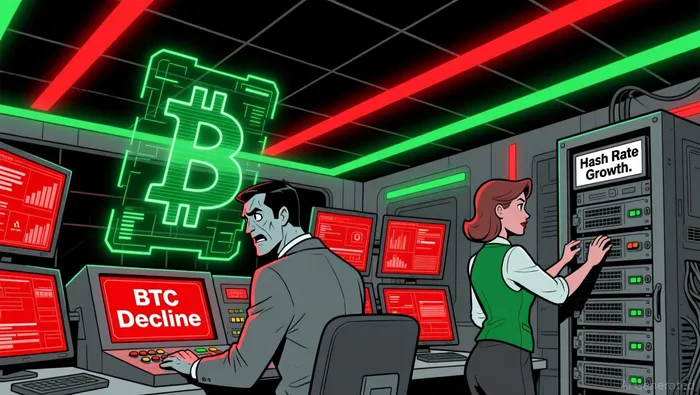
The October 2025 production report revealed a 2% monthly decline in Bitcoin output to 437 BTC, with a 14% year-over-year drop, according to the October production update. At first glance, this suggests operational headwinds. Yet, deeper metrics tell a more nuanced story. Riot's deployed hash rate grew by 25% year-over-year to 36.6 EH/s, while its average operating hash rate rose 46% to 33.2 EH/s, per the October production update. Fleet efficiency remained stable at 20.5 J/TH, indicating that the production dip was not due to technical inefficiencies but likely external factors like network difficulty adjustments or temporary maintenance cycles.
The company also sold 400 BTC for $46.0 million in net proceeds, averaging $114,970 per Bitcoin-a strong price realization amid a bullish Bitcoin market, according to the October production update. Its Bitcoin holdings increased to 19,324 BTC, a 77% year-over-year rise, further insulating it from short-term volatility (October production update). These figures suggest that while production dipped, Riot's balance sheet and capacity expansion remain robust.
Strategic Diversification: A Buffer Against Volatility
Riot's pivot into AI and high-performance computing (HPC) has emerged as a key differentiator. The company initiated 112 MW of core and shell development at its Corsicana data center campus, signaling a shift toward recurring revenue streams less tied to Bitcoin's price cycles, according to its Q3 financial results. This diversification aligns with broader industry trends, as mining firms seek to leverage their infrastructure for AI workloads and cloud services. Analysts view this as a strategic hedge, as noted in a FinancialContent article.
Stock Price Reaction and Investor Sentiment
The October production report triggered an immediate market reaction. Shares of Riot fell 4.87% in pre-market trading following the announcement, according to a Seeking Alpha report, reflecting investor concerns over the production decline. However, this dip occurred against a backdrop of strong year-to-date performance. By October 26, 2025, Riot's stock had surged 104.8% YTD, driven by a $219.5 million net income in Q2 2025 (largely from a $470+ million mark-to-market gain on Bitcoin holdings) and a bold AI pivot, as reported by FinancialContent. Analysts upgraded the stock, with Citigroup raising its price target to $24.00 from $13.75 (FinancialContent).
Implications for Mining Stock Valuations
Riot's experience underscores a broader theme in the sector: operational volatility is inevitable, but strategic adaptability determines long-term valuation resilience. While production dips can spook investors, metrics like hash rate growth, energy efficiency, and diversification into AI infrastructure often outweigh short-term noise. For mining stocks, the key is to assess whether companies can scale operations profitably while mitigating exposure to Bitcoin's price swings.
Riot's balance sheet strength-$2 billion in Bitcoin holdings and $104.5 million in Q3 net income-provides a buffer against near-term volatility, as reported by CoinPaper. Its AI expansion also introduces a narrative of multi-service data center growth, which could justify higher valuation multiples. However, investors must remain cautious: if production declines persist without corresponding efficiency gains, the stock's premium valuation may face pressure.
Conclusion
Bitcoin mining remains a sector defined by duality-high rewards paired with operational risks. Riot's October 2025 production decline, while concerning, is contextualized by its strategic investments in AI, rising hash rates, and a robust balance sheet. For mining stocks, the path forward hinges on balancing short-term execution with long-term innovation. As the industry evolves, companies that successfully diversify into high-growth areas like AI will likely outperform peers reliant solely on Bitcoin's price cycles.





Comentarios
Aún no hay comentarios