
Bitcoin Mining Profitability and Geopolitical Shifts in 2025: Strategic Investment Opportunities in Decentralized Infrastructure and Energy Efficiency
The BitcoinBTC-- mining landscape in 2025 is defined by a paradox: record-high network hashrate coexists with razor-thin profit margins, while geopolitical forces reshape energy policies and critical mineral supply chains. For investors, this volatility presents both risks and opportunities, particularly in decentralized infrastructure and energy-efficient mining solutions.
The Profitability Crisis and the Push for Efficiency
Bitcoin's price collapse from $126,000 in October 2025 to $81,000 by late November has had a cascading effect on mining economics. According to a report by , the network's hash price plummeted to below $35/PH/s by December 2025, far below the $44/PH/s production cost threshold. This has rendered mining unprofitable for operators with higher operational costs, forcing many to scale back or shut down entirely. The return on investment (ROI) for new mining hardware now exceeds 1,000 days at current margins, a metric that underscores the industry's struggle to justify capital expenditures.
To survive, miners are pivoting to energy efficiency. Texas has emerged as a critical hub, leveraging its deregulated power market and renewable energy resources to cut costs. Companies like Sangha Renewables and Phoenix Group have partnered with energy giants such as TotalEnergiesTTE-- to secure flexible, low-cost power solutions. 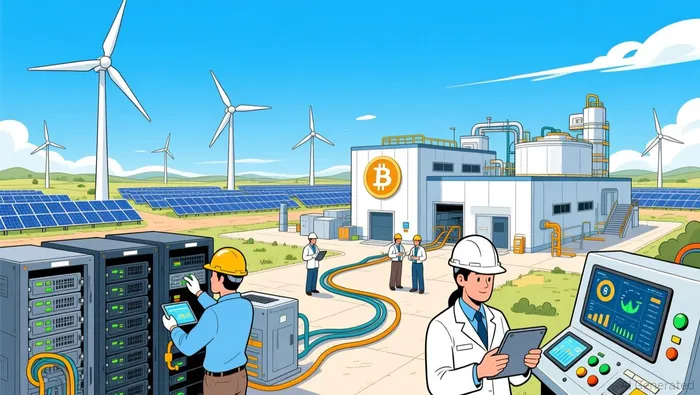 Meanwhile, the hash ribbon indicator-a technical analysis tool suggests a capitulation phase among miners, as the 30-day hashrate moving average dipped below the 60-day average. Historically, such signals have preceded price bottoms and difficulty adjustments, hinting at potential market inflection points.
Geopolitical Shifts and the Energy-Mining Nexus
The geopolitical landscape in 2025 has further complicated Bitcoin mining's energy dynamics. Governments are increasingly intervening in critical mineral supply chains, deploying public capital and tightening foreign investment rules to secure access to lithium, cobalt, and rare earth elements. These minerals are essential for both Bitcoin mining hardware and the broader energy transition, creating a strategic overlap between crypto and traditional energy sectors.
The U.S. has taken a leading role in this arena. Under President Trump, the Strategic Bitcoin Reserve was established, positioning Bitcoin as a strategic national asset. The BITCOIN Act of 2025 further codified this approach, aiming to integrate Bitcoin into national energy and financial strategies. Meanwhile, countries like El Salvador and Paraguay are leveraging Bitcoin mining to stabilize grids and promote renewable energy adoption.
However, the Middle East's geopolitical tensions have introduced volatility. As noted by , energy market disruptions in the region have amplified the urgency for miners to diversify their energy sources. This has accelerated the adoption of hybrid models, where Bitcoin mining coexists with AI data centers and high-performance computing, offering miners more stable revenue streams.
Strategic Investment Opportunities
For investors, the key lies in capitalizing on the convergence of energy efficiency and geopolitical resilience. Decentralized mining infrastructure, particularly in regions with abundant renewables, offers a hedge against centralized energy risks. Texas's success story demonstrates how deregulated markets and renewable partnerships can create scalable, low-cost operations.
Energy-efficient miners, meanwhile, are redefining the industry's value proposition. Innovations like waste heat repurposing-where Bitcoin mining's byproduct is used for residential and industrial heating-are gaining traction. According to , if just 1% of global heating energy were converted to mining, the network's computational power could double. This "heatpunk" movement not only reduces energy waste but also aligns Bitcoin mining with sustainability goals, a critical factor in regulatory acceptance.
Investors should also consider the long-term implications of the 2024 halving. With block rewards cut by 50%, the industry's survival hinges on transaction fees and operational efficiency. Those who can optimize energy costs and diversify revenue streams-through AI or grid stability services-will outperform peers.
Conclusion
The Bitcoin mining sector in 2025 is at a crossroads. While profitability challenges persist, the industry's pivot to energy efficiency and decentralized infrastructure is creating new avenues for strategic investment. Geopolitical shifts, from mineral supply chain interventions to energy policy reforms, further underscore the importance of aligning with sustainable, adaptable models. For investors, the path forward lies in supporting miners who can navigate these dual pressures-leveraging renewables, embracing innovation, and positioning themselves at the intersection of crypto and energy.





Comentarios
Aún no hay comentarios