
Bitcoin Mining Operational Efficiency: Capitalizing on Hash Rate Growth and Production Milestones
Bitcoin mining in 2025 is operating in a high-stakes environment defined by surging network hash rates, narrowing profit margins, and a post-halving landscape where block rewards have been cut in half. Yet, for investors, this volatility presents opportunities to capitalize on operational efficiency gains and strategic production milestones by leading mining firms.
Hash Rate Growth: A Double-Edged Sword
The BitcoinBTC-- network's hash rate-a measure of computational power securing the blockchain-has surged to unprecedented levels. By Q2 2025, the hash rate reached nearly 1,000 exahashes per second (EH/s), a 77% increase from the 2024 low of 519 EH/s, according to the CleanSparkCLSK-- slides. This growth reflects aggressive capital investment by major players such as MARAMARA--, CleanSpark, and Riot PlatformsRIOT--, which have expanded their mining capacity despite rising costs. However, the surge has also driven up mining costs by 34%, with the cost to mine a single Bitcoin now exceeding $90,998-split between electricity ($54,469) and hardware ($36,529), per the Riot update.
The hash rate's rapid ascent has compressed the "hashprice" (the value of a single petahash per second of mining power) to just $52/PH/s, down from historical averages of $100–$150/PH/s, as the Riot update also shows. This compression underscores the intensifying competition among miners, particularly as transaction fees now account for less than 1% of block rewards, according to a Cointelegraph report. For investors, the key question is whether operational efficiency can offset these margin pressures.
Production Milestones: Scaling for Profitability
Leading mining firms have set ambitious production targets to maintain profitability in this challenging environment. MARA HoldingsMARA--, for instance, reported Bitcoin holdings of 52,477 BTC by August 2025, up from 49,940 BTC in June, while maintaining a consistent block production rate of 208 blocks per month, as detailed in a MARA release. The company plans to expand its hashrate to 75 EH/s by year-end, leveraging 1.7 gigawatts of captive energy capacity and a joint venture with EDF's Exaion subsidiary to integrate AI-driven energy solutions, as the release explains.
CleanSpark has similarly prioritized scalability, exceeding 42.4 EH/s in April 2025 and mining 633 bitcoins in the same month. The firm's $650 million convertible bond offering is expected to fund a 50 EH/s expansion by mid-2025, driven by greenfield projects and strategic M&A, per the CleanSpark slides. Meanwhile, Riot Platforms achieved a 117% annual increase in operating hash rate to 31.4 EH/s in August 2025, supported by a 15% improvement in fleet efficiency to 21.0 J/TH, according to the Riot update.
These milestones highlight a broader industry trend: miners are prioritizing scale and efficiency over speculative growth. As a Blockchain Council report notes, "The post-halving era has forced operators to adopt a 'cost-per-hash' mindset, where every watt and terahash must justify its economic value."
Operational Efficiency: The New Competitive Edge
Efficiency gains are emerging as the linchpin of profitability. Technological advancements in hardware and energy management are enabling miners to reduce costs per terahash (J/TH). For example, Bitmain's Antminer S21+ and MicroBT's WhatsMiner M66S+ now achieve 16.5 J/TH and 17 J/TH, respectively-down from 20–25 J/TH in 2023, as shown in the CleanSpark slides. Riot Platforms' 21.0 J/TH efficiency in August 2025, while slightly higher than these benchmarks, still represents a 15% improvement year-over-year, according to the Riot update.
Geographical diversification is another critical strategy. Miners are increasingly locating operations in regions with subsidized energy, such as Oman and the UAE, where electricity costs as low as $0.035–$0.075/kWh provide a 30–50% cost advantage over U.S. operations, per the MARA release. For instance, Riot Platforms' 2.6c/kWh power cost in August 2025-achieved through strategic site selection-enabled it to mine 477 bitcoins in a single month, according to the CleanSpark slides.
Beyond energy and hardware, operational innovations like immersion cooling and vertical integration are gaining traction. MARA's partnership with Exaion to develop AI-optimized energy systems exemplifies this trend, aiming to reduce processing costs and enhance edge infrastructure scalability, as described in the MARA release.
Investment Implications
For investors, the Bitcoin mining sector in 2025 is a study in contrasts: while hash rate growth and production milestones signal robust demand for mining services, they also highlight the sector's vulnerability to energy price volatility and regulatory shifts. However, firms that combine aggressive efficiency improvements with strategic diversification-such as MARA's AI integration or CleanSpark's energy expertise-position themselves to outperform in this environment.
The current average margin of 22% for Bitcoin miners (with Bitcoin trading at $118,000), reported in the Riot update, suggests that operational excellence can still yield returns, but only for those who can sustain low-cost operations. As the Blockchain Council report concludes, "The next phase of Bitcoin mining will be defined not by who can deploy the most hashpower, but by who can do it most efficiently."
Conclusion
Bitcoin mining in 2025 is at a crossroads. The post-halving reduction in block rewards has forced operators to innovate, but the surging hash rate and rising energy costs have also created a highly competitive landscape. For investors, the path to value creation lies in supporting firms that prioritize operational efficiency-whether through cutting-edge hardware, low-cost energy, or AI-driven optimization. As the industry matures, these efficiency-focused players will likely dominate, turning today's challenges into tomorrow's opportunities.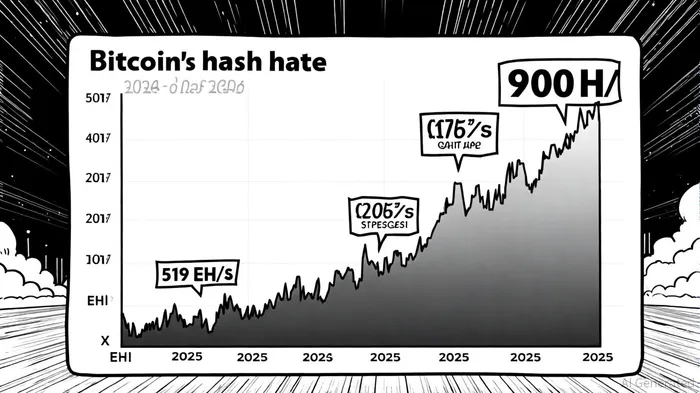





Comentarios
Aún no hay comentarios